Key Takeaways
- Iran seized an Anduril Dive‑LD autonomous underwater vehicle (AUV) that can operate for up to 10 days at depths of 6,000 m.
- The platform measures 5.8 m × 12 m, weighs ≈3 t, and cruises at 7 knots (≈13 km/h).
- Its modular, 3‑D‑printed payload bay allows rapid re‑configuration for ISR, mine counter‑measure (MCM), or cable‑inspection missions.
- The unit’s dry‑cost is roughly US $2.5 million, though sensor suites can push the price well above US $5 million.
- U.S. officials claim the vehicle suffered a malfunction and was “dead in the water” for more than a day before capture.
Background: What Is the Anduril Dive‑LD?
The Dive‑LD (Large‑Diameter Autonomous Undersea Vehicle) is Anduril Industries’ flagship long‑range AUV, fielded by the U.S. Navy beginning in 2025. Designed for persistent Intelligence, Surveillance, Reconnaissance (ISR) and underwater mine‑hunting, the system emphasizes endurance, depth capability, and payload flexibility.
| Specification | Dive‑LD | Typical Legacy AUV (e.g., Bluefin‑21) |
|---|---|---|
| Length × Beam | 5.8 m × 12 m | 4.9 m × 1.5 m |
| Maximum Depth | 6,000 m | 4,500 m |
| Endurance | 10 days (continuous) | 60 h |
| Cruise Speed | 7 kn (13 km/h) | 4 kn (7 km/h) |
| Dry Cost | US $2.5 M (base) | US $1.2 M |
| Payload Capacity | 3 t modular bay (3‑D‑printed) | 500 kg fixed bay |
| Power Source | Lithium‑ion battery + fuel‑cell hybrid | Lithium‑ion battery only |
| Primary Missions | ISR, MCM, seabed mapping, cable inspection | Seabed mapping, acoustic surveys |
Sources: Anduril product brief (2025); Bluefin‑21 datasheet (2022).
Incident Overview
Capture Details
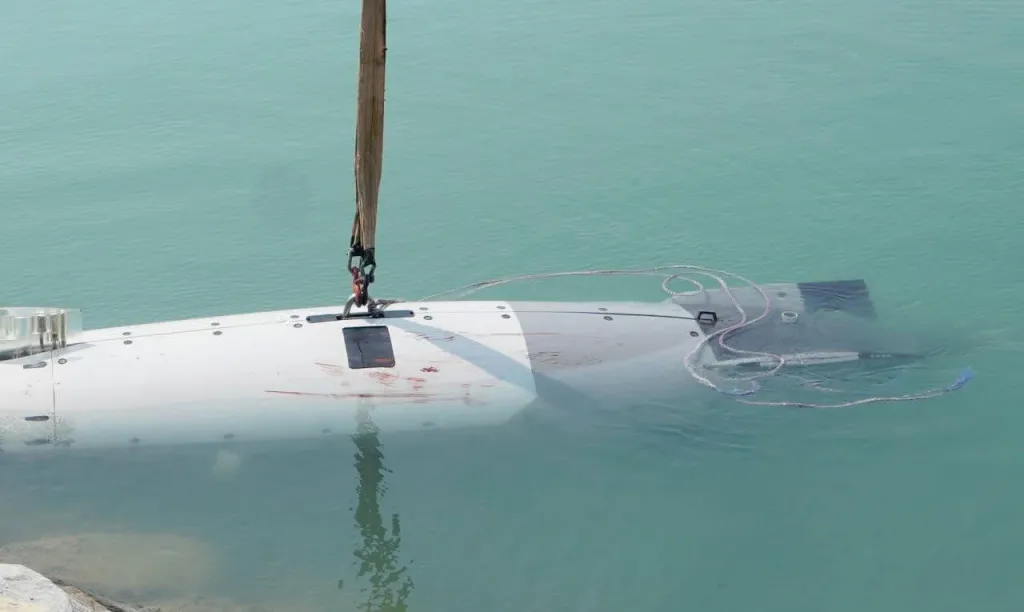
According to multiple defense news outlets, Iranian forces recovered the Dive‑LD off the Strait of Hormuz in early September 2026. Visual evidence shows the vehicle’s hull bearing red paint transfer—likely from a collision with a commercial tanker—while a conformal antenna array appears to have been fabricated via additive manufacturing.
U.S. Response
- Malfunction Claim: The U.S. Navy stated the AUV experienced a critical systems failure, rendering it inoperable for “more than a day” before the Iranian team retrieved it.
- Model Age: Officials suggested the vehicle was an “older prototype,” though the Dive‑LD entered service only a year earlier, making the “old” label questionable.
Technical Observations
- 3‑D‑Printed Payload Section: The interchangeable bay, printed with high‑strength polymer composites, permits rapid swapping of sensor suites—ranging from side‑scan sonar to synthetic‑aperture radar (SAR) modules.
- Antifouling Markings: The red residue is consistent with marine‑grade antifouling paint used on oil tankers, not the gray/black coatings typical of naval vessels, hinting at a civilian‑ship encounter.
Operational Implications
- Strategic ISR Gap – Losing a high‑end AUV reduces the U.S. Navy’s ability to conduct prolonged under‑sea surveillance in a region where Iranian naval activity is intensifying.
- Technology Transfer Risk – The captured modular payload bay could be reverse‑engineered, potentially enabling Iran to develop indigenous under‑sea ISR or MCM capabilities.
- Supply‑Chain Scrutiny – The incident underscores the importance of additive‑manufacturing security; 3‑D‑printed components can be replicated if design files are compromised.
Comparison with Conventional Platforms
| Feature | Dive‑LD (Anduril) | Conventional MCM AUV (e.g., REMUS 600) |
|---|---|---|
| Depth Rating | 6,000 m | 600 m |
| Mission Endurance | 240 h (10 days) | 48 h |
| Modularity | Fully interchangeable 3‑D‑printed payload bay | Fixed sensor suite |
| Cost (Dry) | US $2.5 M | US $800 k |
| Launch Method | Ship‑deployed via A‑frame | Small‑boat or shore launch |
The Dive‑LD’s superior depth and endurance make it uniquely suited for deep‑water cable inspection and long‑duration mine‑countermeasure patrols—capabilities that legacy platforms cannot match.
Bottom Line
Iran’s seizure of an Anduril Dive‑LD AUV reveals a rare vulnerability in a cutting‑edge maritime system: a single-point failure can expose a high‑value asset to adversaries. While the U.S. narrative emphasizes a malfunction, the vehicle’s advanced 3‑D‑printed modular architecture, 10‑day endurance, and 6,000‑meter depth rating remain unmatched in the current AUV market. The loss not only creates a temporary ISR gap in a geopolitically sensitive corridor but also raises the specter of technology proliferation if Iran succeeds in reverse‑engineering the payload bay. Continued investment in robust fault‑tolerance, secure additive‑manufacturing, and redundant under‑sea platforms will be essential to mitigate similar risks in the future.


