Key Takeaways
- Service‑first model: 3D2GO builds revenue from scanning, design, and post‑processing rather than pure part‑printing.
- End‑to‑end portfolio: The Manila firm offers 3D scanning, CAD modeling, SLA/FDM printing, LiDAR, rapid prototyping and CNC machining.
- Market relevance: Southeast Asia’s additive‑manufacturing market is projected to hit US$5.2 bn by 2027 (CAGR ≈ 18 %). A service‑centric approach aligns with the region’s SME‑driven growth.
- Product diversity: From architectural replicas of the Eiffel Tower to custom toys, 3D2GO demonstrates the breadth of low‑volume, high‑customization demand.
- Scalable footprint: Since its 2014 launch, the company has expanded to a staff of ≈ 45 specialists and operates 7 + industrial‑grade printers across FDM, SLA and SLS technologies.
3D2GO: How a Manila Startup is Shaping Southeast Asia’s 3D‑Printing Landscape
The Southeast Asian Context
Additive manufacturing in Southeast Asia is still emerging, but analysts estimate the regional market will grow from US$1.4 bn in 2023 to US$5.2 bn by 2027 (IDC, 2023). The growth driver is not large‑scale factory automation; it is the surge in service‑oriented, low‑volume production that meets the needs of SMEs, designers, and cultural creators.
From a Print Shop to a Full‑Cycle Service Provider
Breaking the Traditional Model
Unlike a conventional “drop‑in” print shop that merely accepts STL files, 3D2GO structures each project into three distinct phases:
| Phase | Core Activities | Typical Turnaround |
|---|---|---|
| Scan | Hand‑held LiDAR, structured‑light 3D scanning (up to 0.1 mm accuracy) | 1‑2 days |
| Design | Reverse engineering, CAD modeling, parametric design (Fusion 360, SolidWorks) | 2‑5 days |
| Print & Finish | SLA (Formlabs Form 3, 25 µm layer), FDM (Ultimaker S5, 0.1 mm), SLS (EOS P 396, 0.12 mm) + sanding, painting, CNC post‑machining | 3‑7 days |
This workflow lets 3D2GO serve architectural firms, toy manufacturers, and corporate gift programs with a single point of contact, dramatically reducing the coordination burden for clients.
Service Portfolio (2024)
- 3D Scanning & LiDAR: Portable scanners (Artec Eva) and stationary LiDAR rigs for objects up to 5 m³.
- CAD Modeling & Reverse Engineering: In‑house engineers produce production‑ready files in STL, OBJ, or STEP formats.
- Additive Manufacturing:
- FDM: 4 × Ultimaker S5 (450 mm build volume) – ideal for functional prototypes.
- SLA: 2 × Formlabs Form 3 (145 mm cube) – high‑detail visual models.
- SLS: 1 × EOS P 396 (295 mm cube) – durable, batch‑ready parts.
- Post‑Processing: CNC milling, vapor smoothing, UV curing, and full‑color painting.
- CNC Machining: 3‑axis mill (Haas Mini‑Mill) for metal inserts and hybrid parts.
Building a Business Around Customization
Since its incorporation in 2013 and operational launch in 2014, 3D2GO has grown from a modest hobby‑shop to a ≈ 45‑person studio. The company’s portfolio includes:
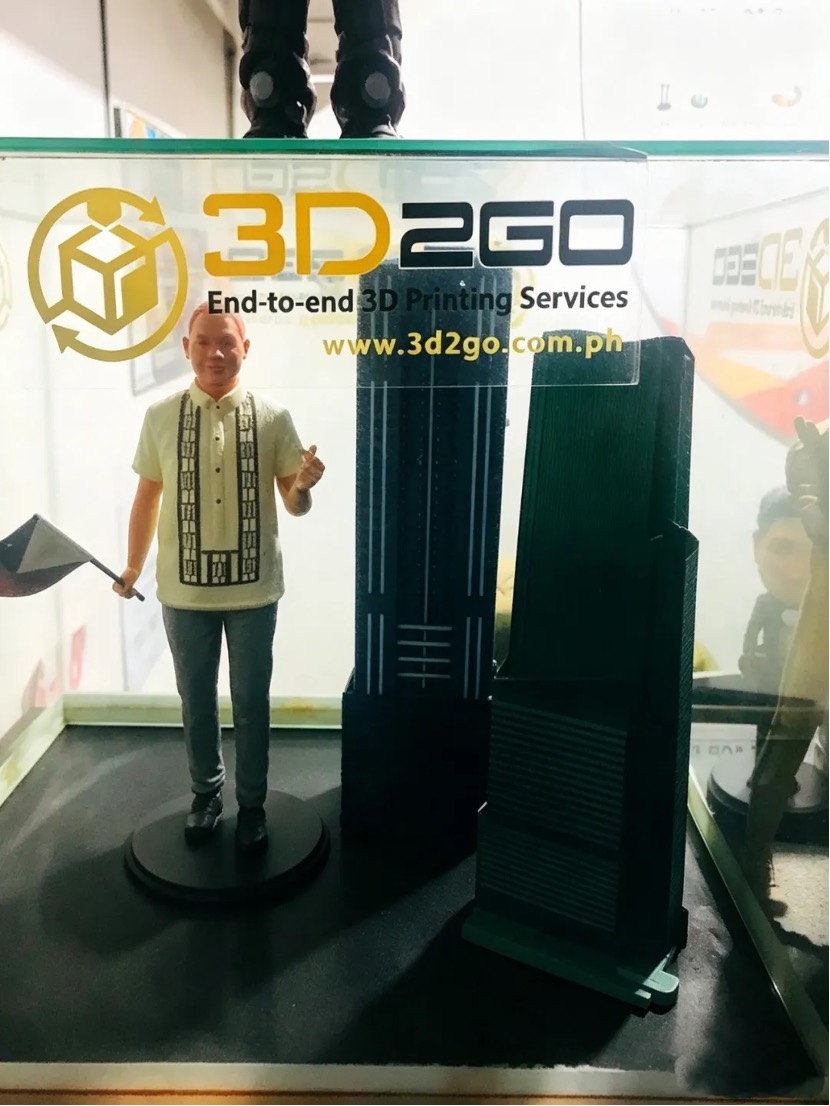
- Architectural replicas – Miniature models of the Leaning Tower of Pisa, Statue of Liberty, Eiffel Tower, and Empire State Building, each printed at 1:100 scale with ±0.2 mm dimensional tolerance.
- Character and toy production – Over 1,200 bespoke figurines for local pop‑culture events in the past two years.
- Corporate gifts – Branded keychains, desk accessories, and award trophies for multinational clients operating in the Philippines.
These offerings illustrate how low‑volume, high‑value items can be monetized without the capital outlay of mass‑production tooling.
Why the Service‑First Model Wins in Southeast Asia
| Factor | Traditional Equipment Sales | 3D2GO Service Model |
|---|---|---|
| Capital Requirement for Clients | High (printer cost ≈ US$10‑30 k) | Low (pay‑per‑part) |
| Skill Barrier | Requires in‑house CAD & maintenance expertise | Outsourced to specialists |
| Speed to Market | Weeks for setup & training | Days to weeks, full workflow handled |
| Scalability for SMEs | Limited by budget & space | Flexible order size, from 1 to 500 units |
| Revenue Predictability | One‑off hardware sale | Recurring service contracts & repeat orders |
The table underscores why many Philippine SMEs prefer to outsource their additive‑manufacturing needs rather than purchase and maintain their own printers.
Bottom Line
3D2GO exemplifies a pragmatic growth path for 3D printing in Southeast Asia: start with consumer‑proximate services, expand into a comprehensive design‑to‑delivery pipeline, and leverage the region’s appetite for rapid, customized production. By coupling high‑


