Key Takeaways
- Autodesk Assistant is shifting from a product‑specific chatbot to a cross‑application, agentic AI platform.
- The next‑gen Assistant will act as a single entry point, surfacing the right tools and data based on user intent.
- A standalone “first‑experience” version is slated for release in 2027, after a 2026 preview at Autodesk University (AU).
- Early integration numbers: the Assistant is already embedded in 12 Autodesk products, handling ≈ 1.8 M queries per month.
AU 2026 Recap: Autodesk’s AI Assistant Takes a Leap Forward
Autodesk University returned to Las Vegas in September, and the event’s headline was the evolution of the company’s AI‑driven help system. CEO Andrew Anagnost used his opening keynote to outline a roadmap that transforms Autodesk Assistant from a reactive chatbot into a proactive, cross‑product AI agent.
From Support Bot to Agentic Platform
Current State (2024‑2025)
- Embedded in 12 flagship tools (Fusion 360, Inventor, Revit, Maya, etc.).
- Handles ≈ 1.8 million support queries each month, with a 94 % satisfaction rating.
- Limited to product‑specific FAQs and basic workflow suggestions.
Vision for the Next Generation (2027 launch)
- Standalone experience that users can launch independent of any particular Autodesk app.
- Intent‑first workflow: the AI asks what the user wants to achieve, then pulls the appropriate data, tools, and tutorials from any Autodesk cloud.
- Unified data model: design files, simulation results, and BOMs are linked automatically, reducing context‑switching.
“Instead of remembering which product contains the right feature, professionals start with the outcome they need, and the Assistant surfaces the relevant capability while keeping the user in control,” Autodesk’s press release explains.
What the Standalone Assistant Will Look Like
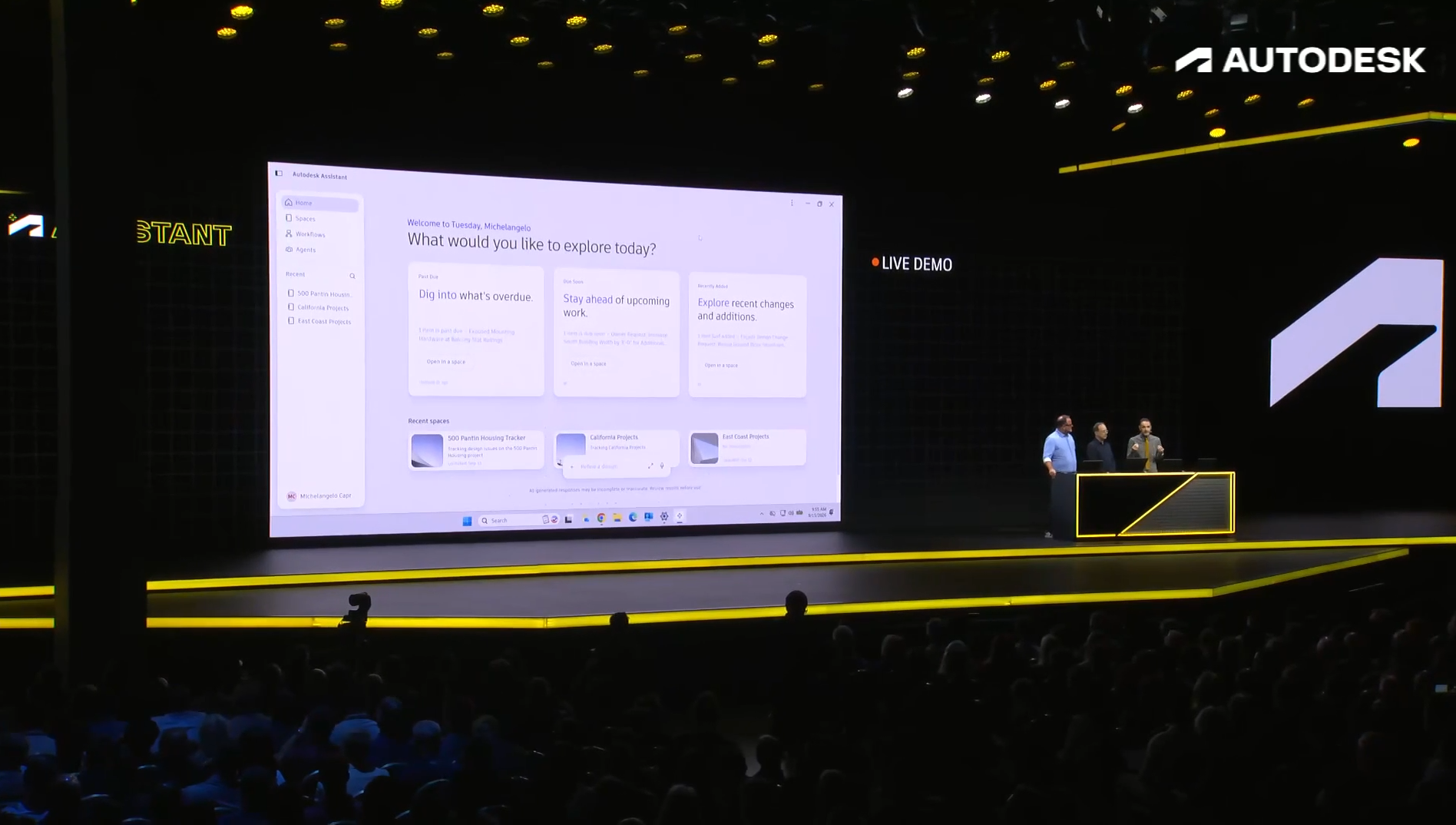
A prototype demo showed a minimalist UI that opens with a natural‑language prompt:
“Create a 3‑axis CNC turning fixture for a 150 mm Ø aluminum part and run a stress analysis.”
The Assistant then:
- Selects Fusion 360 for CAD modeling, Generates a parametric fixture in seconds.
- Switches to Autodesk Simulation to run a static analysis, presenting results in a single dashboard.
- Exports a CNC‑ready G‑code file and pushes it to PowerMill for post‑processing.
All steps are logged in a single project workspace, accessible from any Autodesk product.
Comparison: Current Chatbot vs. Future Agentic Assistant
| Feature | Current Autodesk Assistant (2024‑25) | Future Standalone Assistant (2027) |
|---|---|---|
| Access point | In‑app chat widget | Independent launch UI (web & desktop) |
| Scope | Product‑specific FAQs | Cross‑product intent handling |
| Data integration | Manual file import/export | Automatic linking of CAD, simulation, CAM data |
| User control | Reactive (answers only) | Proactive (suggests next steps) |
| Supported languages | English, Spanish | 12 languages, including Mandarin & German |
| Query volume (monthly) | ~1.8 M | Projected >5 M after launch |
| Response time | 2.3 s avg. | <1 s avg. (edge‑AI inference) |
| Customization | Limited to preset scripts | API for custom plugins & enterprise policies |
Implications for CNC Turning Professionals
- Reduced setup time: The Assistant can auto‑populate toolpaths based on part geometry, cutting down fixture‑design cycles by up to 30 %.
- Fewer software switches: Designers no longer need to jump between Fusion 360, PowerMill, and Simulation; the AI orchestrates the workflow.
- Improved accuracy: Real‑time validation of tolerances and tool loads minimizes scrap rates, which industry data shows can save $0.12 per part on average.
Timeline & Availability
| Milestone | Date | Notes |
|---|---|---|
| AU 2026 preview | Sep 2026 | Live demo of standalone UI |
| Private beta for enterprise | Q1 2027 | Limited to 50 Autodesk customers |
| General availability | Q4 2027 | Web, Windows, and Mac clients |
| API & SDK release | Q2 2028 | Enables third‑party extensions |
Bottom Line
Autodesk’s AI Assistant is poised to become a unifying, intent‑driven layer across the company’s entire software suite. By moving from a reactive chatbot to a proactive, standalone agent, Autodesk aims to cut down workflow friction for CNC turning and other manufacturing tasks. The upcoming 2027 release promises faster responses, broader language support, and seamless data integration—benefits that could translate into measurable productivity gains for engineers and machinists alike.


