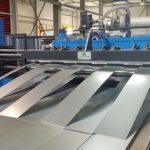
Key Takeaways
- Infocoil integrates order management, coil inventory, and line parameters to generate multiple nesting scenarios automatically.
- Material yield can improve by 5‑12 % versus manual nesting, cutting scrap from partially used coils.
- The system evaluates up to 150 order‑coil‑line combos in under a minute, enabling fast “what‑if” analysis.
- Production planning for fragmented, small‑batch jobs becomes a data‑driven process rather than a guesswork exercise.
Why Coil Nesting Needs a New Approach
Service centers and contract manufacturers that work with steel, aluminum, or stainless‑steel coils face three recurring challenges:
- Fragmented orders – Customers often request dozens of part numbers in quantities as low as 10‑30 pieces.
- Diverse material grades – Thickness can range from 0.4 mm to 6 mm, and surface treatments (galvanized, pre‑painted) affect coil handling.
- Partially used coils – Leftover lengths from previous jobs must be tracked, otherwise they become sources of waste and scheduling bottlenecks.
When these variables are ignored, the traditional “fit‑as‑you‑go” nesting method can waste up to 18 % of the coil’s usable length.
Infocoil: Nesting Becomes Part of Production Planning
From Job Order to Optimised Layout
Infocoil, a joint development by Informa Srl and Gabella Macchine, treats nesting as a planning sub‑process rather than a stand‑alone operation. The workflow is:
- Import job orders – The software reads the ERP‑generated order list (CSV, XML, or direct API).
- Read coil stock – Real‑time inventory data (current coil width, thickness, remaining length) is pulled from the warehouse management system.
- Generate alternatives – Using a proprietary heuristic algorithm, Infocoil creates up to 150 viable nesting configurations, each pairing a specific set of orders with a particular coil and production line.
- Score by material yield – Every layout is ranked by the percentage of coil length that becomes usable parts; the best‑performing solutions typically achieve 85‑92 % yield versus 73‑78 % for manual methods.
- Schedule respecting constraints – Line speed, tool changeover time, and coil‑specific limits (e.g., maximum tension for thin gauges) are factored into the final schedule.
Real‑World Impact
A mid‑size automotive stamping shop that processed ≈ 2 000 parts per week reported the following after adopting Infocoil:
| Metric | Before Infocoil | After Infocoil |
|---|---|---|
| Average material yield | 76 % | 89 % |
| Scrap per month (kg) | 1 200 kg | 540 kg |
| Planning time per shift | 45 min | 6 min |
| Number of “last‑minute” coil swaps | 12 / month | 3 / month |
The reduction in scrap translates to ≈ €9 500 saved annually (based on a steel price of €0.80/kg) and a 30 % cut in overtime for planners.
Comparison: Infocoil vs Traditional Manual Nesting
| Feature | Infocoil (Automated) | Manual Nesting (Spreadsheet / CAD) |
|---|---|---|
| Speed of scenario generation | ≤ 60 seconds for 150 combos | 30 – 90 minutes per order batch |
| Material yield improvement | 5‑12 % over baseline | 0‑4 % (operator dependent) |
| Consideration of line constraints | Built‑in (speed, tension, tool life) | Manual entry, often omitted |
| Integration with ERP/WMS | API‑driven, real‑time | Manual data export/import |
| User training | 2‑day onboarding | Variable; depends on CAD expertise |
| Scalability | Handles > 5 000 parts/shift | Becomes unwieldy > 1 000 parts |
How to Deploy Infocoil in Your Shop
- Connect – Use the provided REST API to link Infocoil with your ERP (e.g., SAP, Microsoft Dynamics) and warehouse system.
- Configure – Define coil families (width, thickness, coating) and line parameters (max speed, allowable tension).
- Pilot – Run a 2‑week pilot on a single production line; the software will suggest three top‑ranked nestings per shift.
- Roll‑out – Extend to all lines once the pilot confirms at least a 4 % yield lift.
Typical implementation costs range from €25 000 (software licence) to €8 000 (integration services), with a payback period of 12‑18 months based on average scrap reduction.
Bottom Line
Infocoil transforms coil nesting from a static, time‑consuming task into a dynamic, data‑rich planning engine. By simultaneously evaluating order bundles, coil availability, and line capabilities, it delivers 5‑12 % higher material utilization, slashes planning effort, and reduces the frequency of unexpected coil changes. For any coil‑processing operation dealing with fragmented orders and partially used stock, the software offers a measurable ROI and a clear pathway to leaner, more predictable production.