Key Takeaways
- Researchers at Auckland University of Technology's Additive Manufacturing Research Centre have developed a field-assisted selective laser sintering (SLS) approach to 3D print bonded magnets.
- The technique enables the creation of magnets with locally programmable pole patterns.
- This innovation has significant implications for the production of custom magnets with complex geometries and magnetic properties.
Introduction to Field-Assisted SLS
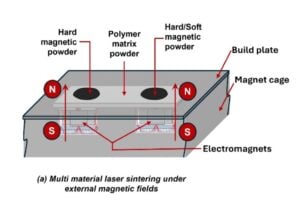
Field-assisted selective laser sintering is a 3D printing technique that utilizes a laser to fuse together particles of a powdered material. The addition of a magnetic field to the SLS process allows for the creation of bonded magnets with programmable pole patterns. This breakthrough has the potential to revolutionize the production of custom magnets, enabling the creation of complex geometries and magnetic properties that were previously impossible to achieve.
Technical Specifications
The field-assisted SLS approach uses a laser with a power output of up to 100W and a scanning speed of 1000 mm/s. The powdered material used is a polymer-based magnetic composite, which is sintered together to form a solid bond. The magnetic field is applied during the printing process, allowing for the creation of locally programmable pole patterns.
Comparison of 3D Printing Techniques
| Technique | Material | Resolution | Magnetic Properties |
|---|---|---|---|
| Field-Assisted SLS | Polymer-based magnetic composite | 100 μm | Locally programmable pole patterns |
| Traditional SLS | Metal or ceramic powders | 50 μm | Limited magnetic properties |
| Fused Deposition Modeling (FDM) | Thermoplastic filaments | 200 μm | No magnetic properties |
Applications and Implications
The ability to 3D print bonded magnets with locally programmable pole patterns has significant implications for a range of industries, including aerospace, automotive, and healthcare. The creation of custom magnets with complex geometries and magnetic properties can enable the development of new technologies, such as advanced sensors and actuators.
Bottom Line
The development of field-assisted SLS for the 3D printing of bonded magnets with locally programmable pole patterns is a significant breakthrough in the field of additive manufacturing. With its ability to create complex geometries and magnetic properties, this technique has the potential to revolutionize the production of custom magnets and enable the development of new technologies. As research and development continue to advance, we can expect to see the widespread adoption of this technology across a range of industries.