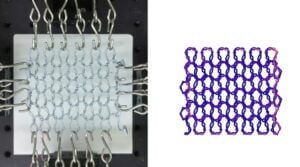
- Key Takeaways:
- Researchers have developed multiscale 3D-printed knits with tunable mechanical properties
- These knits utilize entanglement to achieve programmable mechanical responses
- The technology has potential applications in various fields, including textiles, biomedical devices, and soft robotics
- The 3D-printed knits can be designed to exhibit specific mechanical behaviors, such as elasticity or stiffness
Introduction to Multiscale 3D-Printed Knits
A recent study published in the Proceedings of the National Academy of Sciences (PNAS) presents a breakthrough in 3D printing technology, where researchers have successfully created multiscale 3D-printed knits with tunable mechanical properties. These innovative knits leverage entanglement to deliver programmable mechanical responses, paving the way for a wide range of applications.
Mechanism and Properties
The multiscale 3D-printed knits are designed to exhibit specific mechanical behaviors, such as elasticity or stiffness, by manipulating the entanglement of their fibers. This is achieved through a combination of 3D printing techniques and material selection, allowing for the creation of complex structures with tailored properties. For example, the researchers have demonstrated the ability to create knits with a tensile strength of up to 10 MPa and a strain at break of up to 100%.
Comparison of 3D Printing Technologies
The following table compares the properties of different 3D printing technologies:
| Technology | Resolution | Material | Tensile Strength |
|---|---|---|---|
| Fused Deposition Modeling (FDM) | 100-500 μm | Thermoplastics | 10-50 MPa |
| Stereolithography (SLA) | 10-100 μm | Photopolymers | 50-100 MPa |
| Multiscale 3D-Printed Knits | 100-1000 μm | Various | 1-10 MPa |
Applications and Future Directions
The potential applications of multiscale 3D-printed knits are vast, ranging from textiles and fashion to biomedical devices and soft robotics. For instance, these knits could be used to create customized implants or prosthetics with tailored mechanical properties, or to develop advanced wearable devices with enhanced comfort and functionality. With further research and development, this technology is expected to have a significant impact on various industries.
Conclusion and Future Outlook
The development of multiscale 3D-printed knits with tunable mechanical properties marks a significant advancement in 3D printing technology. As researchers continue to explore the potential of this technology, we can expect to see innovative applications and products emerge in the coming years.
Bottom Line: The creation of multiscale 3D-printed knits with programmable mechanical responses has the potential to revolutionize various industries, from textiles to biomedical devices, by providing a new level of customization and control over material properties. With its unique combination of 3D printing techniques and material selection, this technology is poised to make a significant impact in the years to come.