Key Takeaways
- Sintavia utilizes NVIDIA's RTX Pro 6000 Blackwell Workstation Edition GPU to accelerate additive manufacturing pipeline
- The technology reduces design and validation timeline for an aerospace heat exchanger by 11x
- Sintavia achieves 30% weight reduction and 20% increase in thermal efficiency using Siemens' Simcenter STAR-CCM+ CFD software and nTop implicit modeling
- The production schedule is shortened from months to approximately two weeks
Introduction to AI-Driven Additive Manufacturing
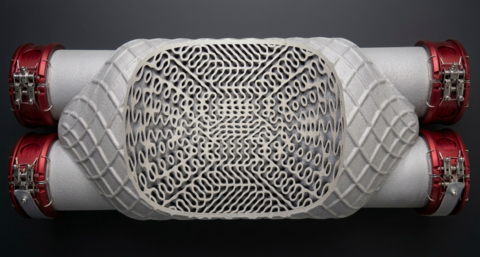
The additive manufacturing industry is undergoing a significant transformation with the integration of artificial intelligence (AI). NVIDIA, a leading chipmaker, has been at the forefront of this revolution. Recently, Sintavia, a Florida-based contract manufacturer, has tapped into NVIDIA's technology to accelerate its additive manufacturing pipeline. This collaboration has yielded impressive results, with Sintavia reducing the design and validation timeline for an aerospace heat exchanger by a substantial margin.
Accelerating Design and Validation
Sintavia used NVIDIA's RTX Pro 6000 Blackwell Workstation Edition GPU to design and validate the heat exchanger. The GPU enabled the company to run over 300 iterations of a heat transfer simulation in just seven minutes, a process that would have taken 11 times longer with advanced CPUs. This significant reduction in processing time allowed Sintavia to shorten its production schedule from months to approximately two weeks.
Comparison of NVIDIA's RTX Pro 6000 Blackwell Workstation Edition GPU with Advanced CPUs
| Technology | Processing Time | Iterations |
|---|---|---|
| NVIDIA's RTX Pro 6000 Blackwell Workstation Edition GPU | 7 minutes | 300+ |
| Advanced CPUs | 77 minutes | 300+ |
Achieving Weight Reduction and Increased Thermal Efficiency
Sintavia utilized Siemens' Simcenter STAR-CCM+ CFD software and nTop implicit modeling to design the heat exchanger. The result was a combined 30% weight reduction and 20% increase in thermal efficiency. This achievement demonstrates the potential of AI-driven additive manufacturing to produce high-performance components with reduced material usage.
Conclusion
The collaboration between Sintavia and NVIDIA has demonstrated the potential of AI-driven additive manufacturing to accelerate production pipelines and produce high-performance components. With the ability to reduce processing times and increase efficiency, this technology is poised to revolutionize the manufacturing industry.
Bottom Line
The integration of AI into additive manufacturing has the potential to transform the industry, enabling companies like Sintavia to produce complex components with increased efficiency and reduced material usage. As demonstrated by Sintavia's achievement, NVIDIA's RTX Pro 6000 Blackwell Workstation Edition GPU can significantly accelerate design and validation timelines, making it an attractive solution for manufacturers looking to stay ahead of the curve. With the ability to shorten production schedules and increase component performance, AI-driven additive manufacturing is set to play a critical role in the future of manufacturing.