- Key Takeaways:
- Researchers have developed innovative magnetic actuators inspired by human muscle for 3D printed soft robots
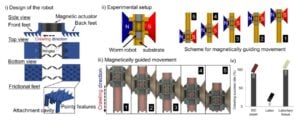
- These actuators enable 3D printed robots to perform various movements such as pushing, pulling, crawling, and grasping
- The technology has the potential to revolutionize the field of soft robotics and expand its applications
Introduction to Muscle-Inspired Magnetic Actuators
The field of soft robotics has witnessed significant advancements in recent years, with 3D printing playing a crucial role in the development of flexible and adaptable robots. A team of researchers has made a groundbreaking discovery by creating muscle-inspired magnetic actuators that can be integrated into 3D printed soft robots. These actuators are designed to mimic the movements of human muscles, enabling the robots to perform a range of actions such as pushing, pulling, crawling, and grasping.
How Magnetic Actuators Work
The magnetic actuators are made possible by the combination of 3D printing technology and magnetic materials. The actuators consist of a magnetic core surrounded by a flexible, 3D printed structure. When an electric current is applied, the magnetic core generates a magnetic field, causing the actuator to contract or expand. This movement can be controlled and fine-tuned to achieve the desired action.
Comparison of Actuation Methods
| Actuation Method | Description | Advantages | Disadvantages |
|---|---|---|---|
| Magnetic Actuators | Use magnetic fields to generate movement | High precision, fast response time, and low power consumption | Limited range of motion, potential for magnetic interference |
| Pneumatic Actuators | Use compressed air to generate movement | High force output, simple design, and low cost | Slow response time, limited precision, and potential for air leakage |
| Hydraulic Actuators | Use fluid pressure to generate movement | High force output, high precision, and fast response time | Complex design, high cost, and potential for fluid leakage |
Applications and Future Developments
The development of muscle-inspired magnetic actuators has significant implications for the field of soft robotics. These actuators can be used to create robots that can interact with and manipulate their environment in a more natural and intuitive way. Potential applications include search and rescue operations, healthcare, and manufacturing. As the technology continues to evolve, we can expect to see more advanced and sophisticated soft robots that can perform complex tasks with precision and accuracy.
Bottom Line
The creation of muscle-inspired magnetic actuators for 3D printed soft robots represents a major breakthrough in the field of soft robotics. With its potential to enable robots to perform a range of movements and actions, this technology has the potential to revolutionize various industries and applications. As researchers continue to develop and refine this technology, we can expect to see significant advancements in the field of soft robotics, leading to the creation of more advanced and capable robots that can interact with and adapt to their environment in a more natural and intuitive way.