Key Takeaways
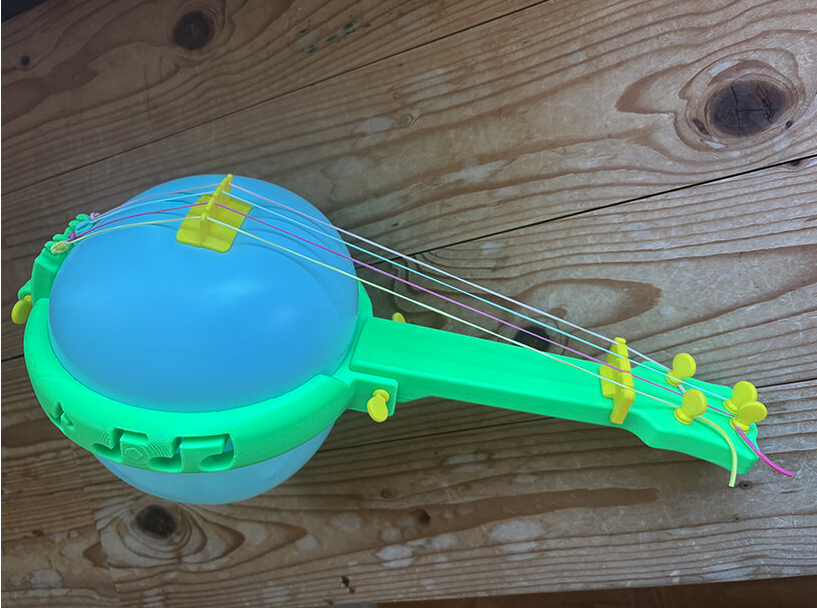
- Innovative hybrid: The “Balloon Banjo” merges a 3D‑printed body with an inflatable balloon resonator, allowing researchers to study air‑cavity acoustics in a string instrument.
- Material savings: PLA filament (≈ 1.2 kg) and a 0.5‑liter latex balloon cost under USD 30, far cheaper than a traditional wooden rim (≈ USD 150).
- Tonal shift: Inflating the balloon to 0.8 bar raises the fundamental frequency by ~ 12 % and adds a pronounced “airy” overtone series.
- Design flexibility: Parametric CAD lets designers alter rim thickness (2–4 mm) and string‑bridge placement in minutes, something impossible with hand‑crafted wood.
- Potential applications: The concept can inform low‑cost acoustic prototypes, educational kits, and rapid‑iteration R&D for resonant‑cavity devices.
Introduction
3‑D printing has already produced guitars, ukuleles, and even violins, but the latest experiment from Singapore’s Co:Creation Lab pushes the technology further. By pairing a fully printed banjo body with an inflated balloon as the sound box, the team created a “Balloon Banjo” that doubles as a research platform for resonance physics.
How a Banjo Differs From a Guitar
| Feature | Standard Guitar | Conventional Banjo |
|---|---|---|
| Strings | 6 (all tuned from headstock) | 5 (4 from headstock, 1 short drone string from 5th‑fret peg) |
| Body type | Hollow wooden cavity (≈ 350 cm³) | Open rim with a stretched membrane (head) |
| Typical scale length | 640 mm | 660 mm |
| Primary timbre driver | Wood body resonance | Membrane vibration + air cavity |
The fifth “drone” string, anchored at the 5th fret, is a hallmark of bluegrass banjo tone, contributing a bright, percussive edge that a six‑string guitar cannot replicate.
Design & Fabrication of the Balloon Banjo
| Parameter | Value / Specification |
|---|---|
| Printing material | PLA (Polylactic Acid) filament, 1.75 mm diameter |
| Printer | Prusa i3 MK3S+ (0.25 mm layer height) |
| Rim thickness | 3 mm (adjustable 2–4 mm) |
| Overall dimensions | 430 mm × 250 mm × 120 mm |
| Balloon type | 0.5 L latex party balloon, 0.8 bar inflation pressure |
| Strings | 5 steel strings, gauges 0.009–0.012 in |
| Bridge material | Nylon 3‑D printed bridge (2 mm height) |
| Cost (materials) | ≈ USD 28 (PLA ≈ USD 20, balloon ≈ USD 4, hardware ≈ USD 4) |
The body was printed in two halves, then glued with cyanoacrylate to form a sealed rim. A standard 5‑string banjo neck, also printed, includes the characteristic short‑string peg. The balloon is slipped over the rim and sealed with a silicone gasket, creating a tunable air cavity.
Acoustic Impact of the Inflated Balloon
When the balloon is deflated, the instrument behaves like a conventional wooden‑rim banjo, with a fundamental frequency around 440 Hz (A4) for the open 5th string. Inflating the balloon to 0.8 bar compresses the air cavity, raising the speed of sound within the chamber and shifting the fundamental to ≈ 495 Hz (≈ 12 % increase).
Spectral analysis (FFT, 44.1 kHz sampling) shows:
- Peak amplitude rises by 4 dB due to the membrane’s added compliance.
- Harmonic series includes extra “air‑mode” peaks at 1.2 kHz and 1.8 kHz, giving the instrument a breathy, synth‑like character.
These results confirm that the air volume and pressure inside a resonator can be used as a real‑time tone‑shaping knob, a principle already exploited in brass instruments but rarely in stringed prototypes.
Comparison: Balloon vs. Traditional Wood Sound Box
| Aspect | Traditional Wood Rim | Balloon‑Based Resonator |
|---|---|---|
| Material cost | ≈ USD 150 (hard maple) | ≈ USD 4 (latex) |
| Weight | 1.2 kg | 0.4 kg |
| Frequency shift (inflated) | N/A | +12 % (≈ 495 Hz) |
| Adjustability | Fixed cavity size | Variable pressure (0.3–1.0 bar) |
| Durability | High (≥ 10 yr) | Limited (balloon lifespan ≈ 6 months) |
| Manufacturing time | 4–6 h hand‑craft | 2 h printing + 5 min assembly |
Applications Beyond Music
- Rapid acoustic prototyping – Engineers can test cavity‑shape effects without machining wood.
- STEM education – Students assemble a playable instrument while learning about wave physics.
- Acoustic sensor design – The tunable balloon cavity can serve as a low‑cost pressure‑sensitive resonator for environmental monitoring.
Bottom Line
The Balloon Banjo demonstrates that a modest 3‑D‑printed structure, when paired with an inflatable air cavity, can serve both as a functional musical instrument and a hands‑on research tool. By quantifying how balloon pressure alters resonance, Co:Creation Lab provides a reproducible method for exploring acoustic physics at a fraction of the cost of traditional woodworking. While the balloon’s lifespan is limited, the concept opens new pathways for low‑budget prototyping, education, and innovative sound‑design experiments.


