Key Takeaways
- Low‑cost drones are now being produced for under $2 k per unit, a price point that forces defense prime contractors to revisit every step of the value chain.
- Additive manufacturing (AM) and reverse‑engineering (RE) can cut lead times from 12 months to 6 weeks while preserving traceability required by the U.S. Defense Acquisition System.
- Portable metrology tools (e.g., Hexagon’s CMM‑R) enable on‑floor inspection with ≤ 10 µm repeatability, eliminating costly off‑line quality loops.
- Early‑stage design questioning—before a part ever reaches a printer—delivers up to 30 % weight reduction and 40 % cost savings for drone airframes.
The Drone Surge Is Redefining Defense Production
The global market for inexpensive unmanned aerial systems (UAS) is projected to hit $900 million by 2034, according to an AM Research report. This explosion is not just a commercial trend; it signals that rivals can field capable platforms while spending a fraction of the budgets typical of legacy defense contractors. The implication for the defense supply chain is clear: manufacturing efficiency is now a competitive weapon.
Prime contractors must therefore reconcile two seemingly opposed goals: meet stringent domestic program requirements (ITAR compliance, traceability, MIL‑STD‑810 durability) while achieving the rapid, low‑cost production demonstrated by commercial drone makers.
Shifting the Question Timeline
The most successful firms are not waiting until a part is on a build plate to ask “Can we make this cheaper?” They are interrogating the design intent at the concept stage. This pre‑emptive mindset drives three parallel activities:
- Reverse Engineering (RE) – Capturing existing hardware geometry with high‑resolution scanners (≤ 5 µm point spacing).
- Additive Manufacturing (AM) Feasibility – Mapping material‑property requirements (e.g., Ti‑6Al‑4V for high‑stress brackets) to the most suitable AM process (LPBF, DED).
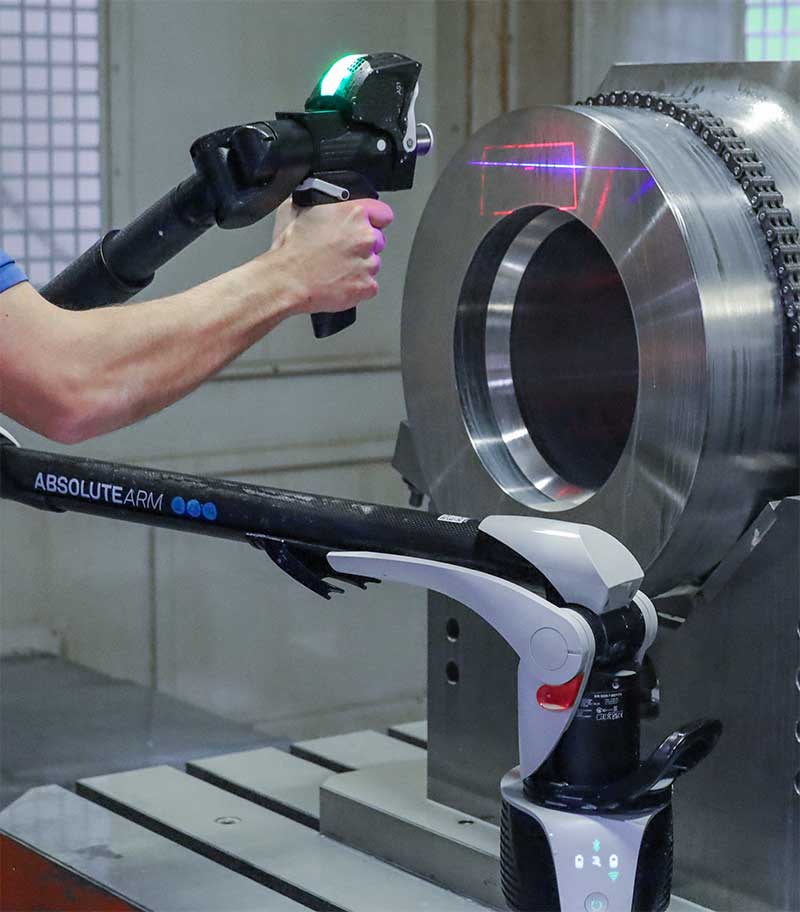
- Portable Metrology Integration – Deploying on‑floor measurement arms that verify dimensional compliance in real time, reducing re‑work cycles by up to 45 %.
Comparison: Traditional Machining vs. Additive Manufacturing for Drone Parts
| Attribute | Conventional CNC Machining | Additive Manufacturing (LPBF) |
|---|---|---|
| Typical Unit Cost | $1,200 – $2,500 | $350 – $900 |
| Lead Time | 8–12 weeks (tooling + setup) | 3–6 weeks (no tooling) |
| Material Utilization | 30‑40 % waste (chips) | > 90 % build efficiency |
| Geometric Complexity | Limited to 2‑axis/3‑axis features | Full 3‑D lattice, internal channels |
| Tolerance (as‑built) | ± 0.025 mm (H7) | ± 0.05 mm (as‑built), post‑process to ± 0.015 mm |
| Weight Reduction | 0 % (baseline) | Up to 35 % (topology‑optimized) |
| Traceability | Serial numbers, CNC logs | Build file hash, laser‑etched IDs, in‑process monitoring |
Source: Hexagon AM Solutions data sheets (2025‑2026).
Portable Metrology: The Inspection Game‑Changer
A modern portable coordinate‑measuring machine (CMM‑R) can be positioned directly on the production line. With a measurement envelope of 800 mm and repeatability of 10 µm, it validates intricate lattice structures that would otherwise require a dedicated lab CMM. The result is a single‑source quality loop: design → AM → on‑floor inspection → feedback → next build.
From Reverse Engineering to Production‑Ready Digital Twins
The workflow that many defense teams now emulate mirrors my early experience in the mining sector, where RE was used to extend the life of legacy equipment. The steps are:
- Capture – Structured‑light or laser scanners generate point clouds at 1 M‑point density.
- Convert – Meshes are cleaned, then converted to NURBS or STEP files for downstream CAE.
- Optimize – Finite‑element analysis identifies mass‑saving opportunities; topology optimization can shave 20‑30 % of material.
- Validate – Portable metrology confirms that the as‑built part matches the digital twin within tolerance.
By completing this loop before any metal powder is melted, manufacturers eliminate costly redesigns and ensure that every component meets MIL‑STD‑883 test criteria from day one.
Bottom Line
The democratization of low‑cost drones is forcing defense manufacturers to adopt a design‑first, data‑driven production philosophy. Leveraging reverse engineering, additive manufacturing, and portable metrology together can slash unit costs by 70 %, compress lead times to a few weeks, and still satisfy the rigorous traceability and performance standards demanded by the Department of Defense. The firms that embed these capabilities early—well before a part reaches a printer—will secure the manufacturing advantage that the next generation of combat‑ready UAS requires.


