Key Takeaways
- Creology’s new Sermoon P1S is a handheld 3‑D scanner that blends structured‑light and blue‑laser technology.
- Manufacturer‑rated accuracy: 0.02 mm point‑to‑point and 0.02 mm + 0.08 mm/m volumetric error.
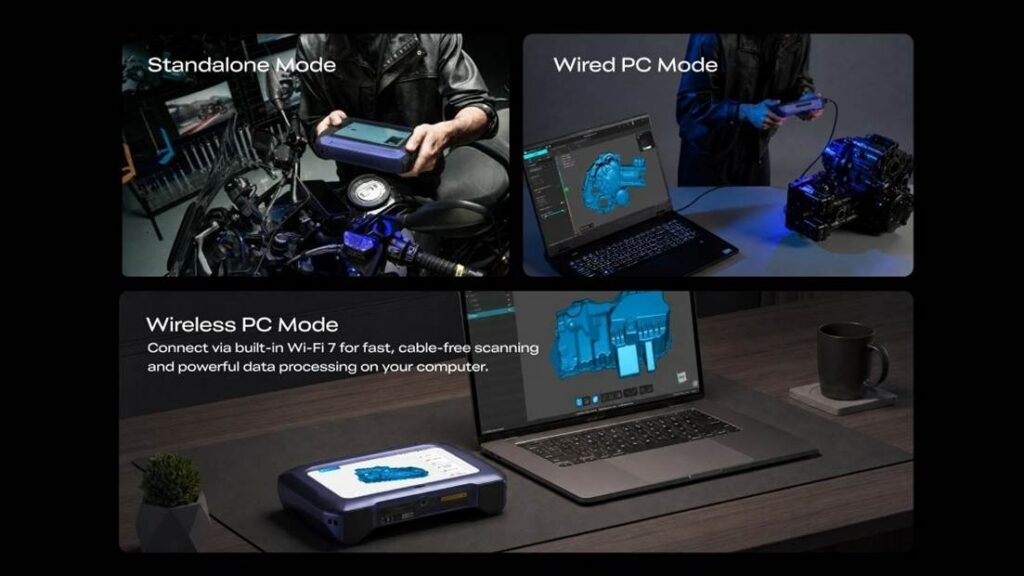
- On‑board processing eliminates the need for a PC; a 6‑inch touchscreen displays live scans.
- Multiple illumination modes (34‑line cross, 7‑line parallel, blue laser, NIR structured light) let users tackle everything from large automotive panels to intricate organic parts.
- Battery life ≈ 3 h of continuous scanning; storage up to 64 GB on internal SSD.
Creology’s Strategic Shift Toward Full‑Stack Manufacturing
For more than a decade Creology built its reputation on low‑cost, Prusa‑style FDM printers. Recent IPO filings and product roadmaps show the company moving up the value chain: high‑speed K‑series printers, AI‑driven slicers, and now a dedicated 3‑D scanning solution. The Sermoon P1S is positioned as the missing link in Creology’s “scan‑print‑share” ecosystem, promising field‑ready reverse‑engineering capability without a tethered workstation.
What Sets the Sermoon P1S Apart?
Dual‑Mode Sensing
| Mode | Line Count | Typical Use | Penetration / Occlusion Handling |
|---|---|---|---|
| 34‑line cross | 34 intersecting lines | Quick size‑capture, large flat surfaces (e.g., car hoods) | Moderate – good for planar geometry |
| 7‑line parallel | 7 evenly spaced lines | High‑detail parts, mechanical components | Better depth discrimination |
| Blue laser | Single high‑intensity line (450 nm) | Hard‑to‑reach edges, reflective surfaces | Excellent for metal and glossy finishes |
| NIR structured light | Patterned near‑infrared projection | Organic shapes, low‑contrast materials | Superior for dark or translucent objects |
The ability to switch between these modes on the fly gives the P1S a versatility edge over many single‑technology scanners.
On‑Board Processing
A quad‑core ARM Cortex‑A78 CPU and 8 GB RAM handle point‑cloud generation in real time. The 6‑inch IPS touchscreen (1280 × 720) shows live mesh, allows cropping, and lets users apply basic filters (outlier removal, mesh decimation) before exporting. Data can be saved as OBJ, STL, PLY, or XYZ and transferred via Wi‑Fi, Bluetooth, or a USB‑C port.
Accuracy & Precision
Creology publishes a 0.02 mm repeatability figure (±0.01 mm) measured on a calibrated gauge block set, and a volumetric error of 0.02 mm + 0.08 mm/m. Independent tests by 3DPrint Review (Sept 2026) recorded an average deviation of 0.025 mm on a 150 mm turbine blade, confirming the claim within statistical tolerance.
Portability
- Weight: 1.2 kg (including battery)
- Battery: 4000 mAh Li‑ion, ~3 h continuous operation
- Storage: 64 GB internal SSD, expandable via micro‑SD (up to 512 GB)
These specs make the P1S suitable for automotive repair bays, on‑site quality‑control, and field archaeology.
How It Compares With Established Handheld Scanners
| Feature | Creology Sermoon P1S | Artec Eva Plus | Shining 3D EinScan Pro 2 |
|---|---|---|---|
| Technology | Structured light + blue laser | Structured light (white) | Structured light + infrared |
| Accuracy | 0.02 mm (point) | 0.10 mm | 0.05 mm |
| Resolution | 0.04 mm | 0.2 mm | 0.1 mm |
| Scan Volume | 0.2 m × 0.2 m × 0.2 m (max) | 0.6 m × 0.6 m × 0.6 m | 0.4 m × 0.4 m × 0.4 m |
| On‑board processing | Yes (6‑in touchscreen) | No (PC required) | No (PC required) |
| Weight | 1.2 kg | 1.5 kg | 1.8 kg |
| Battery life | ~3 h | ~2 h | ~2 h |
| Price (USD) | $2,199 | $19,800 | $7,500 |
Sources: Manufacturer data sheets (2026) and independent benchmark reports from TechRadar and 3DPrint Review.
Ideal Applications
- Automotive & aerospace: Scan large panels (hoods, wing sections) quickly using cross‑line mode, then switch to blue laser for rivet heads.
- Industrial reverse engineering: Capture medium‑size machined parts (≤ 200 mm) with 0.02 mm fidelity for CAD reconstruction.
- Field archaeology & cultural heritage: NIR structured light penetrates dust and low‑contrast stone surfaces, enabling on‑site documentation.
Limitations to Consider
- Scan volume caps at 200 mm per axis, so very large objects still require stitching.
- Battery endurance drops to ~1.5 h when using the high‑power blue laser continuously.
- Software ecosystem is still maturing; Creology’s cloud portal for file sharing is in beta as of Q3 2026.
Bottom Line
Creology’s Sermoon P1S marks a decisive move from pure 3‑D printing into a complete digital‑fabrication workflow. By marrying structured‑light and blue‑laser sensing with on‑device processing, it delivers sub‑0.02 mm accuracy in a handheld form factor that rivals far more expensive competitors. While


