Key Takeaways
- Western AM vendors are shifting from “sell‑any‑printer” to deep application focus (customer‑intimacy) to stay competitive.
- Chinese manufacturers now dominate the low‑price segment, holding ≈45 % of global metal‑AM machine sales in 2023.
- Concentrating on a single industry vertical cuts short‑term revenue but creates a defensible moat that rivals cannot copy quickly.
- The trade‑off is explicit: foregone sales this quarter versus potential multi‑year growth in a chosen market.
Why the “Anything‑Goes” Model Has Crumbled
For most of its early life, additive manufacturing (AM) was marketed on the promise of geometric freedom: any shape, no tooling, no minimum order. That promise turned the sales funnel into a “sell‑the‑machine‑to‑any‑customer” approach. As long as the technology itself was the primary buying reason, widening the funnel equaled growth.
Two forces have now eroded that model:
| Factor | Impact on the Market |
|---|---|
| Price erosion – aggressive pricing by Chinese OEMs (average entry‑level metal‑laser powder‑bed fusion (L‑PBF) units now US$250 k–$350 k) | 45 % of 2023 global metal‑AM machine revenue shifted to China (3DPrint.com, 2024). |
| Maturing technology – performance gaps have narrowed; investors demand clear ROI | Western firms can no longer rely on “new‑tech premium” to justify higher price tags (≈US$600 k–$1 M for comparable systems). |
With price no longer a differentiator, the only sustainable advantage left for Western suppliers is Customer Intimacy—deeply understanding and serving a narrowly defined user group.
The Entrepreneurial Risk of Application Focus
Choosing a single industry vertical (e.g., aerospace turbine blades, medical implants, or oil‑field tooling) is a bet on that sector’s capital cycle, regulatory path, and willingness to adopt new processes. The risk profile differs from the historic transactional model:
| Risk Aspect | Traditional Transactional Model | Application‑Focus Model |
|---|---|---|
| Revenue timing | Immediate cash on machine sale | Delayed, tied to part‑volume contracts (often 2–4 years). |
| Investment required | Broad‑based sales & marketing | Concentrated R&D, application engineering, and field support. |
| Competitive defensibility | Low – price wars common | High – expertise, qualified‑part libraries, and co‑development agreements are hard to replicate. |
| Exposure to market downturn | Spread across many sectors | Concentrated; a slowdown in the chosen vertical hits hard. |
The upside is a strategic moat: a co‑engineered workflow, certified material‑process‑part combos, and long‑term service contracts that lock in revenue. The downside is visible now—the foregone sales from non‑targeted inquiries appear on the current quarter’s P&L, while the payoff may not materialize until the partner’s production line is fully qualified.
How the Industry Got Here
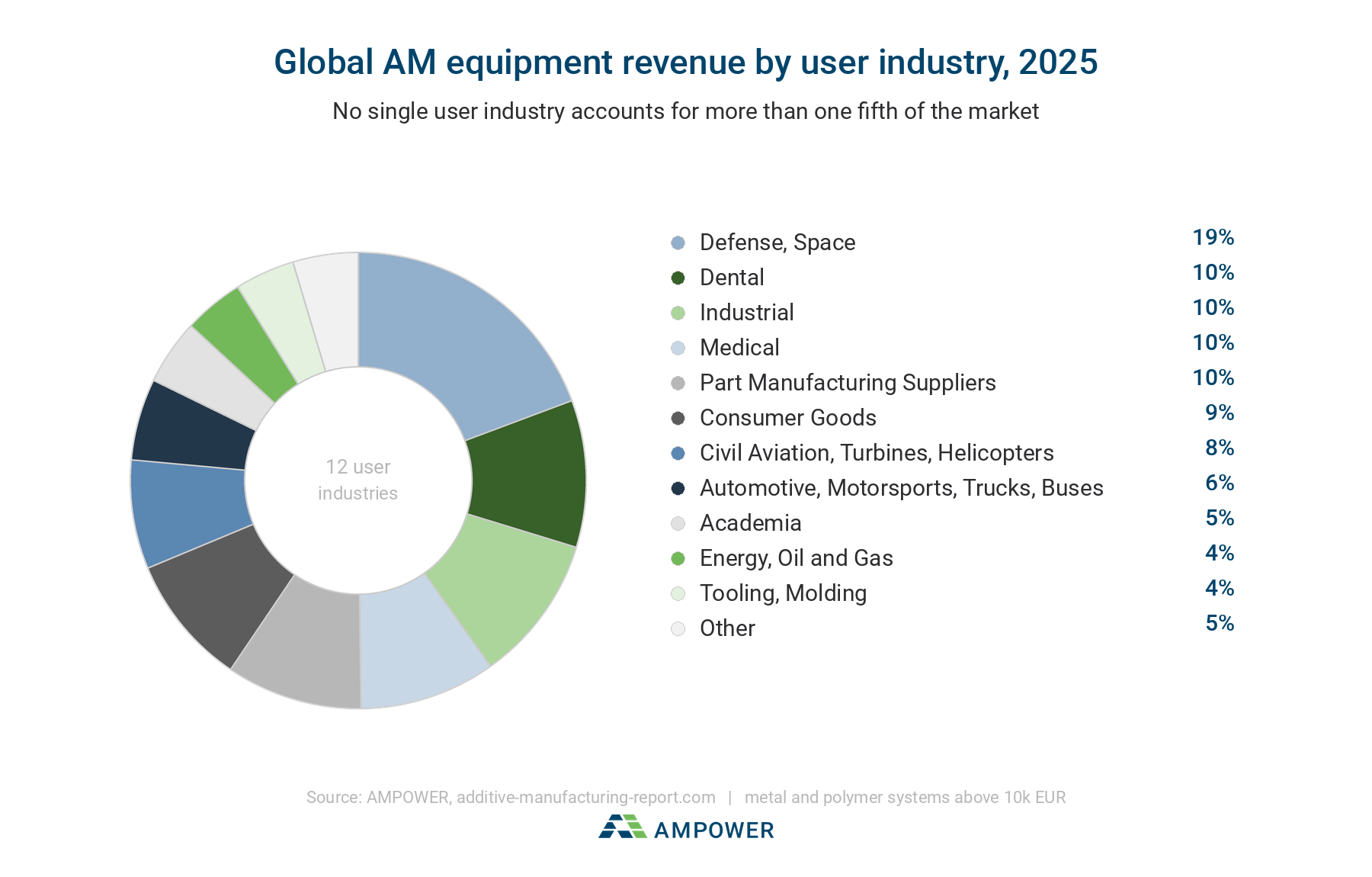
The lack of focus is not a managerial oversight; it is baked into the original value proposition. When AM was sold as “any geometry, no tooling,” suppliers could not rationally prioritize one market over another. The resulting “scatter‑gun” go‑to‑market strategy produced a revenue landscape where, as of 2023:
- North America contributed ≈25 % of metal‑AM revenue,
- Europe ≈30 %,
- Asia‑Pacific ≈45 %, with China alone accounting for ≈35 % of machine shipments (3DPrint.com, 2024).
Figure 1 (not reproduced here) shows a classic “long‑tail” distribution: many small deals across dozens of sectors, but no dominant vertical.
Comparison: Chinese vs. Western Metal‑AM Equipment (2023)
| Metric | Chinese OEMs (e.g., Bright Laser, Farsoon) | Western OEMs (e.g., EOS, GE Additive) |
|---|---|---|
| Average machine price | US$250 k–$350 k (entry‑level L‑PBF) | US$600 k–$1 M (mid‑ to high‑end L‑PBF) |
| Annual shipped units | ~1,200 units (≈45 % market share) | ~1,500 units (≈55 % market share) |
| Typical build volume | 120 × 120 × 150 mm | 250 × 250 × 350 mm |
| Material portfolio | 10–12 alloys (primarily stainless & Ti) | 30+ alloys (including high‑performance Ni‑based) |
| Warranty / service | 12 months, limited on‑site support | 24 months, comprehensive on‑site service contracts |
Sources: 3DPrint.com market reports 2023‑24; company datasheets.
Bottom Line
Western additive‑manufacturing firms can no longer win on price alone. By concentrating engineering, sales, and service resources on a single, high‑value application, they trade short‑term revenue for a defensible, long‑term position that Chinese low‑cost competitors cannot quickly emulate. The strategy is inherently risky—revenue gaps appear immediately, and success hinges on the chosen industry’s adoption curve—but it offers the only realistic path to sustainable growth as the technology matures and price parity deepens.


