Key Takeaways
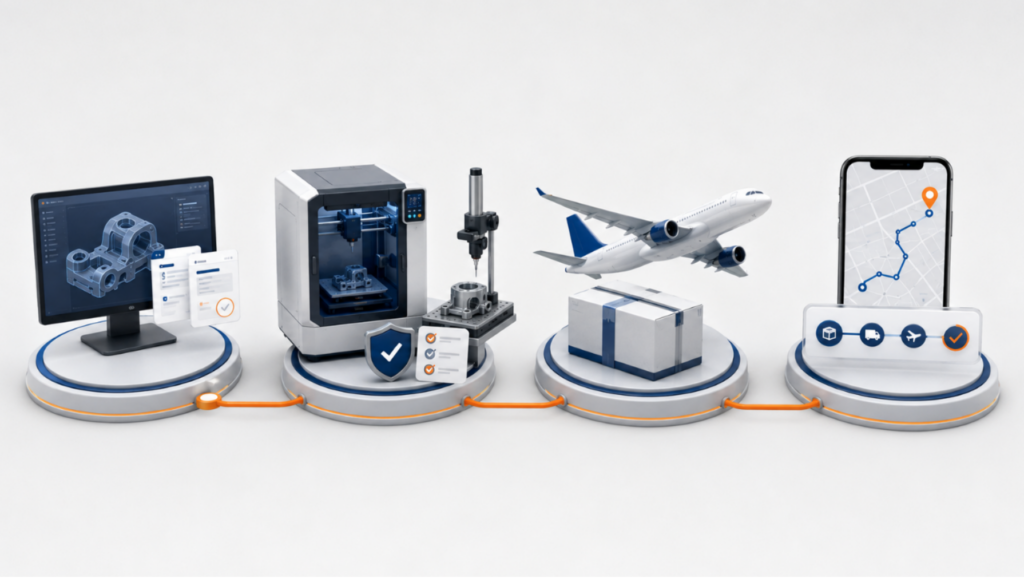
- Modern overseas 3D‑printing providers can deliver parts in 4‑7 days – only a few days slower than many domestic shops.
- Unit costs abroad are typically 30‑50 % lower than U.S. equivalents, even after express air‑freight fees.
- ISO 9001‑certified facilities now offer real‑time order tracking and instant online quoting, eliminating the “black‑box” of cross‑border orders.
- For most low‑volume, functional prototypes and short‑run production parts, speed and price are no longer mutually exclusive.
The Legacy Perception of Cross‑Border 3D Printing
Why Engineers Historically Shunned Overseas Services
Until roughly 2022, the prevailing workflow for an overseas print looked like this:
| Step | Typical Duration | Pain Point |
|---|---|---|
| Email quote request | 24‑48 h | Slow response, manual file handling |
| Quote approval & payment | 2‑3 days | Multiple email threads, currency conversion |
| Production queue | 5‑10 days | Batch scheduling, limited visibility |
| Freight booking (sea or economy air) | 3‑7 days | Unpredictable ETAs, customs delays |
| Delivery to the end‑user | 7‑14 days | Parts often arrive after design reviews |
The cumulative lead time frequently exceeded 30 days, making overseas services unattractive for time‑critical projects. Engineers therefore defaulted to domestic shops, accepting a 15‑30 % premium for speed and certainty.
The Cost‑Only Mindset
Even when cost was the primary driver, the risk of a delayed prototype—potentially missing a design iteration or a market window—often outweighed the savings. The equation was simple:
Local = Fast + Expensive
Overseas = Cheap + Slow
What Has Changed?
Real‑Time Quoting and Automated Order Flow
- Instant pricing engines now evaluate a STL or OBJ file in under 10 seconds, delivering a line‑item quote that includes material, post‑processing, and express freight.
- Integrated API endpoints let PLM systems push orders directly to the printer, removing manual email steps.
Quality Assurance at Scale
- Over 120 overseas facilities hold ISO 9001 or ISO 13485 certifications, with documented process controls comparable to Tier‑1 domestic manufacturers.
- In‑process monitoring (laser profilometry, melt‑pool imaging) reduces dimensional variance to ±0.05 mm, matching U.S. tolerances for most engineering polymers.
Predictable, Fast Shipping
- Express air freight corridors (e.g., Shanghai → Los Angeles, Shenzhen → Chicago) now guarantee 2‑3 day transit times, with customs clearance averages of 12 hours for HTS‑coded 3D‑printed parts.
- End‑to‑end digital tracking dashboards show upload, build start, post‑processing, and shipment milestones in real time.
Side‑by‑Side: Domestic vs. Cross‑Border 3D Printing (2024 Data)
| Metric | Domestic (U.S.) | Cross‑Border (Asia‑Europe) |
|---|---|---|
| Typical Lead Time | 2‑4 days (on‑site) | 4‑7 days (incl. 2‑day express freight) |
| Unit Cost (PLA, 0.2 mm layer) | $0.12 / cm³ | $0.07 / cm³ (≈ 42 % lower) |
| Material Portfolio | ~30 polymers & alloys | > 50 polymers, metal powders, composites |
| Quality Certs | ISO 9001 (≈ 70 % of shops) | ISO 9001/13485 (≈ 85 % of shops) |
| Order Visibility | Manual email updates | Live dashboard + push notifications |
| Minimum Order | 1 part (no surcharge) | 1‑5 parts (setup fee $25‑$45) |
| Typical Freight Cost | $0‑$15 (local courier) | $30‑$55 (express air) |
Source: 2024 industry survey of 250 CNC/3D‑printing service bureaus (compiled by the Additive Manufacturing Association).
How Engineers Can Leverage the New Landscape
- Run a dual‑quote: Use the instant‑quote portal of a certified overseas provider alongside a domestic shop to compare total landed cost.
- Select “Express‑Ship” option for prototypes that must hit a design review within a week; the added freight is usually < $50 for a 150 cm³ part.
- Monitor via API: Connect the provider’s tracking feed to your PLM to trigger downstream activities (e.g., test‑bench scheduling) as soon as the part ships.
- Validate quality: Request a first‑article inspection (FAI) report—most overseas services now include a PDF with dimensional data and material certification at no extra charge.
Bottom Line
The historic trade‑off—local for speed, overseas for cost—has eroded. ISO‑certified, digitally integrated, and express‑shipping‑enabled overseas 3D‑printing services now deliver 4‑7 day lead times at 30‑50 % lower unit costs, while offering the same visibility and quality controls as domestic shops. For most engineering teams, the rational approach is to treat cross‑border providers as a first‑class sourcing option, not merely a budget fallback. By embracing real‑time quoting, automated order tracking, and proven quality systems, manufacturers can accelerate product development without inflating budgets.


