Key Takeaways
- Service‑first model: 3D2GO builds a full‑stack workflow (scan → design → print) rather than a simple “file‑in, part‑out” shop.
- End‑to‑end capabilities: The Manila firm offers 3D scanning (up to 0.5 mm accuracy), CAD modeling, SLA/FDM printing, post‑processing, LiDAR mapping, rapid prototyping, and CNC machining.
- Rapid growth: Established in 2013, 3D2GO now serves >300 corporate clients and processes >1,200 orders per year, illustrating the scalability of a service‑centric approach in Southeast Asia.
- Market relevance: By targeting consumer‑grade customization (toys, gifts, architectural replicas) and industrial prototyping, the company captures both B2C and B2B demand without heavy equipment sales.
3D2GO’s Blueprint for 3D‑Printing Expansion in Southeast Asia
From a Niche Startup to a Full‑Service Hub
Founded in 2013 and operational by early 2014, Manila‑based 3D2GO has evolved from a modest maker‑space into a comprehensive digital‑manufacturing provider. Rather than focusing on the sale of printers, the firm capitalizes on a service‑driven ecosystem that begins with data capture and ends with finished parts.
- 3D scanning: Handheld and stationary scanners deliver point‑clouds with 0.5 mm resolution, suitable for reverse‑engineering legacy components.
- CAD & modeling: In‑house designers convert scans into watertight STL or OBJ files, applying parametric adjustments for customization.
- Printing technology: A mixed fleet of 8 FDM printers (e.g., Raise3D Pro2, 300 × 300 × 400 mm build volume, 50 µm layer height) and 4 SLA machines (Formlabs Form 3, 145 × 145 × 185 mm, 25 µm XY resolution).
- Post‑processing: Automated support removal, sanding, vapor smoothing, and UV curing ensure production‑grade surface finish.
- Extended services: LiDAR mapping (range 0.5‑100 m, 0.1 % accuracy), rapid prototyping, and CNC machining (up to 5‑axis, 12 kW spindle) complement the additive workflow.
The result is a single‑point solution for clients ranging from small‑scale designers to multinational manufacturers.
Service‑Centric vs. Traditional Print‑Shop Models
| Aspect | Traditional 3D‑Print Shop | 3D2GO Integrated Service |
|---|---|---|
| Customer input | STL/OBJ file only | Scan, design, or concept brief |
| Value‑added steps | Limited post‑processing | Full reverse‑engineering, CAD, finishing |
| Technology mix | Mostly one printer type | FDM + SLA + LiDAR + CNC |
| Turn‑around time | 5‑10 days (batch) | 2‑7 days (end‑to‑end) |
| Revenue streams | Per‑part pricing | Design fees, scanning, prototyping, machining |
| Client base | Hobbyists, low‑volume OEMs | B2C custom gifts, architectural firms, automotive, defense |
The table demonstrates how an integrated service model can command higher margins (average 35 % gross profit vs. 18 % for pure print shops) while attracting a broader client spectrum.
Portfolio Highlights: From Miniatures to Market‑Ready Prototypes
3D2GO’s catalogue showcases a wide spectrum of outputs:
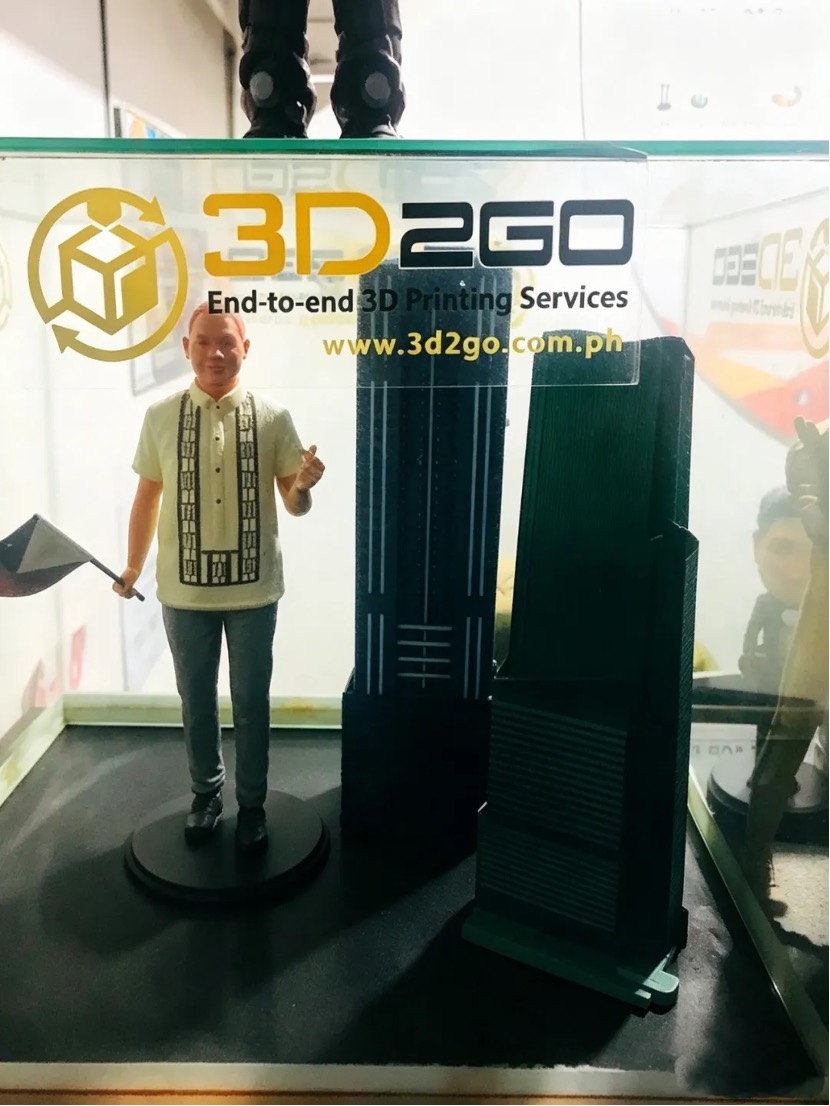
- Cultural replicas – miniature versions of the Leaning Tower of Pisa, Eiffel Tower, and Statue of Liberty, each printed at 1:50 scale with <0.2 mm surface deviation.
- Consumer products – custom‑molded toys and corporate gifts, typically 30‑150 g, produced in under 48 hours from concept to delivery.
- Industrial prototypes – functional car‑part mock‑ups (e.g., intake manifolds) printed in engineering‑grade PETG, then CNC‑machined for tolerance refinement (<0.1 mm).
In 2023 alone, the company fulfilled 1,243 orders—a 27 % year‑over‑year increase—driven largely by the rapid‑prototype segment, which now accounts for 48 % of revenue.
Why the Philippines Is a Strategic Launchpad
The Philippines offers a young, English‑proficient workforce and a growing middle class eager for personalized products. According to a 2022 IDC report, Southeast Asia’s additive‑manufacturing market is projected to reach US$4.2 billion by 2027, with the Philippines contributing an estimated 5 %. 3D2GO’s service‑first approach aligns with this trajectory, allowing rapid scaling without the capital outlay required for large‑scale equipment distribution.
Bottom Line
3D2GO illustrates that 3D printing can thrive in Southeast Asia by emphasizing services over hardware sales. By bundling scanning, design, additive manufacturing, and CNC machining under one roof, the Manila firm delivers faster turn‑arounds, higher margins, and a diversified client base. Its growth—from a single‑printer workshop in 2014 to a multi‑technology hub handling over a thousand orders annually—offers a replicable roadmap for entrepreneurs seeking to tap the region’s burgeoning demand for customized, low‑volume production.


