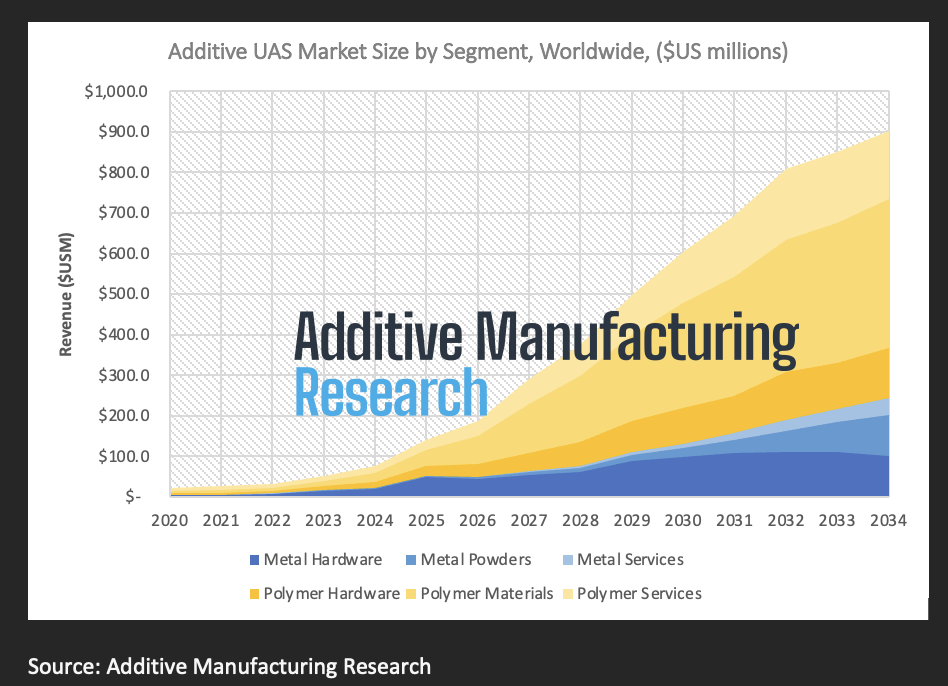
Key Takeaways
- The drone industry is a significant opportunity for additive manufacturing (AM) due to the need for lightweight, customizable, and rapidly produced drones.
- A new report by Additive Manufacturing Research (AM Research) highlights the value of AM in drone production, citing its ability to create complex geometries and reduce production time.
- The report forecasts significant growth in the use of AM in drone production, with the potential to change the dynamics of the industry.
- AM is being used to produce end-use parts, including airframes, housings, and lightweight structural components.
- The use of low-cost 3D printers is becoming increasingly popular in drone production, with drones becoming the largest production application for these printers worldwide.
Introduction to Additive Manufacturing in Drones
The rapid growth of the drone industry has created a significant opportunity for additive manufacturing (AM). Drones require lightweight, customizable, and rapidly produced components, making them an ideal application for AM. According to a recent report by AM Research, the use of AM in drone production is expected to grow significantly in the coming years.
Benefits of Additive Manufacturing in Drones
Additive manufacturing offers several benefits in drone production, including:
- Reduced production time: AM can produce complex geometries and components quickly, reducing production time and increasing efficiency.
- Increased customization: AM allows for the creation of customized components, enabling drone manufacturers to produce aircraft tailored to specific missions or customers.
- Reduced material waste: AM is an additive process, which means that material is added layer by layer, reducing material waste and minimizing the environmental impact of production.
Comparison of Traditional and Additive Manufacturing
| Manufacturing Method | Tooling Costs | Production Volume | Customization | Production Time |
|---|---|---|---|---|
| Traditional Manufacturing | High | High | Limited | Long |
| Additive Manufacturing | Low | Low | High | Short |
Industry Insights
According to Scott Dunham, Executive Vice President of Research at AM Research, "In UAS, we have the recipe for both a significant market opportunity and one that could change the dynamics of additive manufacturing. Geopolitical urgency, supply chain fragility, and regulatory uncertainty have all come together to make additive manufacturing a much more attractive solution than it was just a few years ago." The report forecasts that the use of AM in drone production will continue to grow, with the potential to change the dynamics of the industry.
Bottom Line
The use of additive manufacturing in drone production is expected to grow significantly in the coming years, driven by the need for lightweight, customizable, and rapidly produced components. With its ability to create complex geometries, reduce production time, and increase customization, AM is becoming an essential tool in the drone industry. As the industry continues to evolve, it is likely that AM will play an increasingly important role in shaping the future of drone production.


