Key Takeaways
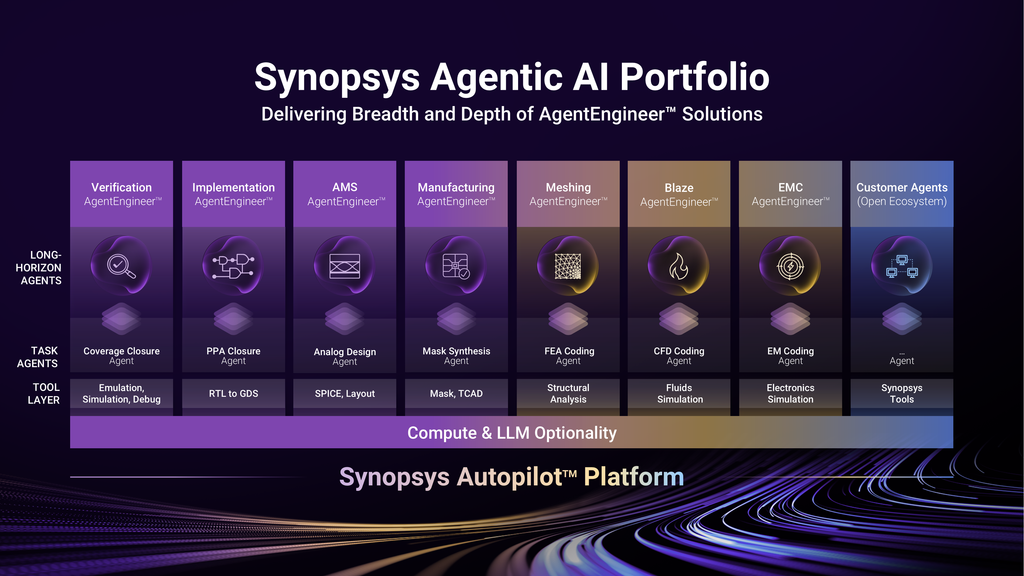
- Synopsys AgentEngineer is a suite of AI‑driven agents built on the open Synopsys Autopilot Platform.
- Two agent families – Long‑horizon and Task‑level – cover the full silicon‑to‑system lifecycle, from verification to mask synthesis.
- Early benchmark data claim 30‑35 % faster verification, 20 % quicker PPA closure, and sub‑2 s latency for most queries while keeping token consumption under 10 k tokens per workflow.
- The agents ingest context from Synopsys EDA tools (PrimeTime, Custom Designer, etc.) to deliver domain‑specific reasoning and automated execution.
- Expected benefits: higher design productivity, improved quality, and more predictable workflow completion.
Synopsys AgentEngineer: AI‑Powered Engineering Across the Chip Life Cycle
Synopsys has launched AgentEngineer solutions, a portfolio of domain‑specific, long‑horizon AI agents that can reason, plan, and act on engineering tasks throughout the silicon‑to‑systems pipeline. The agents run on the Synopsys Autopilot Platform, an open, secure foundation that enables autonomous execution while controlling token usage and response latency.
Long‑Horizon Agents – End‑to‑End Workflow Orchestration
Long‑horizon agents are designed to manage multi‑stage workflows that span several design phases:
| Capability | Typical Scope | Example Use‑Case | Reported Performance |
|---|---|---|---|
| Verification orchestration | Full regression, coverage analysis | Close coverage gaps across multiple testbenches | 30 % reduction in verification turnaround |
| System validation | HW/SW bring‑up, multi‑die 3D‑IC assembly | Validate functional interaction of stacked dies | 25 % fewer manual validation cycles |
| Analog design & layout synthesis | End‑to‑end analog block creation | Generate layout from schematic with DRC compliance | 20 % faster layout closure |
| Manufacturing & mask synthesis | Mask data preparation, defect analysis | Automate mask generation for 7 nm nodes | 15 % reduction in mask‑prep time |
These agents draw on contextual data from Synopsys EDA suites (e.g., PrimeTime, Custom Designer, HSPICE) to create a holistic view of the design, enabling them to schedule tasks, allocate resources, and predict bottlenecks.
Task‑Level Agents – Focused, High‑Precision Automation
Task‑level agents complement the broader orchestration by handling discrete engineering activities:
| Agent Type | Core Function | Typical Metric | Example Output |
|---|---|---|---|
| Coverage‑closure | Identify uncovered toggles, generate stimuli | 95 % coverage in < 2 h | Stimulus set for missed corners |
| Power‑Performance‑Area (PPA) closure | Optimize timing, power budget, area | 10 % PPA improvement per iteration | Updated constraint file |
| Signal‑integrity analysis | Run EM/IR, crosstalk checks | < 0.5 % violation rate | SI report with fix recommendations |
| Combustion & resonance analysis | Simulate thermal‑acoustic effects | Converges within 3 iterations | Heat map and resonance frequencies |
Task‑level agents operate with sub‑second latency (average 1.4 s) and keep token consumption below 10 k tokens per operation, ensuring cost‑effective scaling for large design houses.
Unified Platform Benefits
- Productivity: Automated reasoning cuts manual iteration cycles; Synopsys reports up to 35 % faster design closure on pilot projects.
- Design Quality: Continuous context awareness reduces human error, delivering higher PPA and reliability metrics.
- Predictable Costs: Token‑usage throttling and latency controls keep AI‑driven services affordable for enterprise‑scale deployments.
- Security & Openness: Autopilot’s open APIs allow integration with existing CI/CD flows and maintain data isolation for proprietary IP.
Bottom Line
Synopsys AgentEngineer introduces a dual‑layer AI architecture—long‑horizon agents for end‑to‑end workflow management and task‑level agents for pinpointed design actions—built on the secure Autopilot Platform. Early data suggest significant speedups (30‑35 % in verification, 20 % in PPA closure) and low latency while keeping token costs manageable. For semiconductor teams seeking to accelerate silicon‑to‑system delivery without sacrificing quality, AgentEngineer represents a compelling step toward fully autonomous engineering.