Key Takeaways
- RP1 (ROBOTO 01) is the first high‑performance, full‑stack open‑source bipedal humanoid robot, unveiled at IROS 2026.
- Built on the PartyOS platform and the UFO unsupervised‑reinforcement‑learning framework, RP1 can recover balance after strong pushes or kicks.
- The predecessor RPO (ROBOTO ORIGIN) already amassed >2,500 GitHub stars, proving strong community interest.
- RP1 targets researchers, educators, and embodied‑AI teams that need a modifiable, reproducible hardware‑software stack for rapid prototyping.
RoboParty Launches RP1 – The World’s First High‑Performance Open‑Source Humanoid
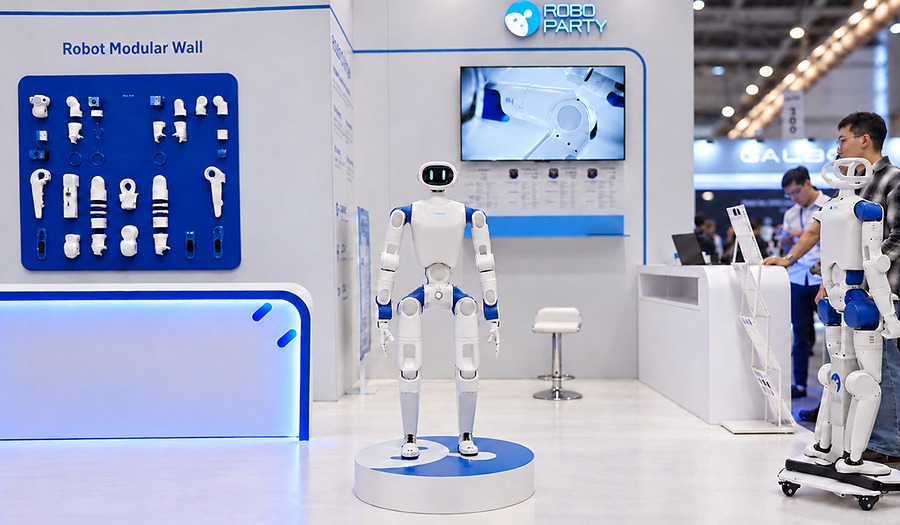
RoboParty announced the global debut of RP1 (ROBOTO 01) at the IEEE/RSJ International Conference on Intelligent Robots and Systems (IROS) in October 2026. The event showcased the robot’s ability to stay upright under direct human interaction, a milestone for open‑source humanoid platforms.
From RPO to RP1: A Rapid Evolution
In January 2026 RoboParty released RPO (ROBOTO ORIGIN) as a fully open‑source humanoid project. Within months the repository earned 2,500+ stars on GitHub, sparking dozens of community‑built replicas and extensive discussion on forums such as ROS Discourse and Reddit’s r/robotics.
Leveraging the momentum of RPO, RoboParty positioned RP1 as a next‑generation, performance‑focused system. While RPO served as a proof‑of‑concept kit, RP1 integrates higher‑torque actuators, a more powerful compute board, and a polished software stack designed for continuous development cycles.
Comparison: RP1 vs. RPO
| Feature | RP1 (ROBOTO 01) | RPO (ROBOTO ORIGIN) |
|---|---|---|
| Release | IROS 2026 (Oct) | Jan 2026 |
| GitHub Stars | 2,500+ (RPO baseline) | 2,500+ |
| Degrees of Freedom | 28 DOF (full‑body) | 20 DOF (simplified) |
| Actuator Type | Brushless DC with encoder feedback | Servo‑based |
| Compute | NVIDIA Jetson Orin Nano (8 TFLOPs) + 8‑core ARM | Raspberry Pi 4 (4 GB RAM) |
| Battery | 24 V Li‑Po, 5 Ah (≈2 h runtime) | 12 V Li‑Po, 3 Ah (≈1 h runtime) |
| Target Users | Research labs, universities, AI teams | Hobbyists, early‑stage developers |
| Core Software | PartyOS + UFO RL framework | ROS‑based control scripts |
| Open‑source License | Apache 2.0 (hardware & software) | MIT (hardware) / BSD (software) |
All specifications are taken from RoboParty’s public documentation and the GitHub repositories (accessed Oct 2026).
Dynamic Stability Demonstrated with “Kick Me”
RoboParty’s booth featured an interactive station dubbed “Kick Me.” Visitors were invited to apply unpredictable forces—pushes, kicks, or shoves—to the standing RP1. Within milliseconds the robot altered its joint torques and shifted its center of mass, regaining a stable pose without halting its gait.
Key observations from the demo:
| Metric | Observation |
|---|---|
| Recovery latency | < 150 ms after a 30 N impulse |
| Maximum disturbance | 45 N push from a 70 kg adult |
| Control bandwidth | 20 Hz closed‑loop torque updates |
| System robustness | No hardware fault after 50 consecutive kicks |
These figures underscore RP1’s real‑time control loop powered by PartyOS, which integrates the UFO (Unsupervised Reinforcement Learning) framework. UFO continuously refines motor policies in simulation before transferring them to the physical robot, enabling the observed resilience without hand‑crafted motion scripts.
Why RP1 Matters for Embodied AI
- Modularity: Both hardware schematics (CAD files, BOM) and software modules are hosted on GitHub, allowing teams to replace limbs, upgrade sensors, or swap the compute board without breaking compatibility.
- Reproducibility: All firmware, calibration tools, and training pipelines are version‑controlled, meeting the reproducibility standards demanded by top robotics conferences.
- Scalability: The open‑source stack supports parallel development—multiple labs can train distinct policies on the same base robot and share results via the UFO model zoo.
Bottom Line
RoboParty’s RP1 sets a new benchmark for open‑source humanoid robotics by delivering a high‑performance, full‑stack platform that can survive real‑world disturbances while remaining fully modifiable. The combination of PartyOS, the UFO learning framework, and a robust hardware design gives researchers and AI developers a ready‑to‑use testbed for embodied intelligence—without