Key Takeaways
- Researchers from the University of Notre Dame and Harvard Medical School have developed a hybrid bioprinting technique to create tiny blood vessel networks.
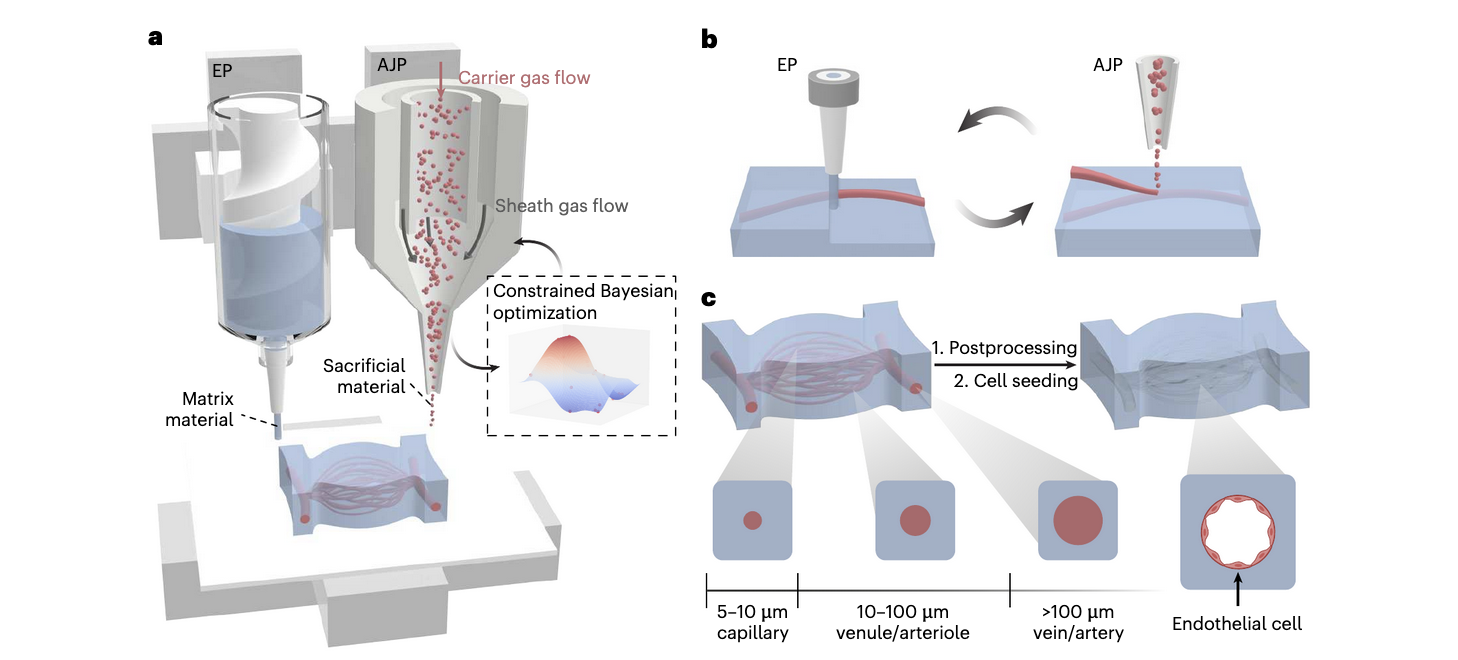
- The technique combines conventional extrusion bioprinting with high-resolution aerosol jet printing to produce capillary-scale features.
- The hybrid printer integrates two manufacturing technologies, enabling the creation of hierarchical vascular networks at capillary-scale resolution.
- The study, published in Nature Chemical Engineering, demonstrates the potential of hybrid bioprinting for advancing organ engineering and tissue fabrication.
Introduction to Hybrid Bioprinting
The field of bioprinting has made significant progress in recent years, with researchers able to print sophisticated tissues. However, one of the major challenges is creating a network of blood vessels to deliver oxygen and nutrients to these tissues. To address this challenge, researchers from the University of Notre Dame and Harvard Medical School have developed a hybrid bioprinting technique that combines two printing methods.
Hybrid Bioprinting Technique
The hybrid bioprinting technique developed by the researchers pairs conventional extrusion bioprinting with high-resolution aerosol jet printing. Conventional extrusion bioprinting is used to build larger tissue structures, while aerosol jet printing creates tiny sacrificial channels that can later be converted into blood vessel-like networks. The technique uses a custom-designed hybrid printer that integrates both printing methods into a single platform.
Comparison of Bioprinting Techniques
| Technique | Resolution | Feature Size |
|---|---|---|
| Conventional Extrusion Bioprinting | 100-500 μm | 100-500 μm |
| Aerosol Jet Printing | 1-10 μm | 1-10 μm |
| Hybrid Bioprinting | 1-100 μm | 1-100 μm |
Applications of Hybrid Bioprinting
The hybrid bioprinting technique has the potential to advance organ engineering and tissue fabrication. The ability to create hierarchical vascular networks at capillary-scale resolution could enable the creation of functional tissues and organs for transplantation. The technique could also be used to create personalized tissue models for drug testing and development.
Conclusion
The development of hybrid bioprinting techniques is a significant step forward in the field of bioprinting. The ability to create tiny blood vessel networks could enable the creation of functional tissues and organs, and has the potential to revolutionize the field of regenerative medicine.
Bottom Line
The hybrid bioprinting technique developed by researchers from the University of Notre Dame and Harvard Medical School has the potential to advance organ engineering and tissue fabrication. With its ability to create hierarchical vascular networks at capillary-scale resolution, this technique could enable the creation of functional tissues and organs, and has the potential to revolutionize the field of regenerative medicine. The study, published in Nature Chemical Engineering, demonstrates the potential of hybrid bioprinting and highlights the importance of continued research and development in this field.


