Key Takeaways
- Photocentric has spun out its space manufacturing activities into a separate business called CosmicMaker
- CosmicMaker's 3D printing technology has been successfully demonstrated aboard parabolic flights, simulating microgravity
- The technology has produced dimensionally accurate parts using four different materials, including silicon carbide, alumina, and two thermoset polymers
- Ceramic materials printed better during microgravity portions of the flight due to even distribution of particles
- CosmicMaker's process eliminates the need for additional support structures in microgravity, making it attractive for off-Earth manufacturing applications
Introduction to CosmicMaker
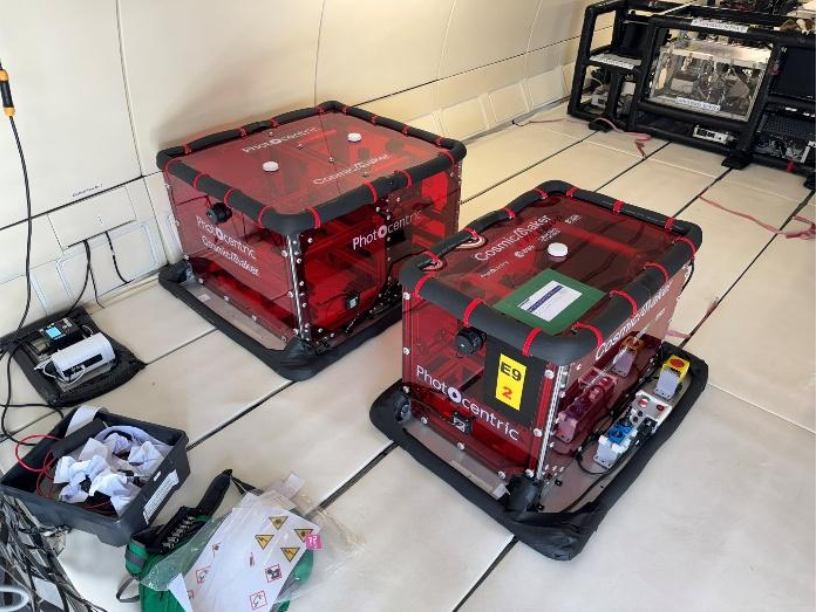
Photocentric, a UK-based 3D printing company, has launched a new business venture called CosmicMaker, dedicated to pursuing in-space manufacturing. This spinout follows a series of successful test flights aboard Novespace's Airbus A310 Zero G aircraft, where three CosmicMaker 3D printers produced parts in microgravity.
Test Flight Results
The test flights, which took place in April, involved cycling the aircraft between 22-second periods of microgravity and higher-gravity periods ranging from 0g to 2g. All three printers functioned throughout the flights, producing parts using four different materials. The resulting components were reported to be dimensionally accurate, with ceramic materials such as silicon carbide and alumina printing better during microgravity portions of the flight.
Comparison of Ceramic Material Printing in Microgravity and Higher-Gravity Phases
| Material | Microgravity Phase | Higher-Gravity Phase |
|---|---|---|
| Silicon Carbide | Even distribution of particles, improved printing | Particle separation, reduced printing quality |
| Alumina | Even distribution of particles, improved printing | Particle separation, reduced printing quality |
| Thermoset Polymers | No significant difference in printing quality | No significant difference in printing quality |
Advantages of CosmicMaker's Technology
CosmicMaker's process keeps parts surrounded by liquid material as they are being built, eliminating the need for additional support structures in microgravity. This characteristic makes the technology particularly attractive for future off-Earth manufacturing applications. Unlike many additive manufacturing systems, CosmicMaker's process may perform better in microgravity than on Earth.
Bottom Line
The successful demonstration of CosmicMaker's 3D printing technology in microgravity marks a significant milestone in the development of in-space manufacturing capabilities. With its ability to produce dimensionally accurate parts using a range of materials, CosmicMaker is well-positioned to play a key role in the growth of the space industry. As the company continues to develop its technology, it is likely to attract significant interest from space agencies, private space companies, and other organizations seeking to leverage the benefits of in-space manufacturing.


