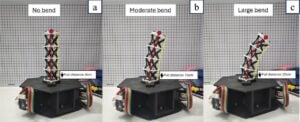
- Key Takeaways:
- Nanyang Technological University (NTU) researchers have successfully 3D printed sacrificial molds to create a self-sensing soft continuum robot
- The robot utilizes machine learning to reconstruct its shape
- This innovation has the potential to revolutionize robotics and manufacturing industries
- The 3D printing process enables the creation of complex geometries and customized shapes
Introduction to 3D Printed Robotics
The field of robotics has witnessed significant advancements in recent years, with 3D printing playing a crucial role in the development of innovative robotic systems. Researchers at Nanyang Technological University have made a groundbreaking discovery by 3D printing sacrificial molds to create a self-sensing soft continuum robot. This robot has the ability to reconstruct its shape using machine learning algorithms, paving the way for a new generation of adaptive and responsive robotic systems.
The 3D Printing Process
The 3D printing process used by the NTU researchers involves creating sacrificial molds with complex geometries, which are then used to shape the soft continuum robot. This process enables the creation of customized shapes and structures that can be tailored to specific applications. The use of 3D printing technology allows for the rapid prototyping and testing of new robotic designs, reducing the time and cost associated with traditional manufacturing methods.
Comparison of 3D Printing Technologies
| Technology | Resolution | Speed | Material |
|---|---|---|---|
| Fused Deposition Modeling (FDM) | 100-200 microns | 100-300 mm/s | Thermoplastics |
| Stereolithography (SLA) | 10-50 microns | 10-50 mm/s | Resins |
| Selective Laser Sintering (SLS) | 50-100 microns | 10-50 mm/s | Powders |
Applications and Implications
The development of self-sensing soft continuum robots has significant implications for various industries, including healthcare, manufacturing, and logistics. These robots can be used for tasks such as search and rescue, assembly, and inspection, where their ability to adapt to changing environments and reconstruct their shape is crucial. The use of machine learning algorithms enables the robot to learn from its experiences and improve its performance over time.
Bottom Line
The 3D printing of sacrificial molds to create self-sensing soft continuum robots is a significant breakthrough in the field of robotics. With its potential to revolutionize various industries, this innovation is expected to have a major impact on the future of manufacturing and robotics. As researchers continue to explore the possibilities of 3D printing and machine learning, we can expect to see the development of even more advanced and sophisticated robotic systems in the years to come.