Key Takeaways
- Researchers from the University of South China and Purdue University developed a new steel alloy designed specifically for 3D printing using machine learning.
- The new alloy exhibits high strength, corrosion resistance, and ductility, making it suitable for various industrial applications.
- The development process involved analyzing over 80 variables, including elemental behavior and processing conditions, to predict the optimal composition.
- The alloy was 3D printed using laser powder bed fusion (LPBF) and underwent mechanical and corrosion testing to validate its properties.
Introduction to 3D Printing Materials
The majority of metals used in 3D printing today were not originally designed for this purpose. Instead, they were adapted from traditional manufacturing processes, such as casting or forging, which can lead to issues like uneven strength, internal defects, and inconsistent part quality. To address these limitations, researchers have started to develop materials specifically tailored for 3D printing.
A New Approach to Material Design
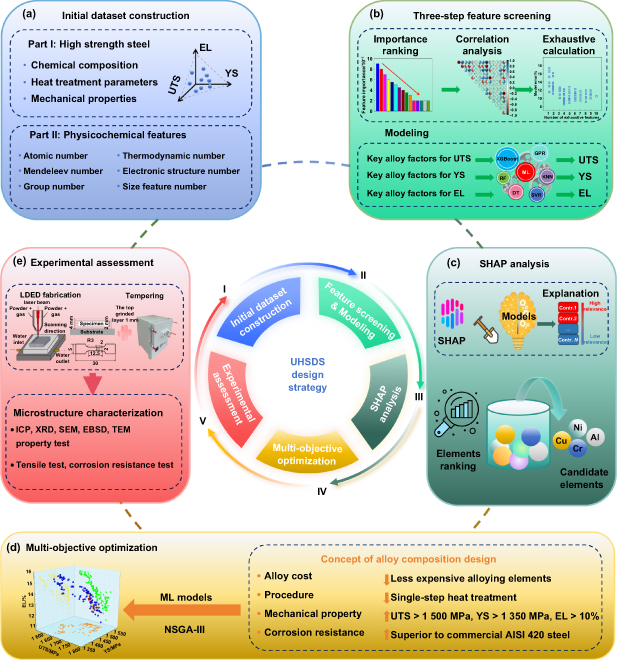
The research team employed machine learning to analyze the effects of various elements and processing conditions on steel performance. By training a model with dozens of physical and chemical parameters, they were able to predict the optimal combination of elements for their desired properties. This approach allowed them to evaluate over 80 variables, including elemental behavior and processing conditions, to design a steel alloy that balances strength, ductility, corrosion resistance, and cost.
Comparison of Traditional and AI-Designed Steel Alloys
| Property | Traditional Steel Alloys | AI-Designed Steel Alloy |
|---|---|---|
| Strength | 500-700 MPa | 900 MPa |
| Corrosion Resistance | Limited | High |
| Ductility | 10-20% | 25% |
| Production Complexity | High | Reduced |
Research and Development
The research, published in the International Journal of Extreme Manufacturing, was led by Yating Luo, Cunliang Pan, Xu Ben, Xudong An, and Hongmei Zhu from the University of South China, in collaboration with Xiaoming Wang from Purdue University. The team used laser powder bed fusion (LPBF) to 3D print the alloy and conducted mechanical and corrosion tests to validate its properties. The results demonstrate the potential of machine learning in designing optimized materials for 3D printing.
Bottom Line
The development of a new steel alloy designed specifically for 3D printing using machine learning marks a significant advancement in the field. With its high strength, corrosion resistance, and ductility, this alloy has the potential to overcome the limitations of traditional metals and enable the production of complex, high-performance parts. As research continues to push the boundaries of material design, we can expect to see further innovations in 3D printing and its applications across various industries.


