Key Takeaways
- Kratos Defense Systems has purchased an EOS AMCM M 8K metal‑additive‑manufacturing (AM) system to expand its hypersonic‑rocket production capacity in Indiana.
- Indiana’s manufacturing ecosystem—ranked #1 in U.S. steel output and the largest pharmaceutical exporter—now hosts a growing defense cluster anchored by NSWC Crane, ACMI, and WestGate@Crane.
- The AMCM M 8K offers a 1 m³ build envelope, up to 4 kW laser power, and compatibility with 40+ alloys, positioning it ahead of many legacy metal‑AM machines for large‑scale aerospace parts.
- By colocating the machine at ACMI’s WestGate@Crane Technology Park, Kratos can leverage shared R&D, workforce pipelines from Indiana University, and federal defense incentives exceeding $2 B since 2020.
Indiana’s Emerging Defense‑Manufacturing Hub
A diversified industrial base
Indiana’s manufacturing cluster spans the full value chain—from raw‑material production to finished‑goods assembly. The state leads the nation in steel production (≈ 13 Mt/yr) and ranks first in pharmaceutical export value (≈ $3.2 B in 2023).
Defense spending surge
Since 2020, Indiana has attracted more than $2 billion in defense‑related investments, driven largely by the Naval Surface Warfare Center (NSWC) Crane and the proximity of Indiana University‑Bloomington’s research talent. The WestGate@Crane Technology Park and the American Center for Manufacturing and Innovation (ACMI) provide a “one‑stop” environment for rapid prototyping, testing, and low‑rate production.
Kratos Defense’s AM Expansion Strategy
Kratos Defense Systems, a San Diego‑based contractor specializing in unmanned systems and hypersonic weapons, has long pursued “digital‑first” manufacturing to shrink development cycles. The acquisition of an EOS AMCM M 8K aligns with that roadmap:
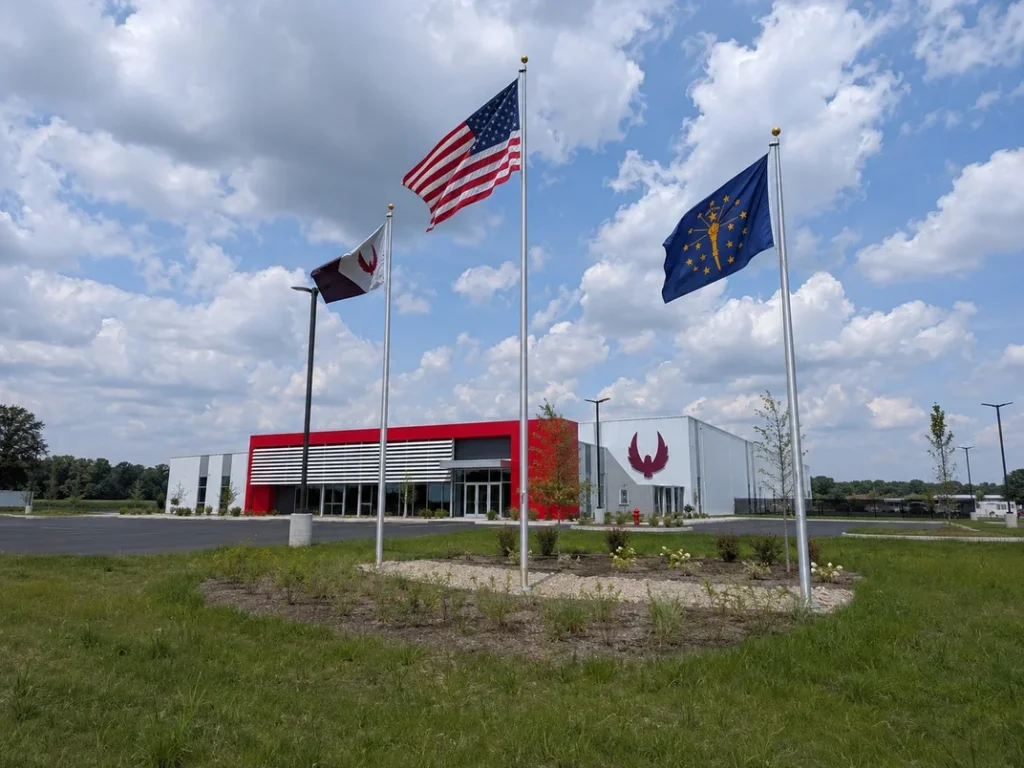
- Location: The machine will be installed at ACMI’s WestGate@Crane campus, giving Kratos immediate access to shared clean‑room facilities and a pipeline of engineering graduates.
- Application focus: Initial builds target hypersonic missile components—rocket chambers, fuel‑tank inserts, and high‑temperature nozzles—where part‑size, material performance, and build speed are critical.
EOS AMCM M 8K – Technical Snapshot
| Spec | AMCM M 8K | EOS M 290 (benchmark) | SLM‑Solutions SLM 500 |
|---|---|---|---|
| Build volume | 1 000 mm × 1 000 mm × 1 000 mm | 250 mm × 250 mm × 350 mm | 250 mm × 250 mm × 350 mm |
| Laser power | 4 kW (IPG‑YLR‑4000) | 400 W (Yb‑fiber) | 400 W (Yb‑fiber) |
| Material portfolio | 40+ alloys (Ti‑6Al‑4V, Inconel 718, 300M, AlSi10Mg) | 25 alloys (Ti‑6Al‑4V, AlSi10Mg) | 20 alloys (Stainless, AlSi10Mg) |
| Layer thickness | 20–100 µm | 20–80 µm | 20–80 µm |
| Process speed (mm³/h) | ~ 1 200 mm³/h | ~ 350 mm³/h | ~ 300 mm³/h |
| Approx. price* | $5.2 M | $3.3 M | $3.0 M |
| *List price, excludes installation & training |
*Sources: EOS product data sheets (2024), SLM‑Solutions catalog (2024).
The M 8K’s four‑times larger build envelope and higher laser power translate into fewer part‑joins, reduced post‑process machining, and a clear advantage for aerospace‑scale components.
How the Purchase Accelerates Hypersonic Production
- Scale‑up capability – Large‑volume builds enable Kratos to move from low‑rate prototyping to short‑run production without re‑tooling.
- Material performance – Access to high‑temperature alloys (e.g., Inconel 718) supports the thermal stresses of hypersonic flight.
- Supply‑chain resilience – On‑site AM reduces reliance on external foundries, aligning with the Department of Defense’s “strategic autonomy” directive.
- Talent integration – Proximity to IU‑Bloomington’s Materials Science program feeds a steady stream of skilled operators and researchers.
Bottom Line
Kratos Defense’s acquisition of the EOS AMCM M 8K marks a strategic inflection point for both the company and Indiana’s defense manufacturing ecosystem. The machine’s unprecedented build size and high‑power laser give Kratos a decisive edge in fabricating large, high‑performance hypersonic components, while the WestGate@Crane location provides a collaborative environment backed by federal investment and academic expertise. As the U.S. defense sector leans increasingly on additive manufacturing to meet rapid‑deployment timelines, Kratos’ move illustrates how a well‑positioned industrial cluster can translate capital investment into tangible capability gains.


