Key Takeaways
- Iran seized an Anduril Dive‑LD large‑diameter autonomous underwater vehicle (LD‑AUV) in September 2026.
- The platform measures 5.8 m × 12 m, weighs ≈3 t, can stay submerged for up to 10 days, and reaches 6,000 m depth.
- Its modular, 3‑D‑printed payload bay allows rapid re‑configuration for ISR, mine‑countermeasure, or other mission sets.
- The unit’s dry‑cost is estimated at US $2.5 million; sensor suites can raise the price well above US $5 million.
- U.S. officials claim the drone suffered a malfunction and was “essentially dead in the water” for more than a day before capture.
Iran Captures Anduril Dive‑LD 3‑D‑Printed Underwater Drone
Background of the Dive‑LD Platform
Anduril Industries introduced the Dive‑LD (Large‑Diameter Autonomous Undersea Vehicle) in early 2025 as a commercial‑off‑the‑shelf solution for long‑duration, deep‑water missions. The vehicle is classified as an LD‑AUV, a category that typically exceeds 1 m in hull diameter and is built for extended endurance rather than high speed.
| Specification | Anduril Dive‑LD | Typical U.S. Navy AUV (e.g., HUGIN) |
|---|---|---|
| Length / Diameter | 12 m × 5.8 m | 13 m × 5 m |
| Maximum Depth | 6,000 m | 5,500 m |
| Endurance | 10 days (continuous) | 7 days |
| Cruise Speed | 7 kn (≈13 km/h) | 5 kn |
| Dry Cost | US $2.5 M (base) | US $3.0 M (base) |
| Payload Flexibility | 3‑D‑printed modular bay (up to 2 t) | Fixed‑frame payload racks |
The Dive‑LD’s 3‑D‑printed payload compartment is a standout feature. Using high‑strength polymer‑reinforced composites, the bay can be swapped in under 4 hours, enabling operators to switch between synthetic‑aperture sonar, electro‑optical cameras, or mine‑neutralization kits without returning to a shipyard.
The Capture Incident
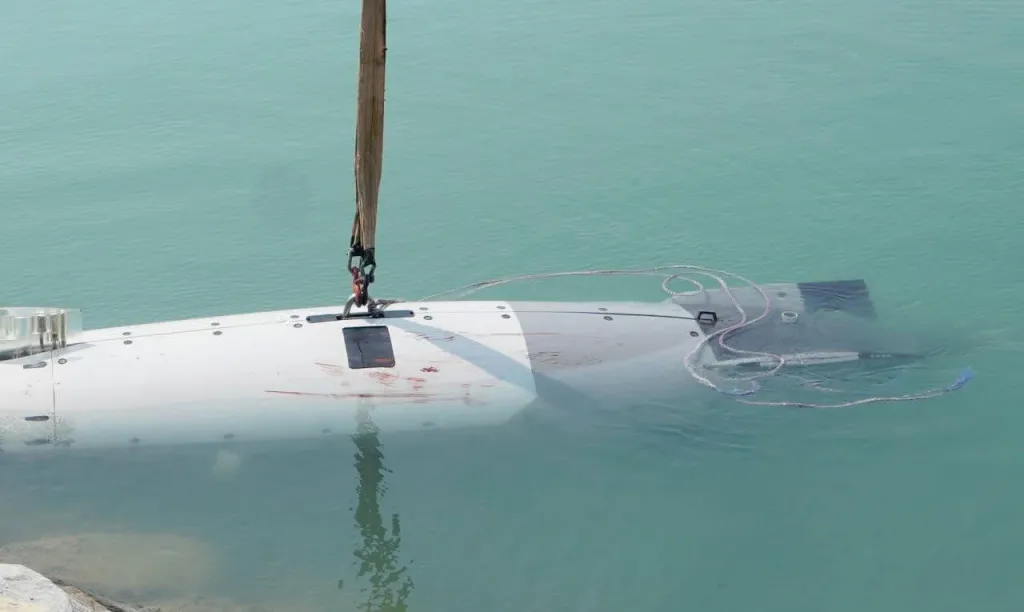
On 8 September 2026, Iranian naval forces recovered an unmanned underwater vehicle drifting near the Strait of Hormuz. Open‑source imagery shows the vehicle bearing red paint streaks consistent with an impact from a civilian tanker, rather than the grey/black antifouling coatings typical of military hulls.
U.S. defense statements describe the drone as an “older prototype” that experienced a critical systems failure, leaving it “dead in the water for more than a day.” The Navy has not disclosed whether the failure stemmed from battery depletion, software glitch, or external damage.
Technical Highlights
- Depth & Endurance: The Dive‑LD’s pressure‑vessel design, built from titanium alloy and carbon‑fiber reinforced polymer, sustains hydrostatic pressure at 6 km depth (≈ 600 atm) and supports a 10‑day mission profile on a 2 MWh lithium‑sulfur battery pack.
- Modular Payload Bay: The 3‑D‑printed section employs Selective Laser Sintering (SLS) of PEEK‑CF (polyether‑ether‑ketone with carbon fiber), delivering a tensile strength of 120 MPa and a thermal tolerance up to 250 °C—suitable for both sonar arrays and explosive ordnance disposal (EOD) tools.
- Communications: A conformal antenna array, likely fabricated via metal‑laser sintering, provides low‑frequency acoustic telemetry up to 200 km and a satellite uplink when the vehicle surfaces.
- Speed & Maneuverability: At a top speed of 7 kn, the Dive‑LD can transit between survey zones while maintaining low acoustic signatures (< 120 dB re 1 µPa).
Operational Implications
The Dive‑LD’s deep‑water endurance makes it ideal for:
- Seafloor Mapping – High‑resolution multibeam sonar can produce bathymetric maps at 0.5 m grid spacing.
- Undersea Cable Surveillance – Persistent acoustic monitoring can detect tampering attempts within a 5 km radius.
- Mine Counter‑Measure (MCM) – Swappable payloads enable rapid deployment of synthetic‑aperture sonar and mine‑neutralization drones.
Iran’s acquisition could allow it to conduct covert ISR along the Persian Gulf and Gulf of Oman, potentially compromising commercial shipping lanes or monitoring U.S. naval movements.
Comparison with Legacy Platforms
| Feature | Anduril Dive‑LD | US Navy AUV (e.g., REMUS 600) |
|---|---|---|
| Modularity | 3‑D‑printed interchangeable bays | Fixed payload racks |
| Depth Rating | 6,000 m | 4,500 m |
| Endurance | 10 days | 4 days |
| Cost (dry) | US $2.5 M | US $3.8 M |
| Launch Method | Ship‑mounted gantry or A‑frame | Ship‑deck crane |
The Dive‑LD’s lower acquisition cost and greater depth capability give it a competitive edge for civilian and allied government customers seeking long‑range undersea data collection.
Bottom Line
Iran’s seizure of an Anduril Dive‑LD AUV underscores the strategic value of deep‑water, modular unmanned platforms. While U.S. officials attribute the loss to a malfunction, the incident reveals how a single 3‑D‑printed payload bay can transform a high‑value ISR asset into a potential intelligence‑gathering tool for an adversary. With a dry price near US $2.5 million, a 10‑day endurance, and a 6,000‑meter depth envelope, the Dive‑LD


