Key Takeaways
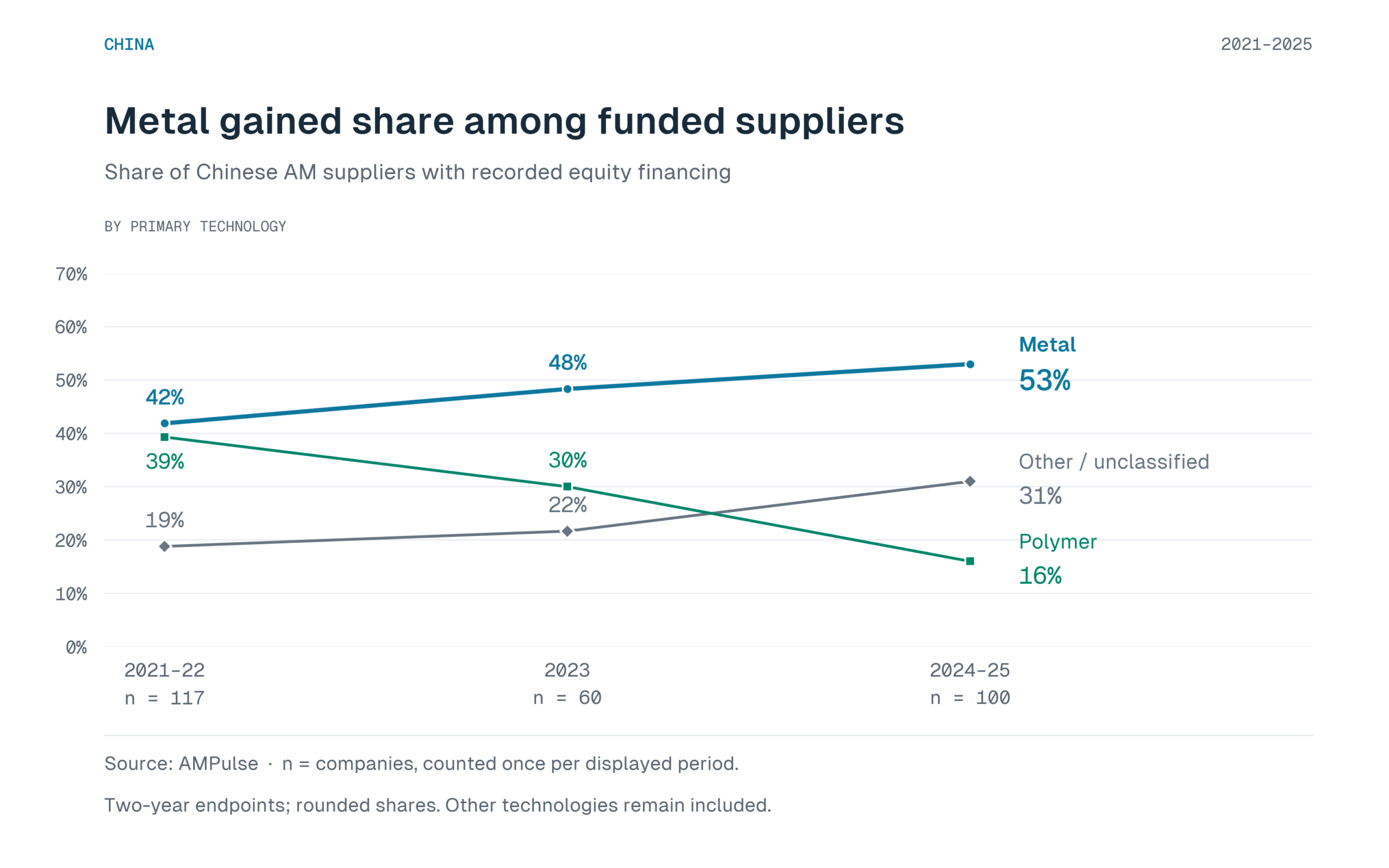
- China (2021‑2025): Metal‑based 3D‑printing firms grew from 42 % to 53 % of equity‑financed suppliers, while polymer‑focused firms fell from 39 % to 16 %.
- United States (2021‑2025): Aerospace & defense remained the dominant sector for new capital, highlighted by X‑Bow’s $105 M Series B and a strategic partnership with Lockheed Martin.
- Investor behavior: U.S. defense majors are acting as both financiers and future customers, whereas Chinese capital is increasingly directed toward metal‑additive manufacturers.
- Overall market: The number of recorded funded AM companies dropped from 117 (2021‑22) to 100 (2024‑25) in China, indicating consolidation around higher‑value metal technologies.
Overview of Funding Shifts (2021‑2025)
China: Metal Takes the Lead
AMPulse tracked equity rounds for Chinese additive‑manufacturing (AM) firms across two‑year windows:
| Period | Total funded firms | Metal‑focused | % Metal | Polymer‑focused | % Polymer | Other/Unclassified |
|---|---|---|---|---|---|---|
| 2021‑22 | 117 | 49 | 42 % | 46 | 39 % | 22 (19 %) |
| 2023 | 60 | 29 | 48 % | – | – | 31 (52 %) |
| 2024‑25 | 100 | 53 | 53 % | 16 | 16 % | 31 (31 %) |
Interpretation: Metal AM’s share rose by 11 percentage points, while polymer companies saw a 23‑point drop, suggesting investors favor the higher‑margin, aerospace‑grade metal printing market.
United States: Aerospace & Defense Remain Dominant
In the U.S., the number of funded AM companies contracted overall, yet aerospace and defense startups continued to attract sizable rounds. The most illustrative case is X‑Bow, a solid‑rocket‑motor specialist that closed a Series B in May 2025:
- Funding amount: $105 M (total U.S. funding now $97 M after prior rounds).
- Strategic tie‑up: Lockheed Martin signed a development agreement, positioning X‑Bow as an independent supplier for solid‑propellant motors. Lockheed’s role is dual‑fold—capital provider and future customer.
Other U.S. sectors (e.g., consumer‑grade polymer printers) saw a decline in new equity, reinforcing the sectoral concentration around high‑performance aerospace applications.
Drivers Behind the Divergence
Chinese Market Forces
- Industrial policy: The “Made in China 2025” roadmap prioritizes metal AM for aerospace, automotive, and heavy‑industry parts, channeling state‑backed venture capital toward metal startups.
- Supply‑chain maturity: Domestic metal powder producers (e.g., Hunan Sanhe) have scaled capacity, lowering feedstock costs from ≈ $150/kg (2021) to ≈ $110/kg (2025).
- Consolidation: Smaller polymer firms are either being acquired or exiting the market, shrinking their funding pool.
U.S. Market Forces
- Defense spending: The FY 2025 defense budget allocated $13 B for advanced manufacturing, with a specific emphasis on additive‑fabricated propulsion components.
- Customer‑investor overlap: Large OEMs such as Lockheed Martin and Boeing now routinely co‑invest in niche AM startups to secure supply‑chain resilience.
- Technology maturity: Metal laser powder bed fusion (LPBF) and directed energy deposition (DED) have reached TRL 7‑8 for aerospace parts, justifying larger capital tickets.
Comparison of Funding Trends
| Aspect | China | United States |
|---|---|---|
| Dominant technology | Metal AM (53 % of funded firms) | Aerospace‑grade metal AM (majority of capital) |
| Polymer AM trend | Decline from 39 % to 16 % | Minor, fragmented |
| Investor type | State‑linked VCs, corporate funds (e.g., China Aerospace) | Defense majors (Lockheed Martin, Boeing) and traditional VCs |
| Typical round size | $5‑15 M (seed‑Series A) | $30‑120 M (Series B‑C) |
| Strategic outcomes | Consolidation around high‑value metal parts | Vertical integration of supply & demand in defense |
Implications for CNC Milling & Hybrid Manufacturing
- Hybrid workflows that combine CNC subtractive machining with metal AM are gaining traction in China, as firms seek to finish complex metal prints with traditional milling for tighter tolerances.
- In the U.S., the surge of defense‑backed metal AM startups is prompting CNC tool‑makers (e.g., DMG Mori) to develop integrated AM‑CNC platforms, targeting aerospace certification pathways.
Bottom Line
From 2021 to 2025, Chinese additive‑manufacturing financing gravitated toward metal‑based solutions, while polymer ventures lost ground. In the United States, aerospace and defense remain the primary magnets for large‑scale equity, exemplified by X‑Bow’s $105 M Series B and its partnership with Lockheed Martin. Investors on both sides of the Pacific are aligning capital with technologies that promise high‑value, mission‑critical parts—fueling a tighter coupling of AM with traditional CNC processes and reshaping the global supply chain for advanced manufacturing.


