Key Takeaways
- Building codes and regulations play a crucial role in the future growth of 3D printed construction
- Regulatory frameworks can either hinder or accelerate the adoption of 3D printed construction methods
- Standardization and certification are essential for widespread acceptance of 3D printed buildings
- 3D printed construction can offer benefits such as increased efficiency, reduced waste, and improved sustainability
Introduction to 3D Printed Construction
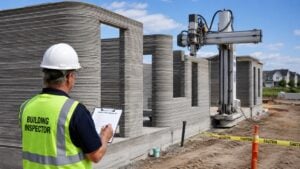
3D printed construction, also known as 3DCP, is a rapidly evolving field that involves the use of 3D printing technology to create building structures. While 3DCP has shown significant promise, its growth and adoption are heavily dependent on regulatory frameworks. In the United States, for example, the International Building Code (IBC) and the International Residential Code (IRC) set the standards for building construction.
Regulatory Challenges
One of the primary challenges facing 3DCP is the lack of standardization and certification. Currently, there is no uniform set of guidelines for 3D printed construction, making it difficult for builders to navigate the regulatory landscape. According to a report by the National Institute of Building Sciences, the lack of standardization can result in increased costs, delays, and even project abandonment. To address this issue, organizations such as the American Society for Testing and Materials (ASTM) are working to develop standards for 3D printed construction materials and methods.
Comparison of Regulatory Frameworks
The following table compares the regulatory frameworks for 3D printed construction in different countries:
| Country | Regulatory Framework | Standardization |
|---|---|---|
| United States | IBC, IRC | ASTM, ACI |
| European Union | EU Construction Products Regulation | EN 16625, EN 16757 |
| Australia | National Construction Code | AS 3700, AS 4100 |
| China | GB 50010, GB 50300 | GB/T 50300, GB/T 50924 |
Benefits of 3D Printed Construction
Despite the regulatory challenges, 3D printed construction offers several benefits, including:
- Increased efficiency: 3DCP can reduce construction time by up to 50%
- Reduced waste: 3DCP can minimize waste generation by up to 30%
- Improved sustainability: 3DCP can reduce carbon emissions by up to 20%
Bottom Line
In conclusion, building codes and regulations play a critical role in determining the future growth of 3D printed construction. While regulatory challenges exist, standardization and certification efforts are underway to address these issues. As the industry continues to evolve, it is essential to strike a balance between innovation and regulatory compliance to ensure the widespread adoption of 3D printed construction methods. With its potential to increase efficiency, reduce waste, and improve sustainability, 3DCP is poised to revolutionize the construction industry, but only if regulatory frameworks can keep pace with technological advancements.