Key Takeaways
- 55 W CO₂ laser gives the R1 a clear edge over typical 5–10 W diode units for cutting transparent acrylic and thicker substrates.
- Work envelope: 600 mm × 300 mm × 20 mm (max acrylic) – large enough for most prototyping panels.
- Auto‑Laser Alignment uses a suite of cameras and distance sensors to self‑calibrate in under 30 seconds, eliminating manual tweaks.
- Optional 3 m conveyor lets users feed continuous sheets, boosting throughput for production runs.
- Bambu Lab’s sensor‑rich architecture promises future software‑driven improvements in speed, accuracy, and material‑specific power curves.
Bambu Lab Expands From 3‑D Printing to Laser Cutting
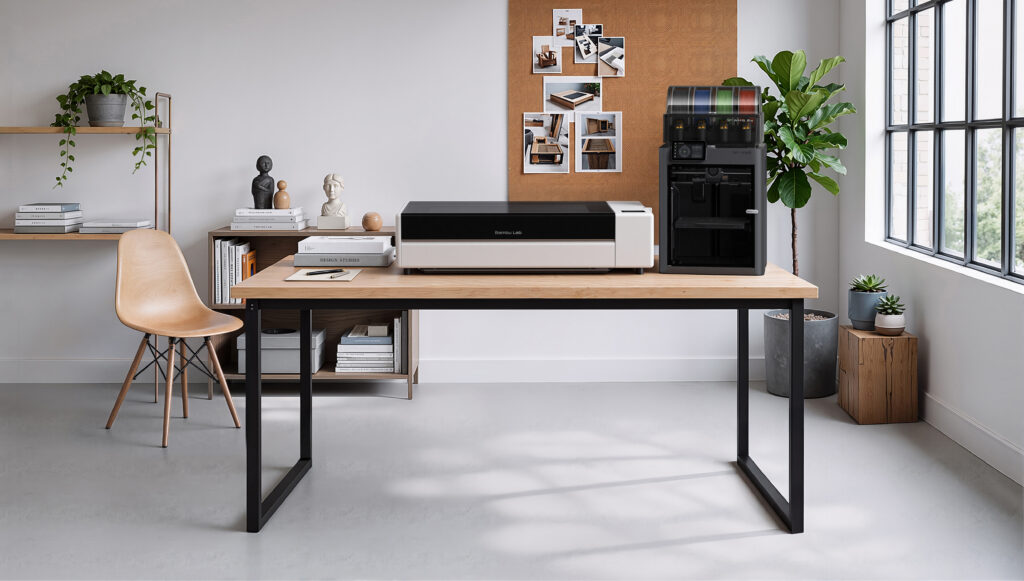
Bambu Lab, the company that disrupted the desktop 3‑D printer market with the X1, A1, and P2S families, is now launching a dedicated laser cutter – the R1. While the brand already offers hybrid machines that pair a nozzle‑based extruder with a low‑power diode laser, the R1 is the first stand‑alone unit built around a 55 W CO₂ laser tube. This shift signals a strategic move into the fast‑growing maker‑shop and low‑volume manufacturing segment.
Core Specifications
| Spec | Detail |
|---|---|
| Laser type | CO₂, 55 W continuous wave |
| Cutting area | 600 mm × 300 mm (23.6 in × 11.8 in) |
| Maximum material thickness | 18 mm plywood, 20 mm acrylic |
| Supported materials | Plywood, MDF, wood veneer, acrylic (clear & colored), leather, fabric, paper, thin glass, stone, coated metal |
| Conveyor accessory | Up to 3 000 mm (118 in) sheet feed |
| Positioning resolution | 0.01 mm (XY encoders) |
| Power modulation | 0–100 % in 0.5 % steps |
| Connectivity | Wi‑Fi, Ethernet, USB‑C |
| Software | Bambu Studio (laser module) with material library and auto‑focus |
How the R1 Differs From Typical Diode Laser Cutters
| Feature | R1 (55 W CO₂) | Common 5–10 W Diode Cutter |
|---|---|---|
| Material cut depth (acrylic) | Up to 20 mm (clear) | 2–3 mm |
| Cut quality on transparent acrylic | Clean edge, <0.1 mm kerf | Melted edges, >0.3 mm kerf |
| Power consumption | ~80 W (laser + electronics) | ~30 W |
| Safety enclosure | Integrated, interlocked | Optional add‑on |
| Auto‑calibration | Full sensor suite, <30 s | Manual alignment required |
| Throughput with conveyor | Continuous 3 m feed, 30 % faster | Not typically offered |
Sensor‑Driven Calibration – “Auto Laser Alignment”
Bambu Lab’s hallmark—camera‑assisted self‑calibration—has been ported to the R1:
| Sensor | Role |
|---|---|
| Bird’s‑Eye Camera | Monitors the entire work surface for debris and material placement. |
| Toolhead Camera | Tracks laser head trajectory in real time, enabling sub‑pixel correction. |
| Pinpoint Laser | Projects a reference dot to verify focal point before each job. |
| Distance‑Measuring Laser | Triangulates the sheet height, automatically adjusting Z‑focus. |
| XY Encoders | Provide closed‑loop positioning with 0.01 mm repeatability. |
During start‑up, the Laser Alignment Sensor scans the bed, detects any skew or focus drift, and commands the actuators to realign the head. The process typically finishes in under 30 seconds, removing the manual “paper‑test” step that plagues most hobbyist cutters.
Material‑Specific Power Curves & Future Software Updates
Because the R1 can modulate power in 0.5 % increments, Bambu Lab’s firmware can store material libraries (e.g., 55 % for 6 mm birch, 70 % for 10 mm acrylic). The sensor data collected during each cut is uploaded to the cloud, where machine‑learning models refine the optimal speed‑power combos. This approach promises progressive performance gains without hardware changes—a strategy that gave Bambu Lab its reputation for rapid iteration in 3‑D printing.
Market Position & Competitive Outlook
The desktop CO₂ market is currently dominated by Epilog Zing (40 W) and Full Spectrum Laser Muse (45 W), both priced above $7,500. Bambu Lab is targeting a sub‑$5,000 price point, leveraging its existing supply chain and in‑house firmware. If the auto‑calibration delivers the advertised time savings, the R1 could attract:
- Educational labs that lack laser‑safety expertise.
- Small‑scale manufacturers needing a fast feed system for sheet‑metal prototypes.
- Makerspaces that already own Bambu 3‑D printers and want an integrated workflow.
Bottom Line
Bambu Lab’s R1 laser cutter translates the company’s self‑calibrating DNA from 3‑D printing into a 55 W CO₂ platform capable of cutting thick acrylic, plywood, and a range of soft materials with minimal user intervention. The combination of a sizable 600 × 300 mm bed, a 3 m conveyor, and a sensor‑rich auto‑alignment system positions the R1 as a compelling, cost‑effective alternative to higher‑priced industrial CO₂ units. For makers, educators, and low‑volume manufacturers seeking reliable, plug‑and‑play laser cutting, the R1 could become the new benchmark—provided Bambu Lab delivers on its promised software updates and maintains its aggressive pricing.


