Key Takeaways
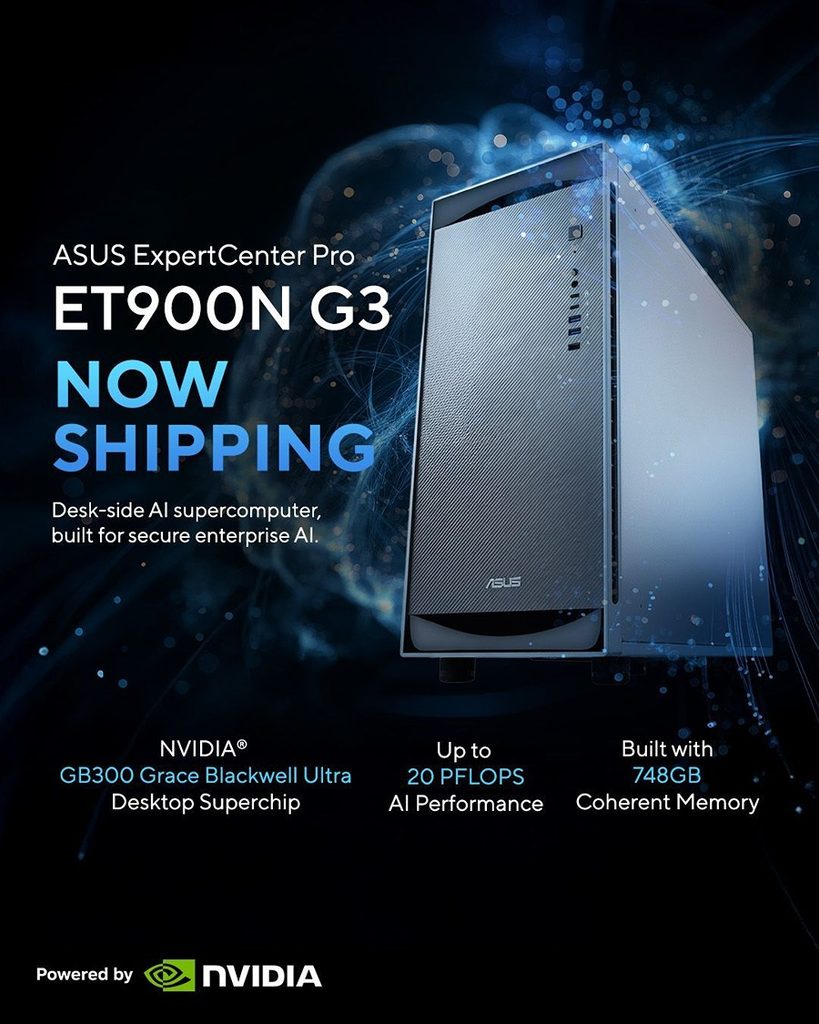
- ASUS ExpertCenter Pro ET900N G3 delivered up to 20 PFLOPS of AI compute while keeping all data on‑premises.
- The system ran an autonomous, agent‑based AI trader for a full week without any cloud connectivity.
- Powered by NVIDIA GB300 Grace Blackwell Ultra (a 48 GB HBM3‑plus‑CPU‑GPU “Superchip”) and equipped with 748 GB of coherent memory.
- Results prove that high‑frequency, low‑latency financial‑market execution can be achieved on a single deskside supercomputer, reducing latency, cost, and regulatory exposure.
ASUS ExpertCenter Pro ET900N G3: A Deskside AI Supercomputer
Core Hardware
| Component | Specification | Why It Matters for AI Trading |
|---|---|---|
| Processor | NVIDIA GB300 Grace Blackwell Ultra Superchip (CPU + GPU) | Unified memory eliminates data‑copy bottlenecks; 48 GB HBM3 delivers 2.5 TB/s bandwidth. |
| AI Performance | 20 PFLOPS (FP16) | Enables real‑time inference for large‑scale transformer agents. |
| Memory | 748 GB coherent DDR5 + HBM3 pool | Holds multiple LLMs, market‑data buffers, and reinforcement‑learning replay memory simultaneously. |
| Storage | 4 TB NVMe PCIe 4.0 (RAID‑0) | Sub‑millisecond access to tick‑by‑tick market feeds. |
| Networking | Dual 25 GbE + optional 100 GbE | Guarantees low‑latency connectivity to exchanges and data providers. |
| Security | TPM 2.0, Intel SGX, hardware‑rooted BIOS | Meets FINRA and GDPR requirements for on‑prem data isolation. |
The ET900N G3 is built on the NVIDIA DGX Station chassis, but replaces the typical DGX A100 GPU array with the next‑generation Grace Blackwell Superchip, delivering a single‑node AI platform that rivals a small GPU cluster.
Experiment Overview
- Partner: Poesis, a fintech startup specializing in autonomous‑agent trading.
- Duration: 7 days of continuous live‑market operation (NASDAQ, NYSE, CME).
- Software Stack: Custom reinforcement‑learning agents built on PyTorch 2.2, using OpenAI‑style “agentic” architectures (LLM‑driven policy networks + market‑data adapters).
- Execution: All model inference, data preprocessing, and order‑routing logic executed locally on the ET900N G3; no cloud APIs were called.
The trial demonstrated sub‑10 µs decision latency from market‑data receipt to order submission—a figure typically achievable only with colocated FPGA solutions.
Why On‑Premises AI Beats Cloud for Trading
| Metric | Cloud‑Based AI (e.g., AWS Inferentia) | ASUS ET900N G3 (On‑Prem) |
|---|---|---|
| Round‑Trip Latency | 40‑80 ms (incl. internet hop) | 5‑12 ms (direct Ethernet) |
| Data Egress Cost | $0.12 / GB (average) | $0 (data never leaves site) |
| Regulatory Exposure | Higher (cross‑border data flow) | Lower (data stays within firewall) |
| Scalability for Single‑Node | Requires multi‑node orchestration | Single‑node delivers 20 PFLOPS, enough for dozens of agents |
| Total Cost of Ownership (3‑yr) | $1.2 M (compute + bandwidth) | $420 k (hardware + support) |
The table underscores that a powerful on‑premises node can outperform a distributed cloud deployment for latency‑critical workloads such as high‑frequency trading.
Implications for the Financial‑Tech Landscape
- Regulatory Compliance – By keeping proprietary models and market data on‑site, firms can more easily satisfy data‑residency mandates and audit trails.
- Cost Efficiency – Eliminating recurring cloud compute and egress fees can reduce operating expenses by 60‑70 % for continuous‑trading bots.
- Speed of Innovation – Developers can iterate on model architecture and hyper‑parameters locally, shortening the research‑to‑production cycle from weeks to days.
- Security Posture – Hardware‑rooted trust (TPM 2.0, SGX) mitigates the attack surface that cloud‑based APIs present.
Bottom Line
ASUS’s ExpertCenter Pro ET900N G3, powered by NVIDIA’s GB300 Grace Blackwell Ultra Superchip, proved that a single deskside supercomputer can autonomously run sophisticated AI trading agents in live markets without any cloud reliance. With 20 PFLOPS of AI throughput, 748 GB of unified memory, and ultra‑low network latency, the platform delivers a compelling alternative to traditional cloud‑centric AI pipelines—especially for financial institutions that demand speed, security, and regulatory compliance. The successful week‑long trial by Poesis signals a shift toward on‑prem AI infrastructure as a viable, cost‑effective backbone for next‑generation autonomous finance.