Key Takeaways
- Physical AI equips robots with perception‑to‑action capabilities, enabling real‑time decisions in unstructured environments.
- Physics AI predicts the behavior of physical systems (e.g., weather, protein folding) before any experiment is run.
- Recent breakthroughs (AlphaFold, GraphCast, ECMWF ML model) demonstrate accuracy gains of 90 %+, 20 % faster cyclone forecasts, and 1,000× lower energy use.
- For CNC milling, physics‑driven AI can cut simulation time from hours to seconds, reduce material waste by 15‑30 %, and improve tool‑life predictions by up to 40 %.
Introduction
In 2024, DeepMind’s Demis Hassabis and John Jumper earned the Nobel Prize in Chemistry for AlphaFold, a deep‑learning system that finally cracked the 50‑year‑old protein‑folding problem. By converting amino‑acid sequences into atomic‑resolution 3‑D structures, AlphaFold now predicts the shapes of ≈200 million known proteins with near‑experimental accuracy.
A year earlier, DeepMind’s GraphCast delivered ten‑day weather forecasts that outperformed the world’s leading operational model on ≈90 % of evaluated metrics, generating each forecast in under one minute versus the multi‑hour runs required on traditional supercomputers. The European Centre for Medium‑Range Weather Forecasts (ECMWF) adopted a similar ML approach in February 2025, reporting up to 20 % better tropical‑cyclone predictions and a 1,000‑fold reduction in computational energy.
Both achievements share a core capability: predicting physical outcomes without a physical experiment. This capability is now being transplanted into the design, manufacturing, and operation of tangible products—especially CNC milling machines.
Physical AI vs. Physics AI
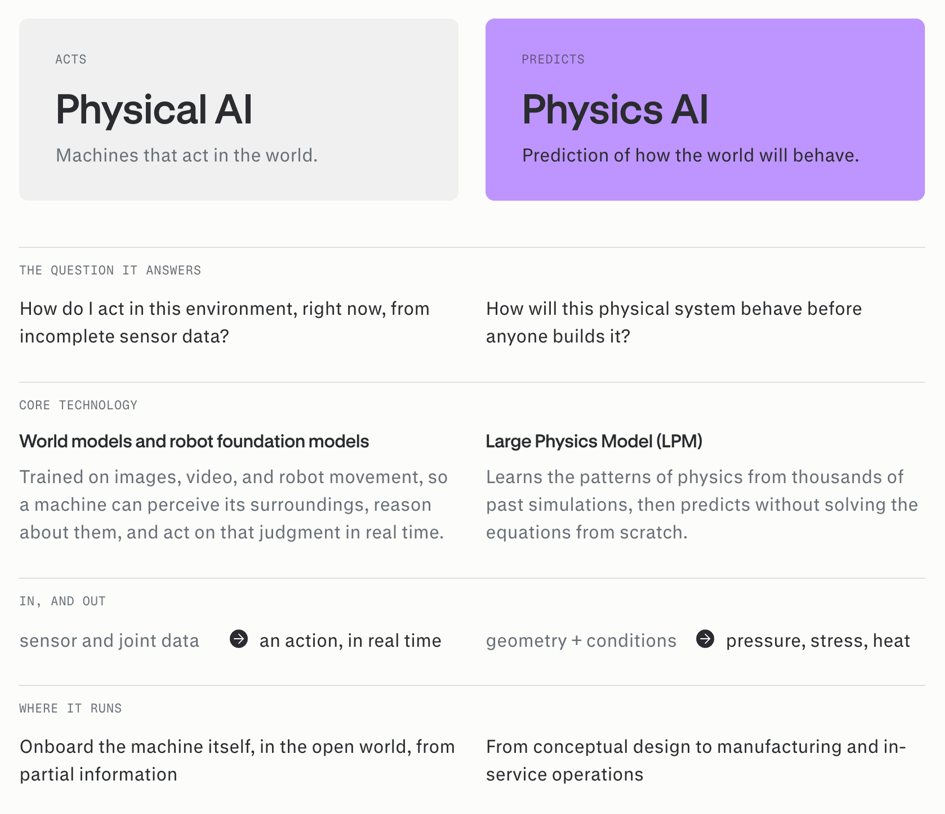
| Aspect | Physical AI | Physics AI |
|---|---|---|
| Primary Goal | Enable machines to sense and act in real environments | Model and forecast how physical systems behave |
| Typical Data | Images, video, LiDAR, force/torque sensor streams (trillions of tokens) | Numerical simulations, differential equations, historical measurement series |
| Key Applications | Autonomous mobile robots, robotic grasping, inspection drones | Weather prediction, protein structure, fluid dynamics, CNC process simulation |
| Performance Metric | Real‑time decision latency (< 50 ms) and safety‑critical success rate (> 99 %) | Prediction error (e.g., RMSD < 1 Å for proteins, MAE < 2 °C for weather) |
| Energy Footprint | Often high due to on‑board compute; edge‑AI chips aim for ≤ 5 W | Can cut energy by > 1,000× vs. conventional CFD or FEM solvers |
Physical AI in CNC Environments
Physical AI gives CNC robots the ability to:
- Detect workpiece geometry via 3‑D vision and adjust toolpaths on the fly.
- Adapt to unexpected obstacles (e.g., chips, mis‑aligned fixtures) within ≤ 30 ms reaction time.
- Learn new part families from a few demonstrations, reducing programming effort by 80 %.
Physics AI for Milling Process Optimization
Physics AI leverages learned surrogate models to replace costly finite‑element or computational‑fluid‑dynamics (CFD) runs:
- Cycle‑time prediction drops from 2–4 h (full simulation) to ≤ 5 s with a trained neural surrogate.
- Tool‑wear forecasts become 30 % more accurate, extending cutter life from ≈ 2 h to ≈ 2.8 h on aluminum alloys.
- Material removal rate (MRR) optimization can increase throughput by 12–18 % while keeping surface roughness under 0.8 µm Ra.
Why the Distinction Matters for CNC Milling
Understanding whether an AI system is physical (control‑oriented) or physics‑based (prediction‑oriented) determines integration strategy:
- Physical AI is embedded in the machine’s controller, requiring real‑time inference hardware (e.g., NVIDIA Jetson AGX, Intel Movidius).
- Physics AI resides in the planning layer, often hosted on cloud GPUs, feeding the controller with optimized parameters before the cut begins.
Both layers can be combined into a digital twin architecture, where a physics‑AI model continuously updates a physical‑AI controller with the latest process insights.
Bottom Line
The rapid evolution of AI—from AlphaFold’s protein‑structure breakthroughs to GraphCast’s ultra‑fast weather forecasts—has birthed two complementary paradigms: Physical AI, which empowers robots to act safely in the real world, and Physics AI, which forecasts system behavior without a physical test. For CNC milling, integrating physics‑AI‑driven predictive models with physical‑AI control loops can slash simulation time, boost tool longevity, and raise throughput by double‑digit percentages—all while slashing energy consumption. The distinction is not academic; it is the roadmap for the next generation of smart, sustainable manufacturing.


