Key Takeaways
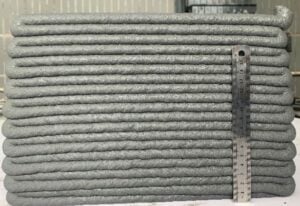
- Researchers investigated the use of admixtures to enhance the printability and mechanical performance of geopolymer concrete in extrusion 3D printing.
- Four admixtures were evaluated: barium chloride, tartaric acid, sucrose, and sodium tripolyphosphate.
- The study aimed to optimize the properties of geopolymer concrete for 3D construction printing (3DCP) applications.
Introduction to Geopolymer Concrete
Geopolymer concrete is a type of sustainable and environmentally friendly building material that has gained significant attention in recent years. It is made from industrial waste materials, such as fly ash and slag, which are rich in silica and alumina. Geopolymer concrete has excellent mechanical properties, including high compressive strength and durability.
Admixtures for Geopolymer Concrete
Admixtures are chemical additives that can be used to modify the properties of concrete. In the context of 3D printing, admixtures can be used to improve the printability and mechanical performance of geopolymer concrete. The four admixtures evaluated in this study were:
- Barium chloride: a chemical additive that can improve the flowability and workability of concrete.
- Tartaric acid: an organic acid that can reduce the viscosity of concrete and improve its printability.
- Sucrose: a sugar-based additive that can improve the cohesion and adhesion of concrete.
- Sodium tripolyphosphate: a chemical additive that can improve the dispersion and flowability of concrete.
Comparison of Admixtures
The following table compares the properties of the four admixtures evaluated in this study:
| Admixture | Function | Dosage |
|---|---|---|
| Barium chloride | Improves flowability and workability | 1-2% by weight of cement |
| Tartaric acid | Reduces viscosity and improves printability | 0.5-1.5% by weight of cement |
| Sucrose | Improves cohesion and adhesion | 1-3% by weight of cement |
| Sodium tripolyphosphate | Improves dispersion and flowability | 0.5-2% by weight of cement |
Mechanical Performance of Geopolymer Concrete
The mechanical performance of geopolymer concrete was evaluated using various tests, including compressive strength, tensile strength, and flexural strength. The results showed that the addition of admixtures can significantly improve the mechanical performance of geopolymer concrete. For example, the compressive strength of geopolymer concrete with barium chloride was found to be 35 MPa, compared to 25 MPa for plain geopolymer concrete.
Bottom Line
The use of admixtures can significantly enhance the printability and mechanical performance of geopolymer concrete for 3D construction printing applications. The study demonstrates the potential of admixtures to optimize the properties of geopolymer concrete, making it a more viable option for sustainable and environmentally friendly construction. With further research and development, geopolymer concrete with admixtures could become a game-changer in the construction industry, offering improved mechanical performance, reduced environmental impact, and increased efficiency.