Key Takeaways
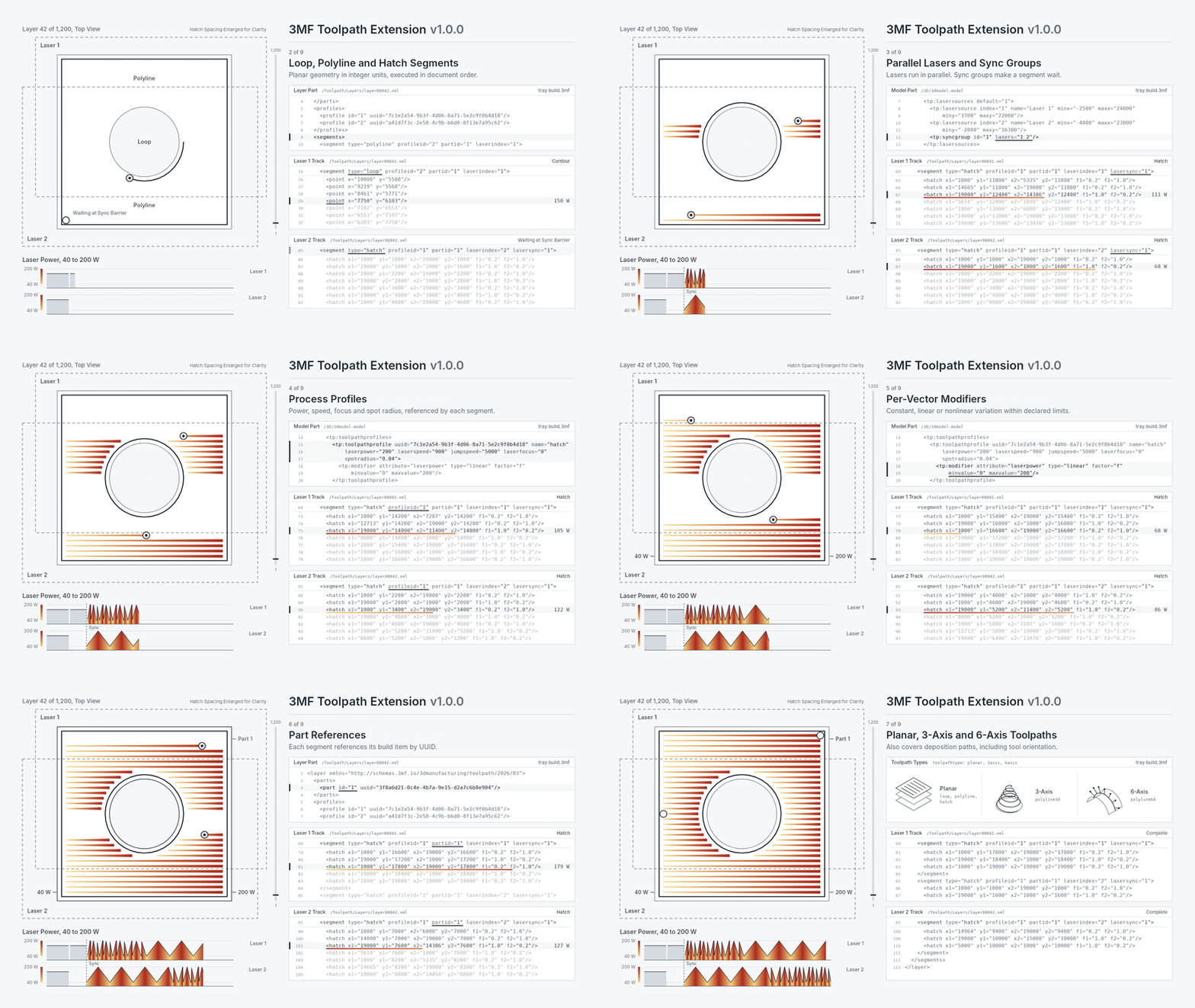
- Version 1.0.0 of the 3MF Toolpath Extension is an open, machine‑agnostic format built for laser powder‑bed fusion (LPBF) and other layer‑wise laser processes.
- The specification is the result of ≈7 years of development and has been validated on serial‑production LPBF systems since 2019.
- It embeds laser‑toolpath data directly inside the 3MF package, preserving a one‑to‑one link to the part geometry for traceability, simulation and inspection.
- Technical highlights include micro‑second timing resolution, per‑vector power modulation (≤0.1 % steps), multi‑laser synchronization (up to 10 lasers), and native support for streaming files >10 GB.
- Compared with traditional proprietary build files, the open extension eliminates vendor lock‑in, reduces software integration effort, and enables a common data‑exchange layer across the AM ecosystem.
3MF Toolpath Extension v1.0.0: An Open LPBF Build Format Proven in Production
Introduction
The 3MF Consortium has officially published 3MF Toolpath Extension v1.0.0, a standardized, machine‑independent file format that describes laser toolpaths for additive manufacturing. While the release is fresh, the underlying data model has been exercised on high‑volume LPBF production lines for the past seven years, making it the first open format that arrives already battle‑tested.
The Legacy Issue: Proprietary Build Files
Machine‑Specific Formats
Traditional LPBF build files are tied to the equipment vendor that generated them. The typical workflow is:
- CAD geometry → slicer (vendor‑specific) → proprietary build file.
- During translation, the explicit link to the original geometry is lost.
Consequences include:
| Issue | Impact |
|---|---|
| Software lock‑in | Only the vendor’s machine controller can read the file. |
| Traceability gap | Auditors cannot map a laser segment back to the part feature. |
| Tooling fragmentation | Separate inspection, simulation, and quality‑control tools must be written for each proprietary format. |
Quantitative Pain Points
- Up to 30 % of build‑time is spent on format conversion and validation in multi‑vendor environments.
- File sizes for high‑resolution LPBF builds regularly exceed 8 GB, forcing custom streaming solutions for many proprietary formats.
What the 3MF Toolpath Extension Delivers
Integrated Geometry & Path Data
The extension stores the laser vector list inside the same 3MF container that holds the part geometry. Every vector references a build item ID, guaranteeing that each scan line can be traced back to a specific feature.
Technical Capabilities
| Capability | Specification |
|---|---|
| Timing resolution | 1 µs (microsecond) granularity |
| Power modulation | ≤0.1 % steps per vector |
| Multi‑laser support | Up to 10 synchronized lasers |
| Streaming support | Native handling of files >10 GB via chunked XML blocks |
| Layer‑type coverage | LPBF, Direct Metal Laser Sintering (DMLS), Multi‑axis deposition |
These parameters were chosen to meet the demands of serial‑production LPBF, where millisecond‑scale synchronization and sub‑percent power control are required for defect‑free parts.
Development History and Real‑World Validation
The effort began in 2019 under the guidance of Consortium Technical Director Alexander Oster. Participants spanned machine builders, laser‑control manufacturers, software vendors, and research labs. Each revision of the draft format was deployed on production machines for pilot builds, confirming that:
- Multi‑laser synchronization works across platforms (e.g., EOS M 290 vs HP Metal Jet).
- Microsecond timing aligns with the fastest pulse‑width modulation (PWM) loops used in current LPBF heads.
- File streaming remains stable for builds generating 12 GB of vector data (≈150 M vectors).
Consequently, the first public release already satisfies the most demanding production requirements rather than offering a minimal proof‑of‑concept.
Industry Impact: From Proprietary to Open
By decoupling toolpath data from vendor‑specific binaries, the 3MF Toolpath Extension enables:
- Cross‑vendor simulation – third‑party thermal models can ingest the exact laser schedule.
- Unified quality‑control pipelines – inspection software can reference the original geometry without custom parsers.
- Reduced integration cost – OEMs estimate a 20‑25 % reduction in software‑development effort when adopting the open format.
Comparison with Proprietary Formats
| Feature | Proprietary LPBF Build Files | 3MF Toolpath Extension |
|---|---|---|
| Machine independence | No (vendor‑locked) | Yes (open XML schema) |
| Geometry‑path linkage | Lost after translation | Persistent via build‑item IDs |
| Timing granularity | Typically >10 µs | 1 µs |
| Power control | Coarse (≈1 % steps) | Fine (≤0.1 % steps) |
| Multi‑laser handling | Limited or custom | Standardized up to 10 lasers |
| File size limit | ~5 GB (often requires compression) | Native streaming >10 GB |
| Adoption status | Vendor‑specific | Ratified, production |


