Key Takeaways
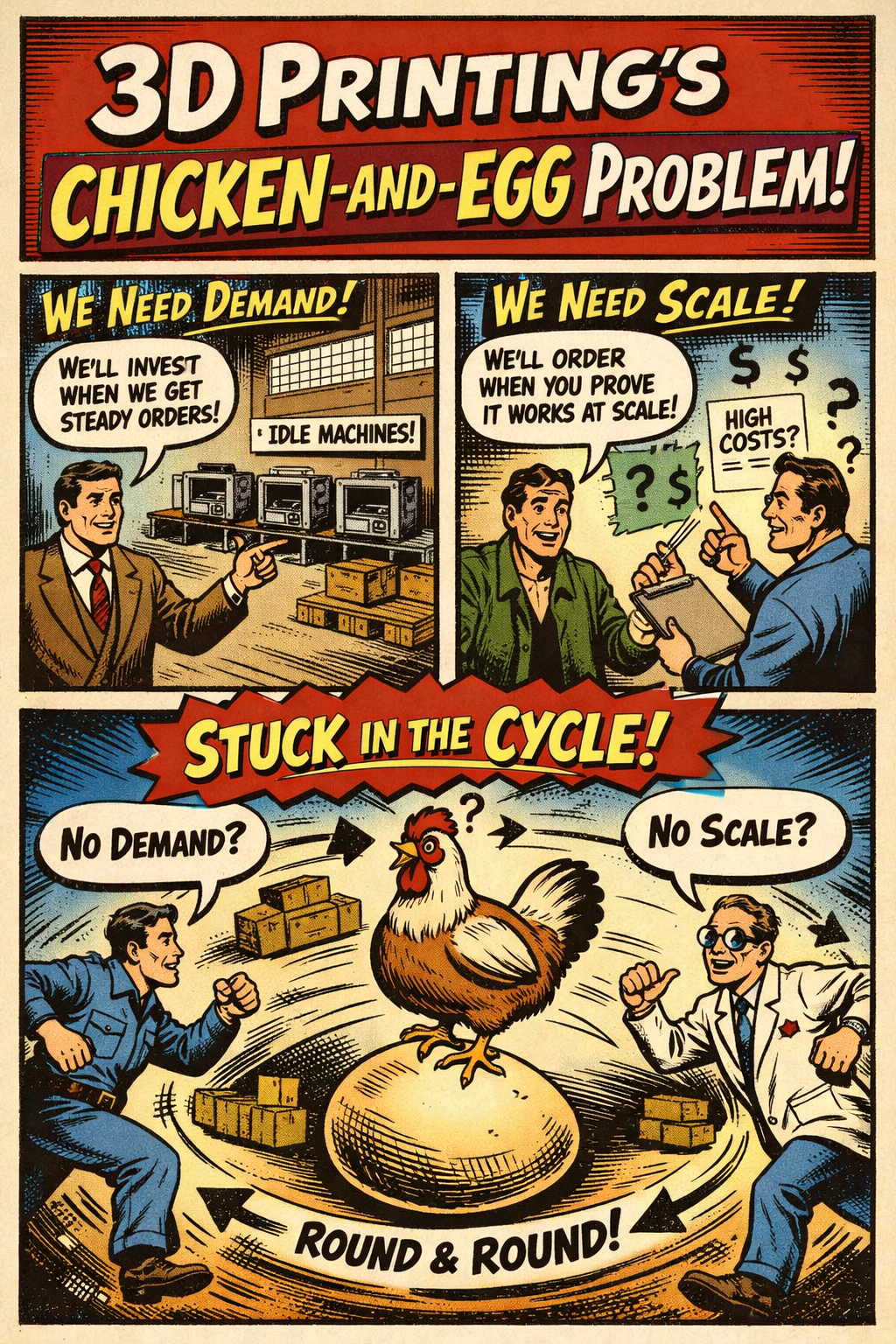
- The 3D printing industry faces a chicken-and-egg problem, where companies wait for demand to scale up and customers wait for proof of scalability.
- Manufacturers require reliability, cost-effectiveness, and consistency at scale before adopting 3D printing.
- 3D printing companies need committed customers to justify investments in equipment and production workflows.
- The aerospace industry has adopted 3D printing for specific parts, but scaling up to full production lines requires time, certification, and long-term proof.
Introduction to the Problem
The 3D printing industry is hindered by a fundamental issue: the lack of demand and scalability. Companies are hesitant to invest in additive manufacturing without a steady demand, while customers are waiting for proof of scalability before committing to the technology. This creates a vicious cycle, where both sides wait for the other to make the first move.
Waiting for Proof
Manufacturers require more than just the knowledge that 3D printing works. They need to be convinced that the technology can produce parts that meet their standards consistently, without disruptions, and at a predictable cost. This level of confidence can only be achieved by seeing the technology in action at scale. However, this is exactly the problem, as companies are not willing to scale up without a guarantee of demand.
Waiting for Demand
On the other hand, 3D printing companies need committed customers to justify investments in equipment, production workflows, and personnel. Without a steady demand, it is challenging to lower costs, improve efficiency, and prove long-term reliability. This creates a stalemate, where suppliers wait for customers to commit, and customers wait for suppliers to scale up.
Comparison of 3D Printing Technologies
| Technology | Scalability | Cost-Effectiveness | Reliability |
|---|---|---|---|
| Fused Deposition Modeling (FDM) | Medium | High | Medium |
| Stereolithography (SLA) | Low | Low | High |
| Selective Laser Sintering (SLS) | High | Medium | High |
Industry Examples
The aerospace industry is a prime example of this dynamic. Companies like Boeing and Airbus have adopted 3D printing for specific parts, such as rotor systems and flex shafts. However, scaling up to full production lines requires significant investments in time, certification, and long-term proof. For instance, Boeing's use of 3D printing in the production of the Apache helicopter's rotor system has shown promising results, with a 30% reduction in production time and a 25% decrease in costs.
Bottom Line
The 3D printing industry's chicken-and-egg problem is a significant hurdle to widespread adoption. To overcome this, companies must be willing to take risks and invest in the technology, while customers must be willing to commit to the technology and provide the necessary demand. With the right balance of scalability, cost-effectiveness, and reliability, 3D printing can reach its full potential and become a mainstream manufacturing technology. As the industry continues to evolve, it is essential to address this problem and create a virtuous cycle of demand and scalability.