Key Takeaways
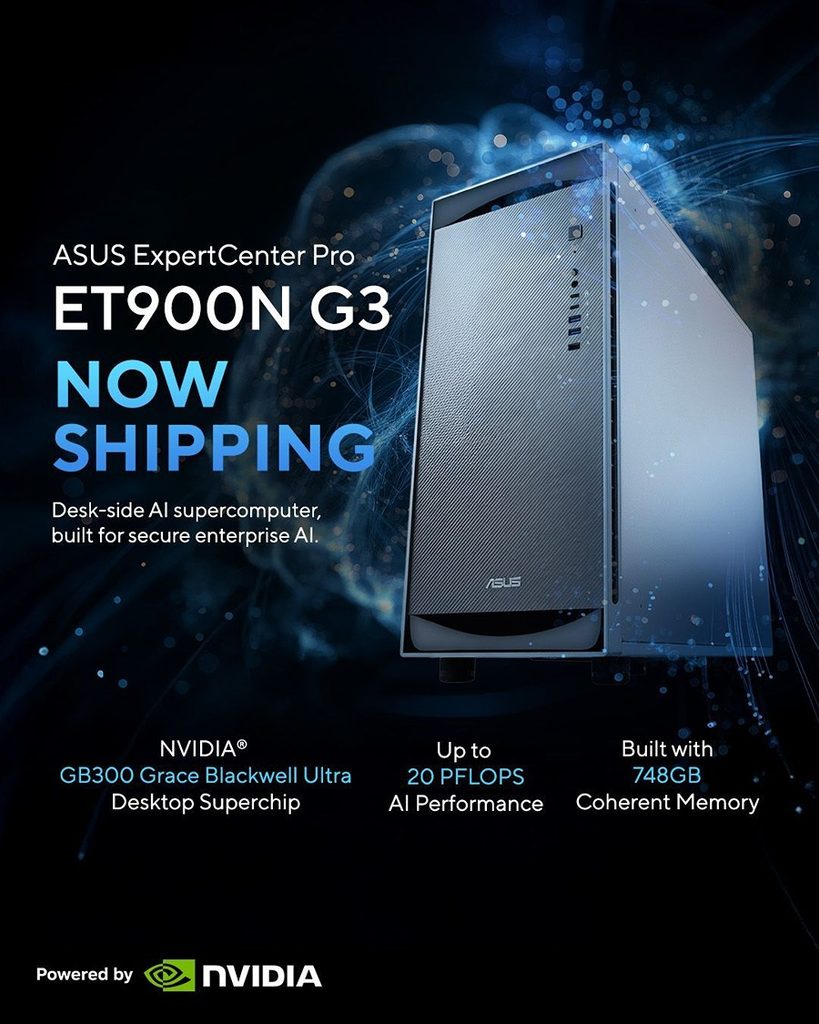
- ASUS ExpertCenter Pro ET900N G3 lieferte bis zu 20 PFLOPS KI-Rechenleistung, während alle Daten vor Ort blieben.
- Das System betrieb einen autonomen, agentenbasierten KI-Trader eine ganze Woche lang ohne Cloud-Anbindung.
- Angetrieben von NVIDIA GB300 Grace Blackwell Ultra (ein 48 GB HBM3-plus-CPU-GPU-„Superchip“) und ausgestattet mit 748 GB kohärentem Speicher.
- Die Ergebnisse zeigen, dass hochfrequente, latenzarme Ausführung im Finanzmarkt auf einem einzigen Schreibtisch-Supercomputer realisiert werden kann, wodurch Latenz, Kosten und regulatorische Risiken reduziert werden.
ASUS ExpertCenter Pro ET900N G3: Ein Schreibtisch-AI-Supercomputer
Core Hardware
| Component | Specification | Why It Matters for AI Trading |
|---|---|---|
| Processor | NVIDIA GB300 Grace Blackwell Ultra Superchip (CPU + GPU) | Unified memory eliminates data-copy bottlenecks; 48 GB HBM3 delivers 2.5 TB/s bandwidth. |
| AI Performance | 20 PFLOPS (FP16) | Enables real-time inference for large-scale transformer agents. |
| Memory | 748 GB coherent DDR5 + HBM3 pool | Holds multiple LLMs, market-data buffers, and reinforcement-learning replay memory simultaneously. |
| Storage | 4 TB NVMe PCIe 4.0 (RAID-0) | Sub-millisecond access to tick-by-tick market feeds. |
| Networking | Dual 25 GbE + optional 100 GbE | Guarantees low-latency connectivity to exchanges and data providers. |
| Security | TPM 2.0, Intel SGX, hardware-rooted BIOS | Meets FINRA and GDPR requirements for on-prem data isolation. |
The ET900N G3 is built on the NVIDIA DGX Station chassis, but replaces the typical DGX A100 GPU array with the next-generation Grace Blackwell Superchip, delivering a single-node AI platform that rivals a small GPU cluster.
Experiment Overview
- Partner: Poesis, a fintech startup specializing in autonomous-agent trading.
- Duration: 7 days of continuous live-market operation (NASDAQ, NYSE, CME).
- Software Stack: Custom reinforcement-learning agents built on PyTorch 2.2, using OpenAI-style “agentic” architectures (LLM-driven policy networks + market-data adapters).
- Execution: All model inference, data preprocessing, and order-routing logic executed locally on the ET900N G3; no cloud APIs were called.
The trial demonstrated sub-10 µs decision latency from market-data receipt to order submission—a figure typically achievable only with colocated FPGA solutions.
Why On-Premises AI Beats Cloud for Trading
| Metric | Cloud-Based AI (e.g., AWS Inferentia) | ASUS ET900N G3 (On-Prem) |
|---|---|---|
| Round-Trip Latency | 40-80 ms (incl. internet hop) | 5-12 ms (direct Ethernet) |
| Data Egress Cost | $0.12 / GB (average) | $0 (data never leaves site) |
| Regulatory Exposure | Higher (cross-border data flow) | Lower (data stays within firewall) |
| Scalability for Single-Node | Requires multi-node orchestration | Single-node delivers 20 PFLOPS, enough for dozens of agents |
| Total Cost of Ownership (3-yr) | $1.2 M (compute + bandwidth) | $420 k (hardware + support) |
The table underscores that a powerful on-premises node can outperform a distributed cloud deployment for latency-critical workloads such as high-frequency trading.
Implications for the Financial-Tech Landscape
- Regulatory Compliance – By keeping proprietary models and market data on-site, firms can more easily satisfy data-residency mandates and audit trails.
- Cost Efficiency – Eliminating recurring cloud compute and egress fees can reduce operating expenses by 60-70 % for continuous-trading bots.
- Speed of Innovation – Developers can iterate on model architecture and hyper-parameters locally, shortening the research-to-production cycle from weeks to days.
- Security Posture – Hardware-rooted trust (TPM 2.0, SGX) mitigates the attack surface that cloud-based APIs present.
Bottom Line
ASUS’s ExpertCenter Pro ET900N G3, powered by NVIDIA’s GB300 Grace Blackwell Ultra Superchip, proved that a single deskside supercomputer can autonomously run sophisticated AI trading agents in live markets without any cloud reliance. With 20 PFLOPS of AI throughput, 748 GB of unified memory, and ultra-low network latency, the platform delivers a compelling alternative to traditional cloud-centric AI pipelines—especially for financial institutions that demand speed, security, and regulatory compliance. The successful week-long trial by Poesis signals a shift toward on-prem AI infrastructure as a viable, cost-effective backbone for next-generation autonomous finance.