Key Takeaways
- Only 5 % of custom AI pilots in manufacturing move beyond the testing phase (MIT NandA report).
- Design‑for‑Manufacturing (DFM) delivers the highest ROI for large OEMs because it couples large financial impact with minimal change‑management overhead.
- Enterprises that prioritize DFM see millions of dollars saved per design tweak and can justify seven‑figure AI investments.
- Existing historical data—standards, past part geometry, and expert judgments—make DFM an “AI‑ready” problem with near‑zero data‑collection cost.
Why Most AI Pilots Stall in Production
Misaligned Scope Is the Core Issue
Large manufacturers often launch AI projects without a crystal‑clear problem definition. Teams try to solve every bottleneck at once, leading to under‑estimated effort and resources. When a pilot works for a single department, scaling it to thousands of engineers becomes a cultural and technical hurdle.
The MIT Study Highlights the Risk
A recent MIT NandA analysis found that just 5 % of bespoke AI pilots ever reach full‑scale deployment. The study attributes the low success rate primarily to scope creep and insufficient alignment between the AI model and the actual manufacturing workflow.
DFM: The High‑Impact, Low‑Effort AI Entry Point
1. Massive Payoff, Small Change‑Management Footprint
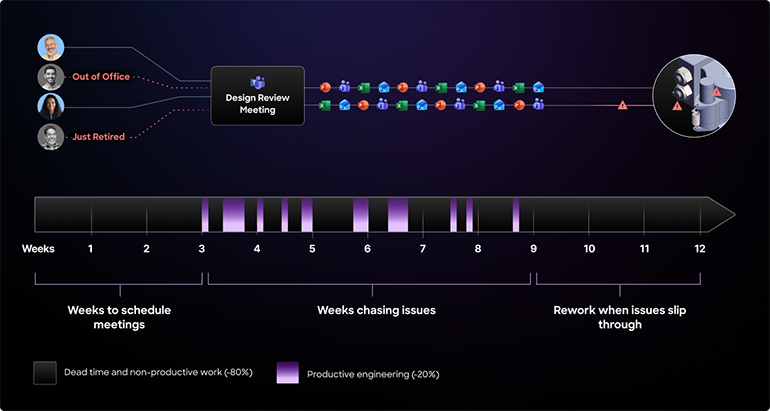
At enterprise volumes, a modest redesign—such as adjusting a rib thickness by 0.2 mm—can shave $1–$3 M off tooling and scrap costs. Because DFM reviews already exist in most product development cycles, integrating AI assistance requires only a software overlay rather than a wholesale process overhaul.
2. Solves a Problem That Grows With Scale
In multi‑plant, globally distributed organizations, manual compliance checks become increasingly error‑prone. AI‑driven DFM can enforce design standards consistently across all sites, reducing non‑conformities by up to 30 % in pilot programs.
3. Data Is Already in the Vault
Decades of engineering change orders, part libraries, and tolerance specifications provide a rich training set. Companies can train models on hundreds of thousands of historical part files without costly data‑gathering initiatives.
Real‑World Evidence
| Company | AI Focus | Investment | DFM Ranking | Reported Savings |
|---|---|---|---|---|
| Global Tier‑1 OEM | AI‑enhanced DFM | US$1.2 M (7‑figure) | Top‑5 priority | US$4 M annual reduction in re‑work |
| European Heavy‑Machinery Maker | General AI pilot | US$300 K | Not a priority | Pilot stalled at 12 % adoption |
| Asian Automotive Supplier | Rule‑based DFM | US$150 K | Mid‑level | US$2 M saved in first year |
Sources: Company disclosures, internal case studies, MIT NandA report.
How to Turn DFM Into a P&L‑Positive AI Project
- Define a Narrow Success Metric – e.g., reduce “design‑to‑tool” time by 15 % for a specific product family.
- Leverage Existing CAD Data – ingest past part files, tolerance stacks, and cost‑to‑make data into a centralized repository.
- Pilot Within One Design Review Loop – embed an AI suggestion engine into the existing DFM checklist for a single engineering team.
- Measure Financial Impact Immediately – track tooling cost, scrap rate, and cycle‑time changes per design iteration.
- Scale Gradually – once the pilot hits the predefined KPI, replicate the workflow across additional product lines.
Bottom Line
For large manufacturers, the smartest first AI investment is not a sprawling, ambiguous pilot but a tightly scoped DFM initiative. The combination of substantial cost avoidance, readily available data, and minimal disruption to existing processes makes DFM the most reliable pathway to turn AI from a curiosity into a profit‑center. Start small, measure hard, and let the numbers drive the expansion—your engineering organization will thank you.


