Key Takeaways
- Siemens + Bosch delivers a fully automated workflow that extracts blocked‑force models in hours instead of days.
- Measurement time for Frequency‑Response Functions (FRFs) drops by ≈ 93 % versus conventional manual testing.
- The solution follows ISO 20270 for blocked‑force extraction and feeds directly into Simcenter virtual‑prototyping.
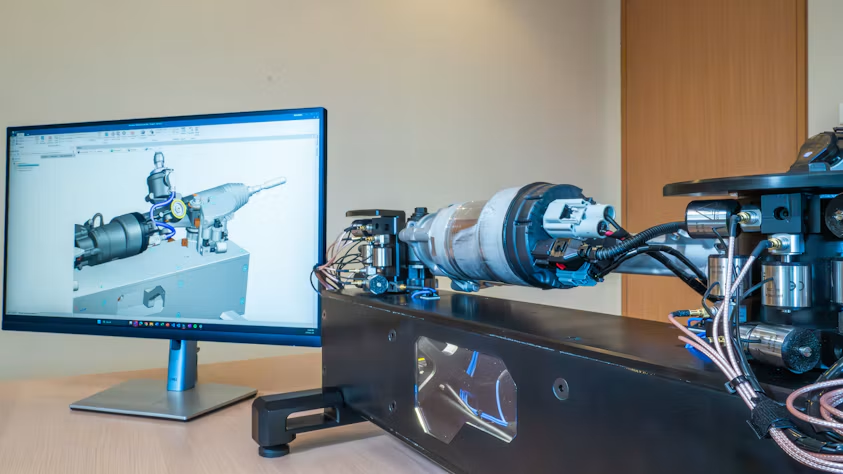
- A self‑measuring fixture equipped with permanently mounted shakers, accelerometers and a control unit removes operator‑dependent variability.
- Re‑usable, simulation‑ready component models accelerate system‑level NVH validation and cut the need for physical prototypes.
Introduction
Siemens has introduced an end‑to‑end hardware‑software package that automates the creation of NVH (Noise, Vibration, Harshness) component models. Developed together with Bosch’s predictiveVIA technology, the system industrialises blocked‑force extraction per ISO 20270, enabling engineers to generate high‑fidelity models for virtual testing in a fraction of the time required by traditional manual approaches.
Why Traditional Component Characterisation Is a Bottleneck
| Aspect | Conventional Manual Process | Siemens‑Bosch Automated Workflow |
|---|---|---|
| Measurement duration | 1 – 3 days per component (≈ 8‑24 h of bench time) | 2 – 4 h (≈ 93 % reduction) |
| Operator involvement | Highly skilled technician required for set‑up, data acquisition, and post‑processing | Operator‑independent; fixture self‑measures |
| Repeatability | Subject to human error; variability up to ± 5 % in FRF amplitudes | Consistent within ± 0.5 % across runs |
| Data format | Raw data often needs manual conversion before CAE import | Direct export to Simcenter Testlab/SCADAS, simulation‑ready |
| Scalability | Limited; each new variant requires full re‑test | Fixture accommodates multiple variants with minimal re‑calibration |
The manual route typically involves repetitive mounting of shakers, manual wiring of amplifiers, and painstaking alignment of virtual‑point adapters. These steps not only consume time but also introduce inconsistencies that propagate through downstream simulations, increasing uncertainty in system‑level NVH predictions.
Architecture of the Automated Solution
1. Self‑Measuring Test Fixture
- Rigid virtual‑point adapters serve as repeatable excitation points.
- Integrated shakers (max 5 kN, 0‑5 kHz bandwidth) and high‑resolution accelerometers (≤ 0.01 g noise floor) are permanently mounted.
- The fixture is calibrated once and remains unchanged for all subsequent component tests.
2. Automation Control Unit
- A dedicated PLC‑based controller drives the shakers through a high‑power amplifier (up to 2 kW per channel).
- Real‑time data acquisition is handled by a 24‑bit ADC, synchronized with the shaker drive signals.
3. Simcenter Software Stack
- Simcenter Testlab orchestrates test sequences, performs FRF extraction, and applies ISO 20270‑compliant blocked‑force calculations.
- Simcenter SCADAS provides the hardware interface and real‑time monitoring.
- Simcenter for Qsources integrates the generated component models into system‑level NVH simulations, supporting both test‑based and CAE‑based representations of parts such as electric motors, gearboxes, and structural sub‑assemblies.
4. Data Flow
- Operator selects component variant in the Simcenter UI.
- Control unit automatically executes the predefined excitation sweep (typically 20 Hz‑5 kHz, 5 dB steps).
- FRFs are computed on‑the‑fly and stored in a simulation‑ready database (XML/JSON).
- Engineers import the model into virtual‑prototype studies without further processing.
Impact on Development Cycles
- Lead‑time compression: Early‑stage digital twins can be validated within a single workday, enabling rapid design iterations.
- Prototype reduction: Siemens estimates up to 30 % fewer physical prototypes for NVH‑critical systems, translating into material savings of > 200 kg per vehicle program.
- Cost efficiency: At an average labor rate of US $80 h⁻¹, the 93 % time reduction yields ≈ US $1,200 saved per component test, not counting downstream simulation savings.
Bottom Line
Siemens’ automated component model extraction, built on Bosch’s predictiveVIA platform, transforms NVH characterization from a labor‑intensive, error‑prone activity into a fast, repeatable, and fully traceable process. By slashing FRF measurement time by roughly 93 % and delivering simulation‑ready models that comply with ISO 20270, the solution empowers OEMs and suppliers to accelerate virtual validation, lower prototype counts, and bring quieter, more refined products to market faster.