Key Takeaways
- Oak Ridge National Laboratory (ORNL) has developed a hybrid 3D printing method to create large, foldable structures using origami-inspired principles.
- The process combines material science with transformative design principles to improve manufacturing efficiency and scalability.
- The method can reduce manufacturing time by 95% and costs by 90% compared to traditional methods.
- ORNL has patented the process and aims to license it out to manufacturers across industries.
Introduction to Hybrid 3D Printing
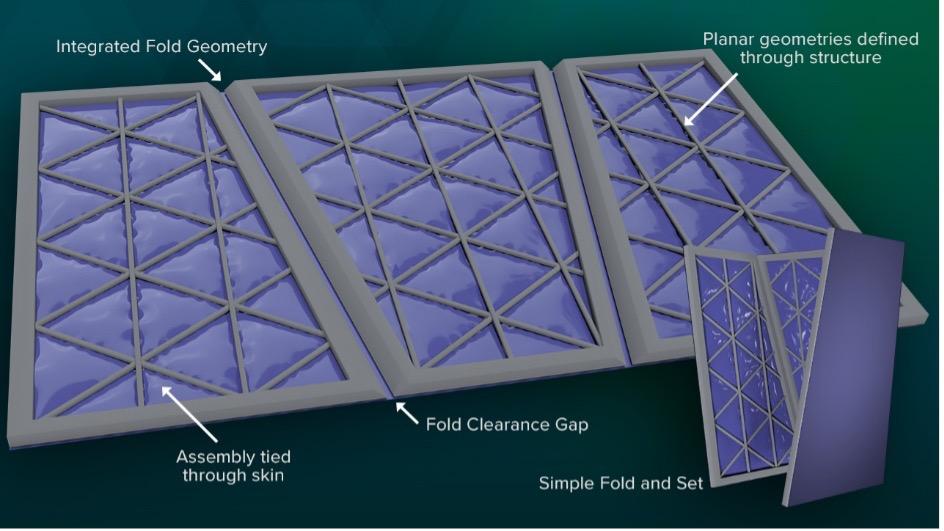
The Oak Ridge National Laboratory (ORNL) has made a significant breakthrough in the field of 3D printing by developing a hybrid method that enables the creation of large, foldable structures. This innovative approach combines material science with transformative design principles, inspired by the art of origami. By fusing these two disciplines, researchers at ORNL's Manufacturing Demonstration Facility (MDF) have successfully turned composite panels into durable, foldable structures.
The Hybrid 3D Printing Process
The process begins with a fabric layer, such as nylon, glass fiber, or resin-infused composite fibers. This is followed by an integration or bonding layer, typically thermoplastic polyurethane, to ensure compatibility and adhesion. The reinforcing layer is then applied using deposited composite materials, including thermoplastic carbon-fiber acrylonitrile butadiene styrene (ABS) for lightweight structural performance or thermoset formulations like styrene-based or epoxy-based resins for enhanced stiffness and durability. The materials bond at the molecular level, forming a strong connection between the grid and the outer layer.
Comparison of Hybrid 3D Printing Methods
| Method | Material | Manufacturing Time Reduction | Cost Reduction |
|---|---|---|---|
| Traditional 3D Printing | Limited to single materials | 0% | 0% |
| Hybrid 3D Printing (ORNL) | Composite materials | Up to 95% | Up to 90% |
| Other Additive Manufacturing Methods | Various materials | Up to 50% | Up to 50% |
Benefits and Future Applications
According to Steven Guzorek, a researcher at ORNL, this pioneering method has the potential to redefine advanced manufacturing by achieving forms unattainable with traditional additive approaches. The goal is to make this innovation scalable, empowering manufacturers to explore new design possibilities and unlock entirely new applications for this transformative technology. With the potential to reduce manufacturing time and costs significantly, this hybrid 3D printing method could have a major impact on various industries, including aerospace, automotive, and construction.
Bottom Line
In conclusion, the Oak Ridge National Laboratory's hybrid 3D printing method has the potential to revolutionize the manufacturing industry by enabling the creation of large, foldable structures with improved efficiency and scalability. With its ability to reduce manufacturing time by 95% and costs by 90%, this innovative approach could have a significant impact on various industries, making it an exciting development in the field of additive manufacturing. As ORNL aims to license out this technology, we can expect to see widespread adoption and further innovation in the years to come.


