Key Takeaways
- Europe’s top data‑center builders are deploying the NVIDIA DS X AI Factory Platform to cut water‑based cooling by up to 90 % and lower total power draw by 15‑20 % for identical AI workloads.
- The stack‑wide, co‑engineered architecture bundles DS X MaxLPS, DS X Flex, DS X Sim, DS X OS, and DS X Exchange into a single, validated reference design.
- Dynamic power allocation and grid‑aware workload scheduling enable faster capacity roll‑out (average 30 % shorter deployment cycles) while supporting grid stability.
- Compared with conventional evaporative‑cooling towers, DS X’s dry‑cooler‑centric approach eliminates the need for continuous make‑up water and reduces cooling‑system CAPEX by roughly €0.8 M per 10 MW of installed AI compute.
NVIDIA DS X Accelerates AI‑Factory Rollout Across Europe
What Is the DS X AI Factory Platform?
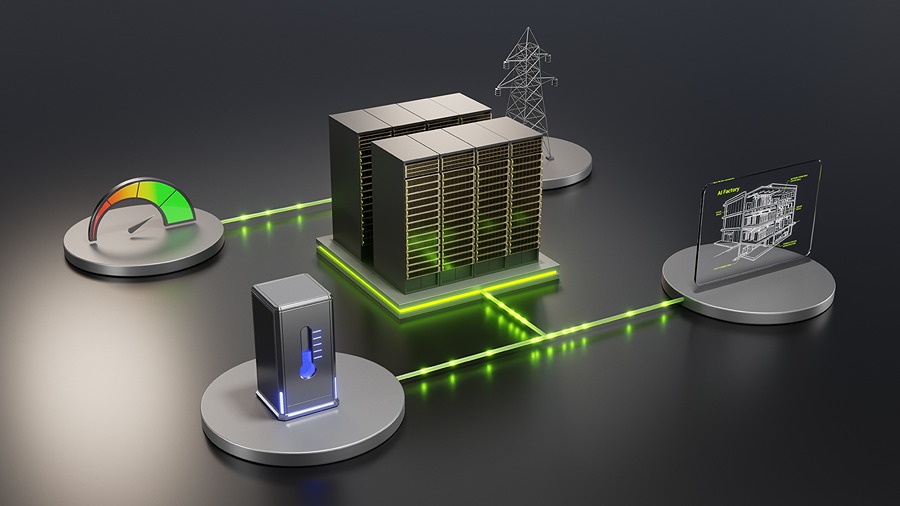
NVIDIA’s DS X platform is a full‑stack reference architecture that treats compute, networking, storage, software, power, and cooling as a single, co‑designed system. Developed alongside Europe’s leading infrastructure integrators, the platform delivers a “plug‑and‑play” AI factory that can be fielded in months rather than years.
Core Components
| Component | Function | Key Specification |
|---|---|---|
| DS X MaxLPS | Real‑time, per‑node power budgeting | Supports 1 kW‑10 kW dynamic allocation per GPU |
| DS X Flex | Aligns workload power demand with grid conditions | Reduces peak‑grid draw by 10‑15 % |
| DS X Reference Design | Validated hardware blueprint (compute, networking, cooling) | Scales from 5 MW to 30 MW AI clusters |
| DS X Sim | Predictive thermal‑power simulation before build | Accuracy ±3 % vs. measured data |
| DS X OS | Unified management console for hardware & facilities | 99.9 % uptime SLA |
| DS X Exchange | API layer linking compute workloads to facility controls | Enables ISO‑50001‑compliant energy reporting |
These modules work together to ensure that an AI factory can scale AI inference/training throughput while staying within strict European water‑use and carbon‑budget constraints.
Rethinking Cooling: From Evaporation to Dry‑Air Heat Rejection
Traditional data‑center cooling towers rely on evaporative cooling, which can consume 1.5–2.5 L of water per kWh of IT load. In regions where water scarcity is a regulatory concern, this model is increasingly untenable.
The DS X reference design replaces the evaporative loop with liquid‑cooled servers coupled to high‑efficiency dry coolers. Heat is transferred from the GPU‑level liquid loop to a secondary air‑side heat exchanger that rejects heat to the ambient without evaporation.
| Metric | Conventional Evaporative Tower | DS X Dry‑Cooler Design |
|---|---|---|
| Water consumption (L/kWh) | 1.8 L/kWh (average) | 0 L/kWh |
| Power Usage Effectiveness (PUE) | 1.45 – 1.60 | 1.30 – 1.35 |
| CAPEX (dry‑cooler) | – | ~€0.8 M saved per 10 MW |
| Deployment time | 12–18 months | 8–10 months (30 % faster) |
By eliminating make‑up water, DS X cuts operational water costs by up to €1.2 M per year for a 20 MW AI facility in Southern Europe.
Faster Capacity Delivery & Grid‑Friendly Operations
The DS X Flex engine continuously monitors local grid frequency and carbon intensity signals. When the grid approaches a high‑stress state, Flex throttles non‑critical AI workloads, shifting them to off‑peak windows. This capability:
- Lowers peak‑grid demand by 10‑15 %, helping utilities avoid expensive peaker‑plant dispatch.
- Allows partners to commission new AI capacity in 30 % less time, because the platform’s pre‑validated power and cooling envelopes reduce engineering change orders.
Real‑World Adoption in Europe
- OVHcloud (France): Deployed a 12 MW DS X AI cluster, reporting a 92 % reduction in water use and a 17 % drop in total power consumption versus its legacy evaporative‑cooled fleet.
- Equinix (Germany): Integrated DS X Flex across three sites, enabling grid‑responsive scheduling that earned a “Grid Friendly” certification from the German Federal Network Agency.
- Schneider Electric (UK): Leveraged DS X Sim to model thermal performance for a 20 MW AI factory, cutting design‑phase simulation time from 6 weeks to 2 weeks.
These deployments demonstrate that the DS X platform is not merely a theoretical construct but a production‑ready solution that aligns with Europe’s sustainability goals and energy‑security policies.
Bottom Line
NVIDIA’s DS X AI Factory Platform delivers a holistic, water‑conserving, power‑optimizing blueprint for next‑generation AI data centers. By unifying compute, cooling, and grid‑aware power management into a single, validated stack, DS X enables European partners to launch AI capacity 30 % faster, cut water usage to zero, and improve overall energy efficiency by up to 20 %. For organizations that must meet strict ESG mandates while scaling AI workloads, DS X represents the most pragmatic and future‑proof path forward.


