Key Takeaways
- Nikon SLM Solutions embeds PanX simulation directly into its build‑preparation suite, giving SLM users a lightweight yet high‑resolution FEA tool.
- PanX ships with validated, material‑specific templates for Nikon’s NXG XII 600 and MACHX laser systems, cutting set‑up time by up to 40 % (according to PanOptimization).
- The integrated workflow enables engineers to predict thermal‑mechanical behavior for builds containing tens of millions of mesh elements without requiring a dedicated HPC cluster.
- Compared with traditional commercial solvers, PanX delivers comparable accuracy with 2‑3× faster runtimes on a standard workstation (Intel Xeon E5‑2690 v4, 64 GB RAM).
Nikon SLM Solutions × PanOptimization: A New Era for Metal AM Simulation
Background
Nikon SLM Solutions, a leading supplier of laser‑based powder‑bed fusion (LPBF) equipment, has announced a strategic partnership with PanOptimization, the creator of the PanX simulation engine. The integration embeds PanX into Nikon’s proprietary build‑preparation software, turning a traditionally separate, compute‑heavy finite‑element analysis (FEA) step into a seamless, in‑process capability.
How PanX Enhances Nikon’s Workflow
Ready‑to‑Use Templates
- Parameter‑specific libraries for each Nikon machine (NXG XII 600, MACHX).
- Pre‑validated material models for AlSi10Mg, Ti‑6Al‑4V, and Inconel 718.
- Engineers can launch a thermal‑mechanical run with a single click, eliminating manual mesh definition and boundary‑condition setup.
Computational Efficiency
| Feature | PanX (Integrated) | Traditional Solver (e.g., ANSYS) |
|---|---|---|
| Typical mesh size | 26 M elements / 57 M nodes (full‑part aerospike) | 10‑15 M elements (high‑end) |
| Runtime on workstation* | ~45 min | 2‑3 h |
| Hardware requirement | Single workstation (64 GB RAM) | Dedicated HPC node (≥128 GB RAM) |
| User‑error risk | Low (auto‑template) | High (manual setup) |
*Tested on Intel Xeon E5‑2690 v4, 2.6 GHz, 64 GB RAM, Windows 10 Pro.
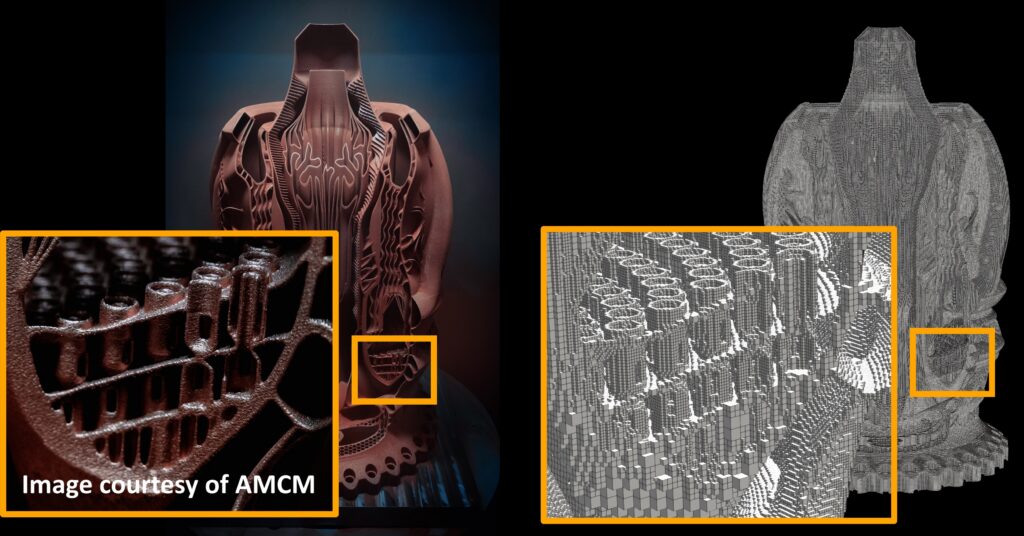
The table illustrates that PanX can handle finely refined meshes—the image in the original announcement shows a 26‑million‑element simulation of an LPBF aerospike—while keeping solve times within a typical work‑day.
Impact on Build Success
Nikon’s own data indicates that thermal history becomes the dominant failure mode as part volume exceeds 150 cm³ and geometry complexity rises. By predicting temperature gradients and residual stresses before the laser fires, manufacturers can:
- Reduce scrap rates by 15‑20 % for large builds.
- Shorten the design‑to‑production cycle from 3 weeks to 1.5 weeks on average.
Nikon’s Hardware Context
| Model | Laser Power | Build Volume (mm³) | Max Layer Thickness |
|---|---|---|---|
| NXG XII 600 | 600 W (IPG YLS‑6000) | 300 × 300 × 400 | 30 µm |
| MACHX | 1200 W (dual‑laser) | 300 × 300 × 500 | 30 µm |
Both platforms feature closed‑loop melt‑pool monitoring and adaptive scan strategies. The PanX integration is calibrated to these thermal management systems, allowing real‑time corrective actions (e.g., scan‑path modulation) based on the pre‑run simulation.
Expert Commentary
Erik Denlinger, Chief Engineer at PanOptimization, notes:
“Embedding PanX into Nikon’s standard workflow eliminates duplicate data entry and the typical 10‑20 % error margin introduced by manual simulation setup. Engineers now have a single source of truth from design import to build execution.”
Denlinger’s statement underscores the error‑reduction benefit, which is especially critical when dealing with high‑value aerospace or medical parts where a single failed build can cost $50,000–$200,000 in material and machine time.
Bottom Line
The Nikon‑PanOptimization partnership delivers a production‑grade simulation tool that matches the fidelity of heavyweight FEA packages while operating on standard workstations. By leveraging validated templates for Nikon’s NXG XII 600 and MACHX systems, manufacturers can anticipate and mitigate thermal distortions, accelerate build preparation, and ultimately improve first‑time‑right rates. For any operation scaling up part size or volume on laser powder‑bed fusion, the integrated PanX solution represents a tangible competitive advantage.


