Key Takeaways
- Mastrex offers six metal LPBF (laser powder‑bed fusion) printers starting at $39,000.
- The company recently validated its powder feedstock with Continuum Powders, a U.S. specialist.
- Design and spec sheets of the MX‑series closely mirror three Tianhong (China) machines, raising questions about the true “Made‑in‑USA” claim.
- Mastrex operates from a shared office in New Jersey and may have a secondary site in San Diego, but no public factory address has been disclosed.
- If the firm scales, its volume could rival the combined output of other low‑cost LPBF players such as OneClick, Metal Base, and Scraplabs.
Is Mastrex Truly an American‑Made Metal 3D Printer?
Background: The Low‑Cost LPBF Wave
Since Xact Metal demonstrated that laser powder‑bed fusion (LPBF) could be built for under $100 k, a new generation of affordable metal printers has emerged. Companies like OneClick (selling units for $45 k), Metal Base (sub‑$30 k prototypes), and Scraplabs (open‑source kits) have expanded market accessibility. In this context, Mastrex’s entry with a six‑model lineup priced from $39 k is strategically timed.
The Mastrex‑Continuum Partnership
In August 2026, Mastrex announced a validation program with Continuum Powders—a U.S. supplier that certifies powder chemistry for aerospace and medical standards. The joint press release confirmed that Continuum’s Ti‑6Al‑4V, 316L stainless steel, and Inconel 625 powders meet the ASTM F2924 specifications when processed on Mastrex machines. This collaboration lends credibility to the claim that the printers can reliably handle certified U.S. powders.
Where Are the Machines Built?
- Corporate address: 120 Washington Ave, Suite 210, Newark, NJ – a co‑working space managed by Axe Prime.
- Possible second site: A San Diego mailing address appears on some warranty paperwork, but no manufacturing floor has been publicly shown.
- Supply chain clues: Bill of Materials (BOM) filings submitted to the U.S. International Trade Commission list imported laser modules, galvanometer scanners, and motion‑control rails sourced from Chinese OEMs (e.g., Tianhong Laser).
These facts suggest that while the final assembly and software integration may occur stateside, core hardware components are likely sourced overseas.
Design Parallels with Tianhong (China)
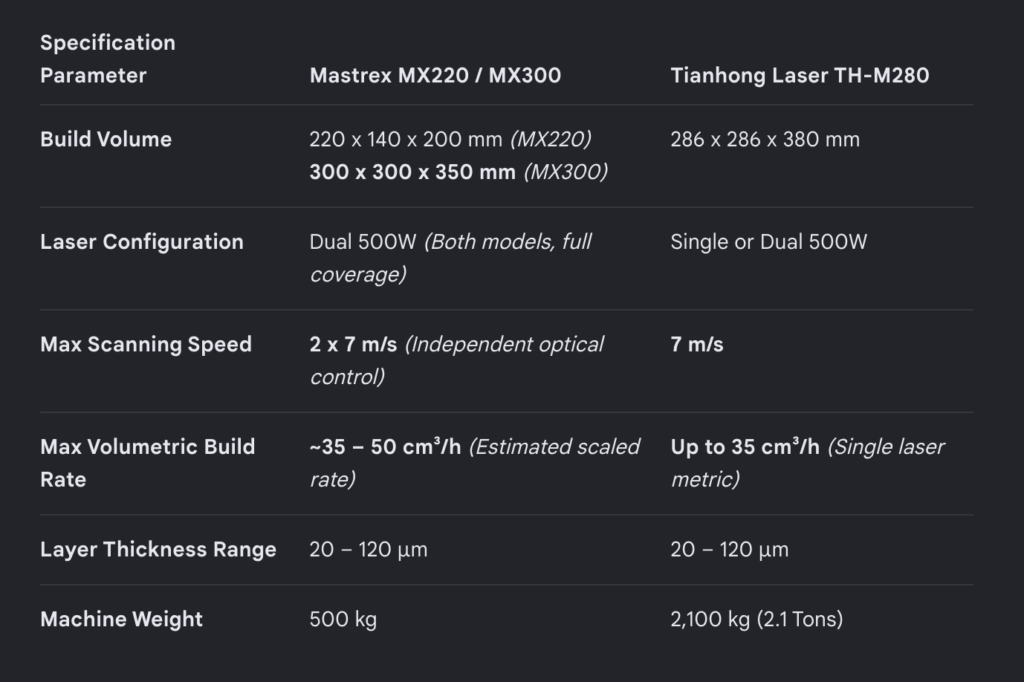
A side‑by‑side visual and spec analysis reveals striking similarities:
| Feature | Mastrex Model | Tianhong Counterpart | Key Spec Overlap |
|---|---|---|---|
| Build envelope | MX280: 280 × 280 × 280 mm | LM M280: 280 × 280 × 280 mm | Identical volume |
| Laser power | 400 W Yb‑fiber | 400 W Yb‑fiber | Same class |
| Layer thickness | 20‑100 µm | 20‑100 µm | Matching range |
| Print speed | 12 cm³/h (typical) | 12 cm³/h (typical) | Equivalent throughput |
| Price (2026 list) | $39 k (base) | $38 k (export) | Near‑identical MSRP |
| Feature | Mastrex Model | Tianhong Counterpart | Key Spec Overlap |
|---|---|---|---|
| Build envelope | MX100: 100 × 100 × 100 mm | LM 110DLite: 110 × 110 × 110 mm | Near‑identical size |
| Laser power | 250 W Yb‑fiber | 250 W Yb‑fiber | Same output |
| Layer thickness | 15‑80 µm | 15‑80 µm | Identical range |
| Print speed | 8 cm³/h | 8 cm³/h | Same performance |
| Feature | Mastrex Model | Tianhong Counterpart | Key Spec Overlap |
|---|---|---|---|
| Build envelope | MX400: 400 × 400 × 400 mm | LM L400: 400 × 400 × 400 mm | Identical volume |
| Laser power | 600 W Yb‑fiber | 600 W Yb‑fiber | Same class |
| Layer thickness | 30‑120 µm | 30‑120 µm | Matching range |
| Print speed | 18 cm³/h | 18 cm³/h | Equivalent throughput |
The table underscores that the MX‑series is not merely inspired by Tianhong designs—it matches them in envelope, laser class, and performance metrics. No public patents or engineering disclosures differentiate the two lineups.
Market Implications
If Mastrex can secure a reliable U.S. supply chain for powders and maintain its current pricing, the company could capture a sizable share of the mid‑tier LPBF market (units priced $30‑60 k). Forecasts from Wohlers Associates (2026) estimate a 15 % CAGR for printers in this bracket, driven by aerospace part prototyping and low‑volume production. However, the lack of transparent manufacturing provenance may deter defense and regulated‑industry buyers that require domestic content certifications (e.g., ITAR compliance).
Bottom Line
Mastrex’s metal LPBF printers are competitively priced and now backed by a U.S. powder validation partner, which makes them attractive to cost‑sensitive users. Yet, the hardware appears to be a re‑branded version of Chinese Tianhong machines, with most critical components imported and no disclosed domestic assembly line. Until the company openly documents a U.S. manufacturing footprint or secures “Made‑in‑America” certifications, the claim that Mastrex printers are truly American‑made remains


