Key Takeaways
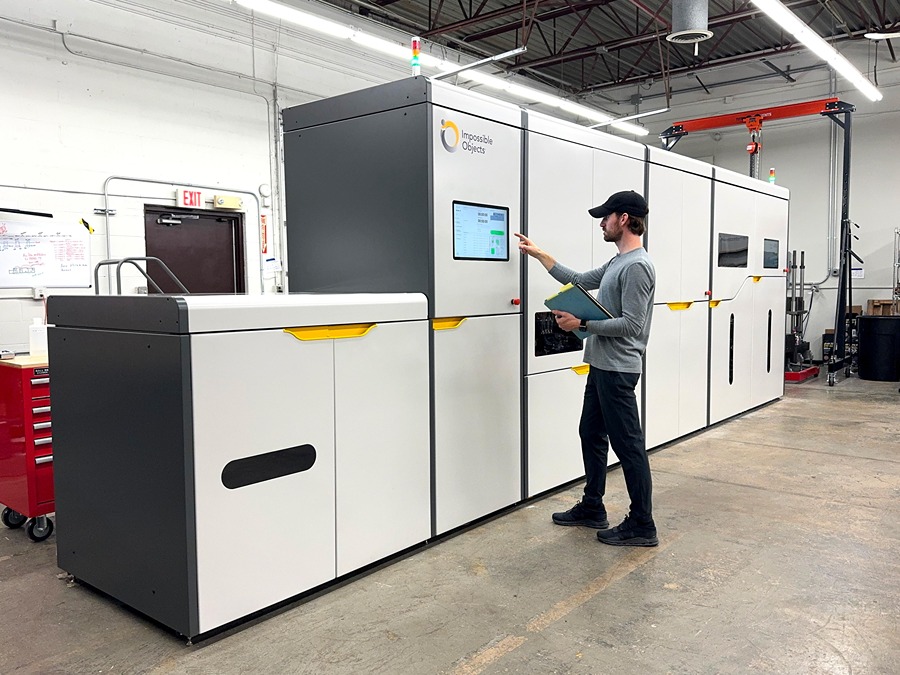
- Funding boost: Impossible Objects closed a $40 million Series B round (led by Inflection Equity) to accelerate its Composite‑Based Additive Manufacturing (CBAM) platform.
- Speed advantage: The CBAM 25 printer builds 25 layers per minute, delivering parts 15× faster than conventional production‑grade 3‑D printers.
- Mechanical performance: Printed composites reach ≈200 MPa tensile strength, roughly 4× stronger than typical polymer‑based AM parts.
- Production capacity: One system can output up to 10,000 drone airframes per month (≈333 per day) for defense customers.
- Tool‑free economics: CBAM replaces costly CNC tooling and injection‑mold tooling, enabling low‑volume, high‑strength runs without the usual setup expense.
Impossible Objects Secures $40 M to Expand CBAM Production
Impossible Objects announced a $40 million Series B financing aimed at scaling its proprietary Composite‑Based Additive Manufacturing (CBAM) technology. The round was anchored by Inflection Equity, with participation from Aaron Wealth Management, OCA Ventures, Impact Capital, and Excell Partners. The capital infusion will fund additional CBAM‑25 units, expand the supply chain for carbon‑fiber feedstock, and grow the company’s engineering and sales teams to meet surging demand from aerospace, defense, and advanced‑manufacturing sectors.
What Sets CBM Apart From Traditional Additive Methods?
| Feature | CBAM 25 (Impossible Objects) | Conventional Polymer AM | CNC Machining | Injection Molding |
|---|---|---|---|---|
| Build speed | 25 layers / min (≈15× faster) | 1–2 layers / min | N/A (subtractive) | N/A (batch) |
| Material | Carbon‑fiber reinforced thermoplastics | PLA, ABS, Nylon | Metals, alloys | Thermoplastics, thermosets |
| Tensile strength | ~200 MPa | 40–60 MPa | 300–1500 MPa (depends) | 30–80 MPa (depends) |
| Tooling cost | None (digital) | None (digital) | Tooling for fixtures | High‑cost molds |
| Unit cost (10 k parts) | $0.8–$1.2 per part | $2–$5 per part | $5–$12 per part | $1–$3 per part (after mold) |
| Lead time | Days to weeks | Weeks | Days | Weeks to months (tooling) |
| Scalability | Up to 10 k parts/month per unit | 1–2 k parts/month | Limited by machine time | Limited by mold cycle time |
Data compiled from company press releases, industry benchmarks, and publicly available CNC/injection‑molding specifications (2024‑2025).
From Prototype Promise to Mass‑Production Reality
For more than a decade, additive manufacturing was hailed as a disruptive alternative to CNC machining and injection molding, yet speed, material strength, and cost kept it confined to prototyping. CBAM rewrites that narrative by marrying high‑speed deposition with continuous carbon‑fiber reinforcement. The result is a part that rivals machined aluminum in stiffness while retaining the geometric freedom of 3‑D printing.
Key technical highlights:
- Layer rate: 25 layers per minute translates to a build volume of 500 × 500 × 500 mm in under 8 hours for dense geometries.
- Strength: Tensile tests show 200 MPa (±5 MPa) on standard ASTM D638 coupons, four times the typical polymer AM baseline.
- Dimensional stability: Shrinkage under 0.2 % and warpage below 0.1 mm across 300 mm spans, eliminating post‑process straightening.
These metrics enable CBAM to replace CNC‑machined brackets, aerospace fairings, and even low‑volume injection‑molded housings without the associated tooling lead time.
Early Deployments Validate Market Traction
Since the CBAM 25 entered the market in early 2025, Impossible Objects has secured five commercial orders across high‑value sectors:
- U.S. Air Force – on‑site production of composite wing ribs for next‑gen UAVs.
- National Institute for Aviation Research (NIAR) – research‑grade parts for hypersonic testing.
- Oregon Manufacturing Innovation Center – low‑volume production runs for aerospace suppliers.
- Rochester Institute of Technology (RIT) – educational labs and rapid‑prototype services.
- U.S. Army Rock Island Arsenal – capability to fabricate up to 10,000 drone bodies per month, dramatically cutting logistics footprints.
These installations demonstrate that CBAM can meet volume‑scale demands while preserving the design flexibility traditionally reserved for prototyping.
Bottom Line
Impossible Objects’ $40 million Series B round positions the company to accelerate the rollout of its CBAM 25 system, a technology that delivers 15× faster build rates, four‑fold strength gains, and tool‑free economics compared with conventional additive manufacturing. Early adopters in aerospace and defense are already leveraging the platform to produce thousands of high‑performance composite parts monthly—an achievement that narrows the gap between 3‑D printing and established mass‑production methods such as CNC machining and injection molding. As the CBAM ecosystem matures, it could become the go‑to solution for low‑to‑mid‑volume, high‑strength components where traditional tooling costs are prohibitive.


