Key Takeaways
- Historic launch: On 5 September 2024, Isar Aerospace performed the first orbital launch from continental Europe, a milestone for the EU space sector.
- Record funding: The Exploration Company (TEC) closed a US$450 M Series C, the largest ever raised by a European space firm; Swiss AM specialist SWISSto12 secured US$70 M in a separate round.
- Additive manufacturing (AM) centrality: All three firms rely heavily on metal‑laser powder‑bed fusion (LPBF) and binder‑jetting to produce engines, structures, and satellite components.
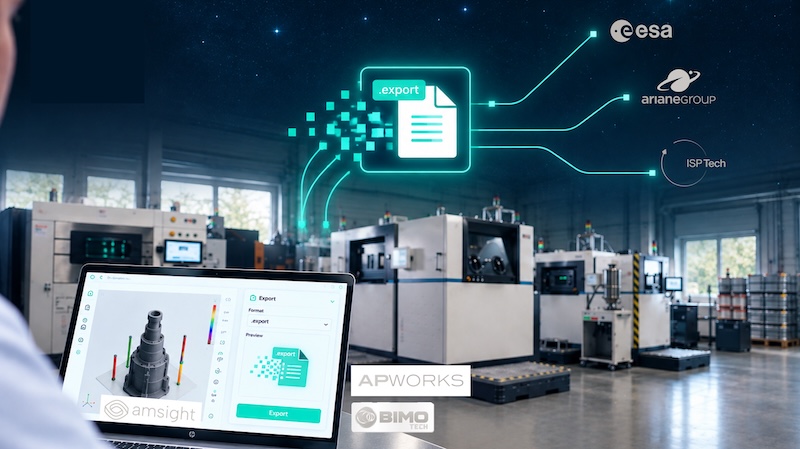
- EU qualification push: ESA’s new DIQAM programme (Digital Qualification Framework for Additively Manufactured Space Components) will standardise testing, data‑management and certification across the continent.
- Software leadership: amsight, a Fraunhofer IAPT spin‑off, has been appointed project lead, leveraging its digital‑thread platform used in semiconductor capital equipment (Semicap) to accelerate AM qualification for aerospace.
1. European Space Start‑ups Reach New Heights
1.1 Isar Aerospace’s Continental Launch
- Date & Site: 5 Sept 2024, Andøya Space Center, Norway (first launch from continental EU territory).
- Vehicle: Aquila 1 – a two‑stage, liquid‑propellant rocket powered by a 15 kN thrust engine produced via LPBF‑printed titanium alloy (Ti‑6Al‑4V).
- Payload: 120 kg to a 500 km Sun‑synchronous orbit (SSO).
1.2 The Exploration Company’s Funding Surge
- Series C: US$450 M led by Temasek and Bpifrance, with participation from Airbus Ventures.
- Goal: Development of the Arc‑4 reusable launch vehicle, targeting a 1‑tonne payload to LEO by 2027.
- AM Role: Over 40 % of the vehicle’s structural mass (e.g., carbon‑fiber‑reinforced polymer inserts printed with selective laser sintering) will be produced in‑house.
1.3 SWISSto12’s Satellite‑Scale AM Expertise
- Series C: US$70 M raised in June 2024.
- Products: End‑to‑end satellite bus frames and propulsion components manufactured with laser‑based metal AM (AlSi10Mg and Inconel 718).
- Recent Flight: The Epsilon‑1 3U CubeSat, launched on a Rocket Lab Electron in July 2024, carried a fully AM‑produced propulsion module (dry mass = 150 g, thrust = 0.5 N).
2. EU’s Strategic Move Toward AM Qualification
2.1 The DIQAM Initiative
- Sponsor: European Space Agency (ESA).
- Duration: 12 months (Sept 2024 – Sept 2025).
- Objective: Build a digital qualification framework that links design, process monitoring, non‑destructive testing (NDT), and certification for space‑grade AM parts.
- Deliverables:
- A standardised data model (based on ISO 10303‑AP242) for the AM digital thread.
- A benchmark suite of 15 test coupons (e.g., tensile, fatigue, thermal‑cycling) with predefined acceptance criteria.
- An open‑access repository of qualified material‑process‑property datasets.
2.2 amsight’s Leadership Role
- Core Platform: amsight Digital‑Thread Suite, already deployed in semiconductor capital equipment (Semicap) where part‑to‑process traceability exceeds 99.9 % reliability.
- Key Capabilities: Real‑time process‑parameter analytics, AI‑driven defect prediction, and automated compliance reporting (compatible with EN 9100 and ISO 9001).
- Partner Network: Includes Fraunhofer IAPT, Airbus Defence & Space, and the German Aerospace Center (DLR).
3. Comparative Snapshot of EU Space AM Players
| Company | Funding (US$) | Primary AM Technology | Notable Space Milestone | Planned Launch Capability |
|---|---|---|---|---|
| Isar Aerospace | — (bootstrapped) | LPBF Ti‑6Al‑4V engine | First continental EU orbital launch (Aquila 1) | 150 kg to 500 km SSO (2024) |
| The Exploration Company (TEC) | 450 M (Series C) | SLS of PA‑12 & carbon‑fiber‑reinforced polymer | Secured largest EU space‑industry round | 1 t to LEO with reusable Arc‑4 (target 2027) |
| SWISSto12 | 70 M (Series C) | LPBF AlSi10Mg & Inconel 718 | Delivered fully AM‑propulsion CubeSat (Epsilon‑1) | 10–50 kg microsat payloads (2025) |
All three firms cite AM as a cost‑reduction driver, reporting up to 30 % lower part‑count and 45 % faster design‑to‑flight cycles.
4. Why AM Is the EU’s Competitive Edge
- Mass‑to‑Cost Ratio: Metal LPBF can produce lattice‑optimized brackets that are up to 70 % lighter than machined equivalents, directly improving launch vehicle performance.
- Supply‑Chain Resilience: In‑house AM reduces reliance on external aerospace suppliers, a strategic advantage highlighted after recent geopolitical disruptions.
- Rapid Iteration: Digital twins and the DIQAM framework enable design changes to be validated in under four weeks, compared with the traditional six‑month aerospace certification timeline.
Bottom Line
The European Union is converting historic launch achievements and record‑breaking capital into a systematic advantage for additive manufacturing in space. By coupling massive private‑sector funding (US$520 M across Isar Aerospace, TEC, and SWISSto12) with ESA’s DIQAM qualification programme, the


