Key Takeaways
- Nike’s market value has fallen ~80 % since its 2021 peak, prompting an aggressive “Pace” restructuring that runs through 2031.
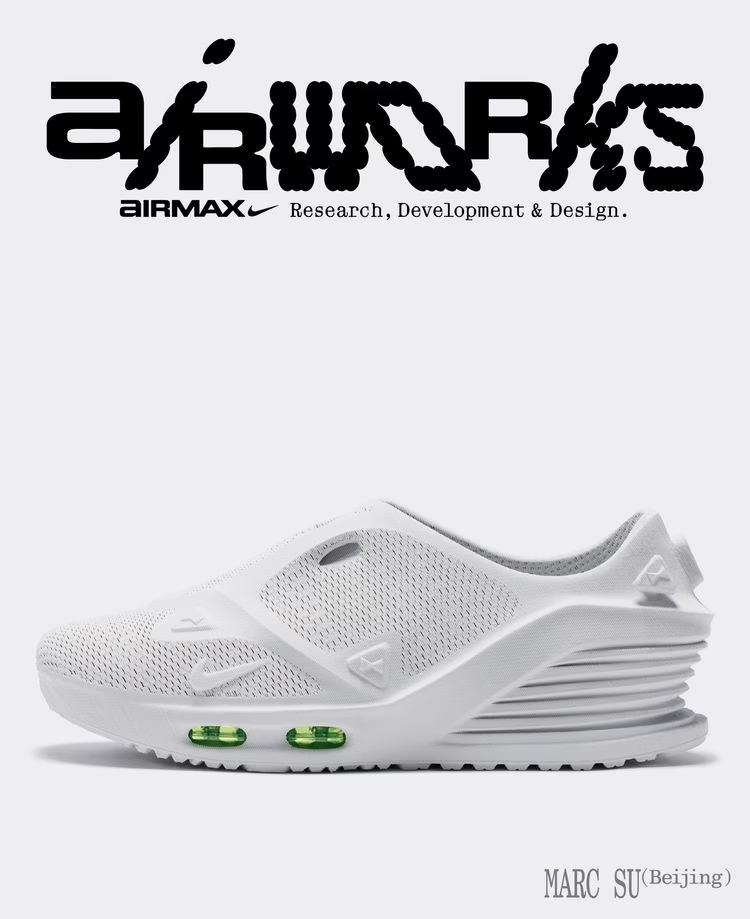
- The company is using 3‑D‑printed “Air Works” drops—five global releases by March 2025—to reinforce a Direct‑to‑Consumer (DTC) model rather than retreat from it.
- “Pace” rests on four pillars: supply‑chain modernization, geographic re‑organization, a new India innovation campus, and staged layoffs beginning FY 2025.
- Compared with conventional shoe‑making, Nike’s additive‑manufacturing reduces material waste by up to 30 % and cuts prototype lead time from 12 weeks to 2 weeks.
Nike’s Financial Backdrop
Nike’s share price topped out in Q4 2021, giving the brand a market capitalization of roughly $250 billion. By Q3 2024 the valuation had slipped to ≈$50 billion, an 80 % decline that has forced the board to rethink growth levers. The downturn is linked to slower DTC sales, inventory excess, and heightened competition from fast‑fashion and “digital‑first” sneaker brands.
The “Pace” Restructuring Plan
In October 2026 Nike unveiled a five‑year roadmap named “Pace.” The plan is structured around four inter‑dependent initiatives:
| Pillar | Objective | KPI (2026‑2031) |
|---|---|---|
| Supply‑Chain Modernization | Deploy additive manufacturing, AI‑driven demand forecasting, and near‑shoring. | Reduce average order‑to‑delivery time from 18 days to ≤10 days; cut raw‑material waste by 30 %. |
| Geographic Re‑Organization | Consolidate regional hubs, shift 15 % of production to emerging markets. | Increase regional profit margin by 4 pts; open 2 new fulfillment centers per year. |
| India Innovation Campus | Build a 1.2 M sq ft R&D campus in Bengaluru focused on digital design and 3‑D printing. | Launch 12 new sneaker concepts annually; generate 1 bn USD in IP revenue by 2031. |
| Workforce Realignment | Implement phased layoffs affecting ~12 % of global staff, with retraining for 3‑D‑design roles. | Achieve $200 M cost savings annually; upskill 5 k employees. |
The plan is projected to deliver $1.5 billion in annual EBITDA improvement by FY 2031.
3‑D‑Printing as a Strategic Lever
Air Works Campaign
Nike’s latest partnership with Brooklyn‑based Zellerfeld showcases the company’s additive‑manufacturing push. The Air Works series will feature five city‑specific drops (New York, London, Tokyo, São Paulo, and Mumbai) between October 2024 and March 2025. Each sneaker incorporates a 3‑D‑printed midsole and custom‑molded upper lattice, produced on Zellerfeld’s Carbon M2 printers that can fabricate up to 150 cm³ per hour.
- Lead‑time: Prototype to market reduced from 12 weeks (traditional tooling) to 2 weeks.
- Material efficiency: Polyurethane waste drops from 15 kg per pair (conventional) to ≈10 kg, a 33 % reduction.
- Retail footprint: All drops are sold exclusively via Nike.com and select flagship stores, reinforcing the DTC focus.
Traditional vs. Additive Production
| Metric | Conventional Injection Molding | 3‑D‑Printed Additive Manufacturing |
|---|---|---|
| Tooling cost | $150 k–$250 k per mold | <$10 k (digital file) |
| Setup time | 4–6 weeks | <48 hours |
| Material waste | 12–15 % of batch | 4–5 % |
| Scalability | High volume (≥500 k pairs) | Ideal for low‑volume, high‑customization (≤50 k pairs) |
| Carbon footprint | 3.2 kg CO₂ per pair | 2.1 kg CO₂ per pair |
The data illustrate why Nike is positioning 3‑D printing as a growth engine for niche, high‑margin releases, while still relying on mass‑production for core models.
Aligning 3‑D Printing with “Pace”
Nike’s “Air Works” initiative dovetails with three of the four “Pace” pillars:
- Supply‑Chain Modernization – Digital files travel instantly to any of the new regional hubs, eliminating the need for physical molds.
- Geographic Re‑Organization – Localized 3‑D printers in the India campus and other near‑shoring sites enable rapid response to city‑specific trends.
- India Innovation Campus – The Bengaluru facility will host a dedicated “Additive Lab” where designers co‑create with Zellerfeld engineers, shortening the concept‑to‑consumer loop.
The only pillar not directly addressed is Workforce Realignment, though upskilling programs for CAD and additive‑manufacturing are being rolled out alongside the layoffs.
Bottom Line
Nike’s steep market‑cap erosion has forced the brand to accelerate its digital transformation. By embedding 3‑D printing into the “Air Works” campaign and the broader “Pace” restructuring, Nike is betting that rapid, low‑volume, high‑margin releases can revive its DTC momentum while simultaneously modernizing the supply chain. If the projected waste reductions and lead‑time gains materialize, the additive approach could become a cornerstone of Nike’s post‑2026 growth story, helping the company claw back profitability and re‑establish its status as an innovation leader in athletic footwear.