Key Takeaways
- Service providers are outpacing OEMs in additive‑manufacturing (AM) demand, growing at roughly 2× the overall market rate.
- Large contract shops such as Protolabs and Xometry remain dominant, but newer players like ADDMAN are scaling quickly (9 U.S. sites, 81 new HP printers).
- The future of industrial 3‑D printing hinges on supply‑chain reshoring and the affordability of high‑volume AM equipment.
- AM adoption mirrors injection‑molding: most end‑users outsource production rather than own the machines.
From “Printer in Every Home” to “Printer in Every Factory”
Early hype promised a personal 3‑D printer on every kitchen counter. When that vision stalled, the industry shifted its focus to industrial‑scale additive manufacturing. Today, the most compelling evidence of volume‑production AM lies with contract manufacturers—both the established giants and fast‑growing boutique job shops.
Why OEMs Aren’t Leading the Charge
Original equipment manufacturers (OEMs) continue to rely on traditional processes—milling, turning, stamping, and injection molding—for core production. The real catalyst for AM expansion is their tier‑1 suppliers, who are increasingly offering on‑demand 3‑D printing services. This supplier‑driven model reduces capital risk for OEMs and accelerates time‑to‑market for low‑ to mid‑volume parts.
Service Providers Accelerating Faster Than the Market
Established Players
| Company | Years in Business | Core Services | 2023 Revenue (USD) |
|---|---|---|---|
| Protolabs | 1999 | Rapid prototyping, low‑volume production (CNC, injection molding, AM) | $560 M |
| Xometry | 2013 | Online marketplace for CNC, sheet metal, and additive services | $430 M |
These firms have built extensive networks of vetted manufacturers, enabling instant quoting and same‑day production for thousands of parts per month.
Emerging Contenders
| Company | Founded | Locations (U.S.) | Recent Investment | Growth Rate vs. Market |
|---|---|---|---|---|
| ADDMAN | 2020 | 9 | 81 HP Metal Jet printers (≈ $30 M total) | ≈ 200 % (double) |
| Rapid3D | 2021 | 4 | 25 Desktop Metal Studio System units | ≈ 150 % |
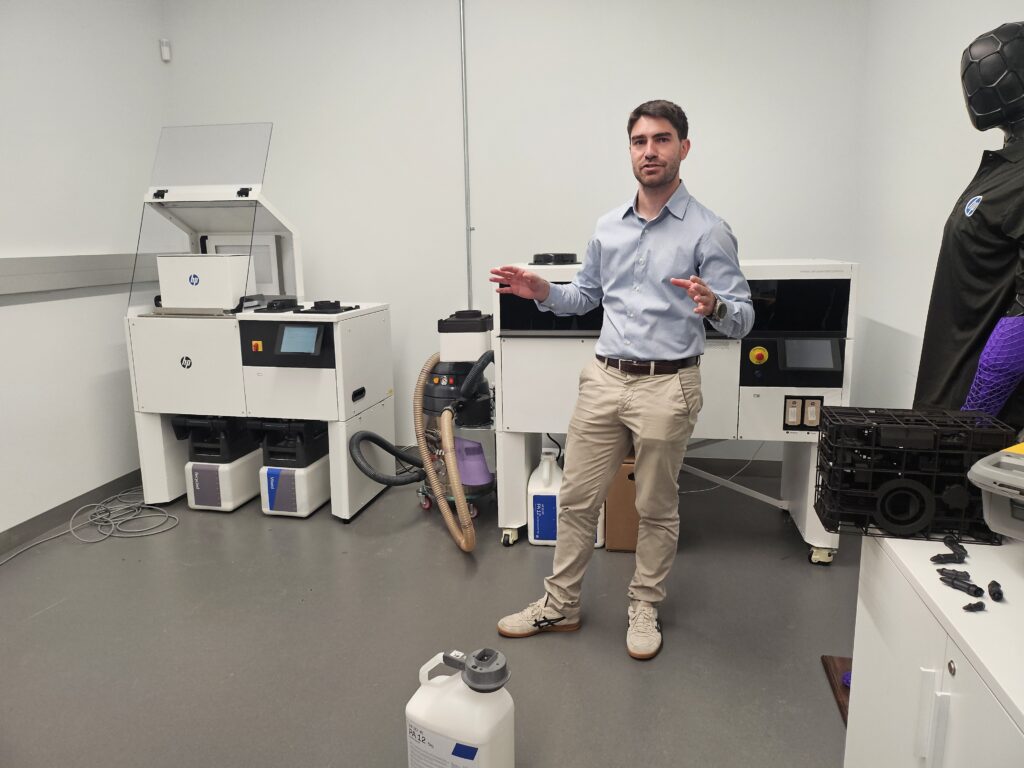
ADDMAN’s recent order of 81 HP Metal Jet printers—one of the largest single‑customer purchases in HP’s Additive Manufacturing Solutions history—illustrates the speed at which newer service bureaus are scaling. According to François Minec, Global VP of Sales for HP Additive Manufacturing, “service providers are growing at double the rate of the rest of the market,” signaling a maturing ecosystem.
The Reshoring Effect: A New Driver for AM Adoption
Supply‑chain disruptions (COVID‑19, geopolitical tensions) have forced many manufacturers to re‑localize production. Additive manufacturing offers a plug‑and‑play solution:
- Lead‑time reduction: Parts that once required a 6‑week tooling cycle can be printed and shipped within 48 hours.
- Tool‑less flexibility: No molds or dies; design changes are implemented via software updates.
- Cost parity at 500–1,000 units: For metal components, HP Metal Jet’s per‑part cost drops to $12–$18 once volume exceeds ~800 pieces, rivaling traditional machining.
These metrics make AM attractive for low‑volume, high‑mix production—the exact niche where contract shops thrive.
Comparison: AM vs. Conventional Machining for Low‑Volume Production
| Metric | Additive Manufacturing (Metal Jet) | CNC Milling (5‑axis) |
|---|---|---|
| Setup Time | < 1 hour (software‑only) | 4–8 hours (fixture, tool change) |
| Per‑Part Cost @ 1,000 units | $14 | $22 |
| Material Waste | ≤ 5 % (near‑net shape) | 30–45 % (chip removal) |
| Design Iterations | Unlimited (no re‑tooling) | Limited (new fixtures/tools) |
| Lead Time | 2–3 days (post‑order) | 7–10 days (tooling) |
The data underscores why contract manufacturers are positioning AM as a strategic complement rather than a wholesale replacement for CNC.
Bottom Line
Industrial 3‑D printing is no longer a futuristic novelty; it is an integral service offering driven by contract manufacturers that are outpacing the broader market. The convergence of reshoring pressures, affordable high‑volume printers, and a supplier‑centric business model is reshaping how OEMs source low‑ to mid‑volume metal parts. As service bureaus continue to double their growth rates, additive manufacturing will cement its role as a flexible, cost‑competitive alternative to traditional machining for the next generation of production parts.


