Key Takeaways
- China has successfully demonstrated metal 3D printing in space using a laser-based system.
- The experiment was conducted aboard the Qingzhou cargo spacecraft and developed by researchers from the Chinese Academy of Sciences and its Institute of Mechanics.
- The equipment operated autonomously, using commands sent from Earth, and was able to start and stop remotely multiple times during the test.
- The technology has potential applications in future space missions, including Moon construction.
Introduction to Metal 3D Printing in Space
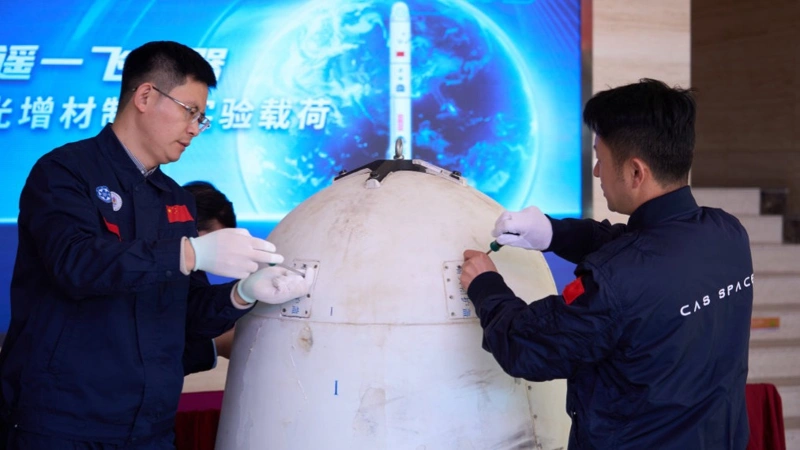
China has become the latest space power to demonstrate metal 3D printing in orbit, marking a significant breakthrough in the development of manufacturing technologies for future space missions. The experiment, conducted aboard the Qingzhou cargo spacecraft, used a laser-based system that melts metal wire and deposits it layer by layer in microgravity.
Technical Details of the Experiment
The equipment used in the experiment was designed to operate autonomously, using commands sent from Earth. The system was able to start and stop remotely multiple times during the test, demonstrating its potential for use in future space missions. The laser-based system used in the experiment has a number of advantages, including high precision and speed, making it an ideal choice for metal 3D printing in space.
Comparison of Metal 3D Printing Technologies
| Technology | Description | Advantages | Disadvantages |
|---|---|---|---|
| Laser-based | Melts metal wire and deposits it layer by layer | High precision and speed | Limited to certain types of metals |
| Electron beam | Uses an electron beam to melt and deposit metal | High precision and speed | Requires high vacuum environment |
| Arc welding | Uses an electric arc to melt and deposit metal | Low cost and easy to implement | Limited precision and speed |
Applications of Metal 3D Printing in Space
The successful demonstration of metal 3D printing in space has significant implications for future space missions, including Moon construction. The technology has the potential to enable the creation of complex metal structures and components in space, reducing the need for resupply missions from Earth. Additionally, metal 3D printing in space could enable the creation of spare parts and tools, reducing the risk of equipment failure and increasing the overall efficiency of space missions.
Bottom Line
China's successful demonstration of metal 3D printing in space marks a significant breakthrough in the development of manufacturing technologies for future space missions. The technology has the potential to enable the creation of complex metal structures and components in space, reducing the need for resupply missions from Earth and increasing the overall efficiency of space missions. With its high precision and speed, laser-based metal 3D printing is an ideal choice for space applications, and its development is expected to play a key role in the future of space exploration.


