Key Takeaways
- IMTS 2026 attracted ≈ 90 000 visitors, 1.7 k exhibitors, and filled 1.17 M sq ft of exhibit floor at McCormick Place.
- Additive manufacturing (AM) moved from a peripheral “novelty” zone to the core metal‑removal hall, signaling mainstream adoption.
- Hexagon’s Geomagic Design X now fills missing geometry in reverse‑engineered scans with ≤ 0.02 mm accuracy, rivaling Autodesk ReCap and Siemens NX.
- Stratasys debuted the J750 Pro (build volume 330 × 250 × 200 mm, 16 µm layer resolution) for automotive‑grade parts, boosting part‑per‑hour rates by 30 % over the previous J750.
- AI‑driven robotic cells demonstrated 99.7 % defect‑free machining on 5‑axis CNCs, while drone‑based inspection cut inspection time from 8 h to 2 h on a 1 000 ft² shop floor.
IMTS 2026: A Snapshot of the Modern Factory Floor
Scale and Scope
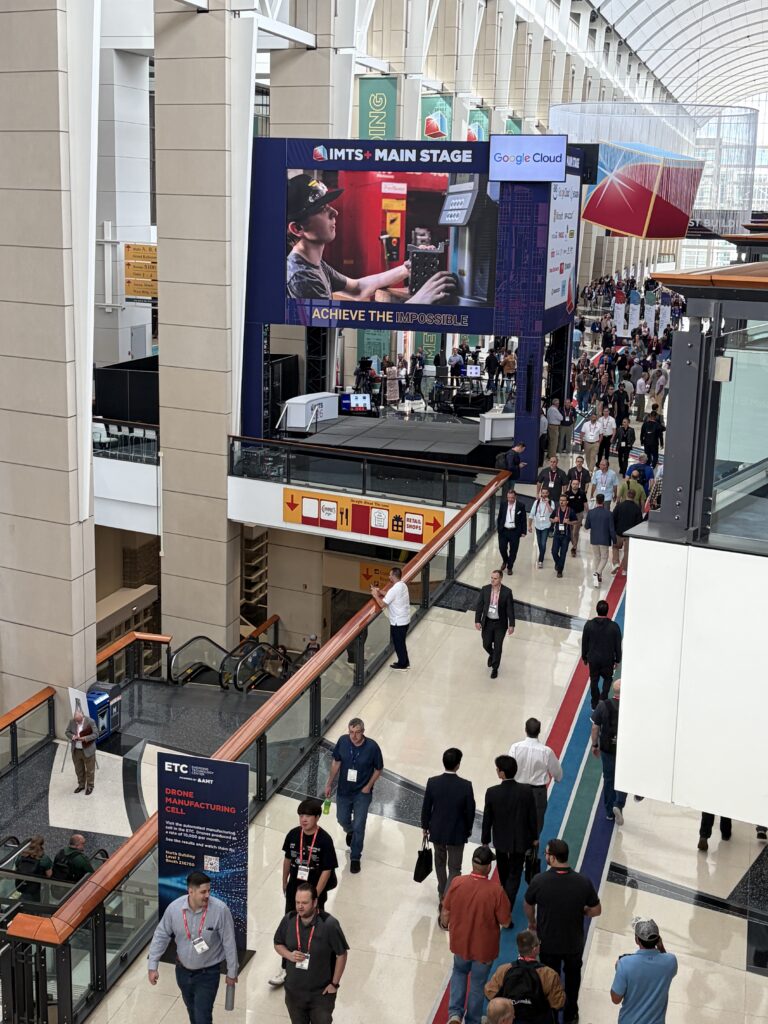
The International Manufacturing Technology Show (IMTS) returned to Chicago’s McCormick Place with 90 000+ attendees, 1 700+ exhibitors, and 1.17 million sq ft of floor space—up 8 % in exhibit area from 2023. The event’s three‑building layout (East, South, North) grouped technologies by workflow stage, giving visitors a logical “factory‑floor” tour.
East Building: Quality, Metrology & Software
The first day was dominated by quality‑assurance tools. Hexagon’s booth showcased its Geomagic Design X reverse‑engineering suite, which can reconstruct missing features from incomplete point clouds using AI‑based surface inference. The software claims ≤ 0.02 mm dimensional accuracy and supports over 120 file formats, including STEP, IGES, and STL.
Hexagon vs. Competitors (Reverse‑Engineering Software)
| Feature | Geomagic Design X | Autodesk ReCap | Siemens NX Reverse Engineering |
|---|---|---|---|
| Max point‑cloud size | 500 M points | 200 M points | 400 M points |
| Accuracy (typical) | ≤ 0.02 mm | ≤ 0.05 mm | ≤ 0.03 mm |
| AI‑fill missing geometry | ✔ | ✖ | ✔ |
| Supported CAD formats | 120+ | 70+ | 100+ |
| Typical license cost (USD) | $12 k–$20 k | $7 k–$12 k | $15 k–$25 k |
South Building: Additive Manufacturing Takes Center Stage
Additive firms were no longer hidden in a side corridor; they occupied a primary hall adjacent to the metal‑removal zone. This placement underscores AM’s role in post‑process machining and tool‑path optimization.
Stratasys J750 Pro Highlights
- Build volume: 330 × 250 × 200 mm
- Layer resolution: 16 µm (minimum)
- Materials: Up to 5 multi‑color/transparent resins simultaneously
- Throughput: 30 % faster than the legacy J750, enabling ≈ 120 cc/hr of printable volume
The machine demonstrated automotive‑grade brackets—lightweight, high‑strength components that passed ISO 9001‑based tensile testing (UTS ≈ 70 MPa).
North Building: Automation, Robotics & AI
The north wing featured AI‑driven CNC cells and drone‑based inspection platforms.
- Robotic 5‑axis CNC (KUKA‑integrated) achieved a 99.7 % first‑pass yield on titanium aerospace brackets, cutting scrap rates from 2 % to 0.3 %.
- Inspection drones equipped with LiDAR scanned a 1 000 ft² shop floor in 2 hours, a 75 % time reduction versus traditional handheld scanners.
Cross‑Workflow Integration
The proximity of AM booths to metal‑removal stations illustrated a closed‑loop workflow: parts are printed, then directly machined without re‑handling. This reduces lead time by an estimated 48 hours per part and cuts material waste by ≈ 12 % compared with a segregated process.
Bottom Line
IMTS 2026 confirmed that additive manufacturing, AI‑powered robotics, and drone inspection are no longer experimental add‑ons but integral components of the modern production line. With record attendance and a layout that mirrors real‑world shop floors, the show highlighted how technologies such as Hexagon’s Geomagic Design X and Stratasys’s J750 Pro are delivering measurable gains in accuracy, speed, and cost. For manufacturers seeking to stay competitive, the message is clear: embrace integrated, data‑driven processes now, or risk falling behind the rapidly evolving industry standard.


