Key Takeaways
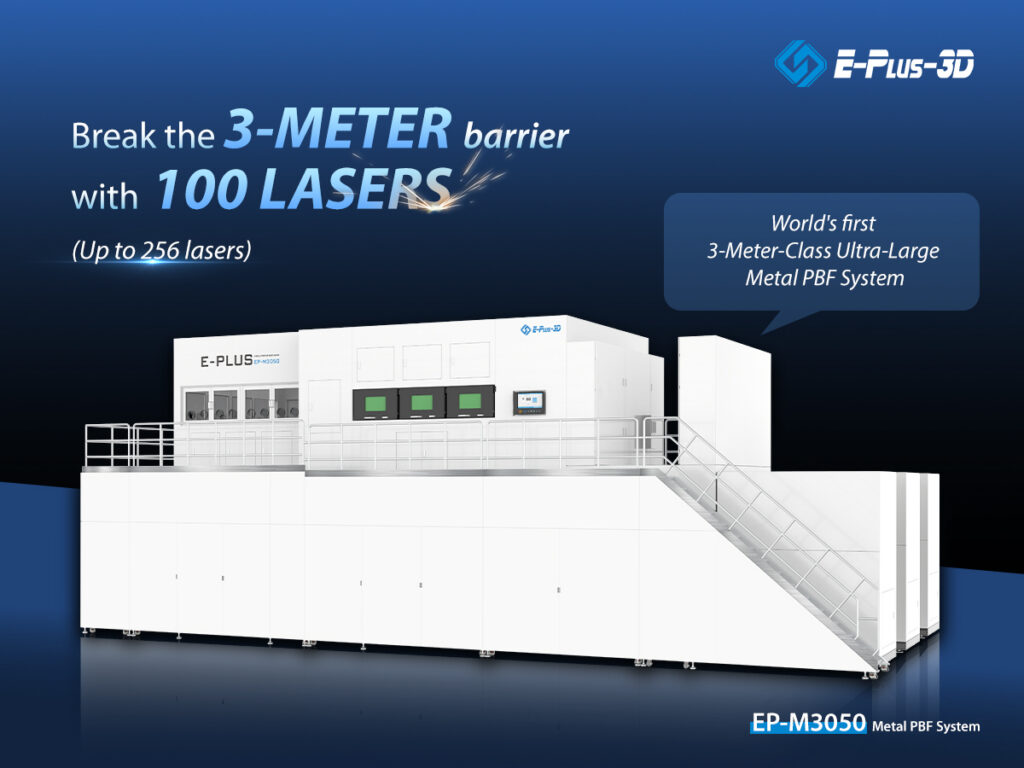
- Eplus3D launches the EP-M3050, a multi-laser metal powder bed fusion 3D printer with a build area of up to 3050 mm x 3050 mm and a customizable Z-axis of up to 5000 mm.
- The EP-M3050 features a high-efficiency, multi-laser architecture with up to 256 lasers, coordinated scan strategies, and real-time process control for uniform part quality.
- Researchers explore the use of agricultural waste to improve the quality of 3D printing plastics.
- Soft robotics research aims to create more flexible and adaptable robots using 3D printing technology.
Introduction to 3D Printing Innovations
The 3D printing industry continues to evolve with new innovations and technologies emerging regularly. Recently, Eplus3D announced the launch of the EP-M3050, a multi-laser metal powder bed fusion 3D printer that breaks the three-meter barrier in additive manufacturing.
Eplus3D's EP-M3050 Metal 3D Printing System
The EP-M3050 features a build area of up to 3050 mm x 3050 mm and a customizable Z-axis of up to 5000 mm, making it possible to achieve one-piece manufacturing of ultra-large structural components. The system includes 100 lasers, with the option to scale up to 256 lasers, and features coordinated scan strategies, path planning, and real-time process control to ensure uniform part quality.
| Feature | EP-M3050 | Traditional Metal 3D Printers |
|---|---|---|
| Build Area | Up to 3050 mm x 3050 mm | Limited to smaller build areas |
| Z-Axis | Customizable up to 5000 mm | Fixed Z-axis height |
| Number of Lasers | Up to 256 lasers | Typically single-laser systems |
| Scan Strategies | Coordinated scan strategies | Limited scan strategies |
Applications of the EP-M3050
The EP-M3050 is suitable for applications that require large, high-performance, integrated components, such as aviation, energy, industrial manufacturing, and oil & gas. For example, a 2.8-meter casing can be printed integrally on the printer, demonstrating its capabilities.
Research into Soft Robotics and Agricultural Waste
In addition to the EP-M3050, researchers are exploring new applications for 3D printing, including soft robotics and the use of agricultural waste to improve the quality of 3D printing plastics. Soft robotics aims to create more flexible and adaptable robots using 3D printing technology, while agricultural waste can be used to enhance the mechanical properties of 3D printed plastics.
Bottom Line
The launch of the EP-M3050 by Eplus3D marks a significant milestone in the development of metal 3D printing technology, enabling the production of large, complex components with high precision and accuracy. As the industry continues to evolve, we can expect to see new innovations and applications emerge, including the use of agricultural waste and soft robotics. With its advanced features and capabilities, the EP-M3050 is poised to revolutionize the field of metal additive manufacturing.