Key Takeaways
- The U.S. Department of War's $1.1 billion Drone Dominance program is driving demand for low-cost, rapidly producible drones
- Additive manufacturing (AM) is revolutionizing drone production with lighter structures, faster iteration, and local high-rate production
- Different drone groups require tailored AM approaches, including high-volume, low-cost manufacturing for small systems and higher-performance composite approaches for larger systems
- The U.S. Army's Best Drone Warfighter Competition highlights the importance of speed, performance, and supply chain resilience in drone manufacturing
Introduction to Drone Dominance and Additive Manufacturing
The drone manufacturing landscape is undergoing a significant shift, driven by government programs such as the U.S. Department of War's Drone Dominance initiative. This $1.1 billion effort aims to deliver low-cost, one-way attack (OWA) small Unmanned Aerial Systems (sUAS) at scale, with a focus on speed, performance, and supply chain resilience. Additive manufacturing (AM) is playing a crucial role in this shift, enabling the production of lighter, more complex structures with faster iteration and local high-rate production.
Why Additive Manufacturing Matters Now
The convergence of new operational requirements, such as payload, performance, range, and resilience, with AM breakthroughs is yielding parts previously impossible with traditional methods. Topology-optimized lattices, fiber-reinforced composites, and geometries that consolidate assemblies are just a few examples of the innovative solutions enabled by AM. For programs like Drone Dominance, which has already produced 30,000 units, additive manufacturing enables both rapid prototyping and scale production while supporting a localized, supply-chain-resilient industrial base.
Comparison of Additive Manufacturing Technologies
| Technology | Description | Advantages | Disadvantages |
|---|---|---|---|
| Fused Deposition Modeling (FDM) | Layer-by-layer deposition of melted plastic | Low cost, easy to use | Limited resolution, slow production |
| Selective Laser Sintering (SLS) | Laser-based fusion of powdered material | High resolution, strong parts | High cost, limited availability |
| Stereolithography (SLA) | Laser-based curing of liquid resin | High resolution, smooth finish | Limited build size, expensive |
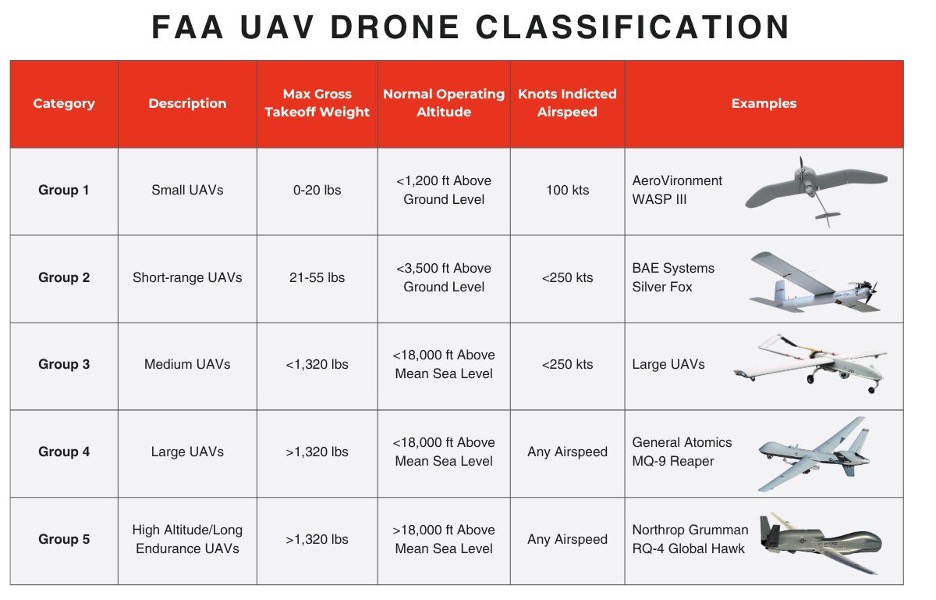
Understanding UAV Groupings and Fit-for-Purpose AM
Not every 3D printing technology suits every drone. Categorizing UAS by mission and manufacturer helps match processes to platforms. The four main groups are:
- Group 1: Very small, portable systems (hand-launched, <20 lbs) for intelligence, surveillance, and reconnaissance (ISR)
- Group 2: Small tactical UAVs (<55 lbs) with longer endurance for persistent ISR or light payload delivery
- Group 3: Medium-altitude tactical systems (>55 lbs) that carry larger payloads and operate beyond visual line-of-sight (BVLOS)
- Group 4: Tactical or operational fixed-wing/multi-role systems with greater range and payload for extended reconnaissance or kinetic action
Bottom Line
The future of drone manufacturing is being shaped by the convergence of government programs, additive manufacturing, and the need for speed, performance, and supply chain resilience. As the industry continues to evolve, it is essential to understand the different drone groups and the tailored AM approaches required to meet their unique needs. With the right technologies and strategies in place, the potential for rapid, low-cost production of high-performance drones is vast, and the implications for military, commercial, and civilian applications are significant.


