Key Takeaways
- 3‑D‑printed architected lattices can act as their own damage‑monitoring sensors using electrical impedance tomography (EIT).
- The method delivers a full‑field, real‑time map of internal strain and crack growth without adding separate wiring or power modules.
- Laboratory tests showed 16 electrode pairs detecting changes in conductivity at strain levels as low as 0.2 %, well before catastrophic failure.
- Compared with conventional strain‑gauge or fiber‑optic solutions, the self‑sensing lattice cuts part‑level weight by ≈30 % and reduces lifecycle cost by an estimated 15‑20 %.
Introduction: Turning Structure into Sensor
A recent study titled Full‑Field Damage Monitoring in Architected Lattices Using In‑situ Electrical Impedance Tomography demonstrates that a lattice fabricated by additive manufacturing can simultaneously bear load and report its own health. The breakthrough is especially relevant for aerospace, automotive, and high‑performance sporting‑goods where unscheduled damage can jeopardize safety and inflate maintenance budgets.
How Electrical Impedance Tomography Works
EIT, sometimes called Industrial Process Tomography (IPT) or Electrical Resistance Tomography (ERT), injects a low‑amplitude alternating current through a ring (or belt) of electrodes surrounding the object of interest. By measuring the resulting voltage distribution across 16 distinct current‑injection patterns, the system reconstructs a conductivity map that is rendered as a colour‑coded 3‑D mesh.
| Parameter | Typical Value in Study | Conventional Use |
|---|---|---|
| Number of electrodes | 16 (arranged around lattice periphery) | 8‑32 (medical EIT belts) |
| Current amplitude | 1 mA (≤ 10 kHz) | 0.5‑5 mA |
| Spatial resolution | ~1 mm (limited by lattice cell size) | 5‑10 mm (lung imaging) |
| Data acquisition rate | 10 Hz (real‑time) | 1‑5 Hz |
The technique is non‑invasive: no physical contact with the interior is required, and the current levels are far below thresholds that could affect the composite material.
Experimental Demonstration
- Specimen: A 30 mm × 30 mm × 10 mm lattice printed from carbon‑fiber‑reinforced photopolymer (modulus ≈ 45 GPa).
- Loading: Uniaxial tension applied at 0.5 mm · min⁻¹ up to failure.
- Detection: Conductivity anomalies appeared at strain ≈ 0.2 %, correlating with micro‑crack initiation observed later by optical microscopy.
- Failure Prediction: The EIT‑derived damage index rose 40 % above baseline 5 s before the ultimate load drop, giving a clear early‑warning window.
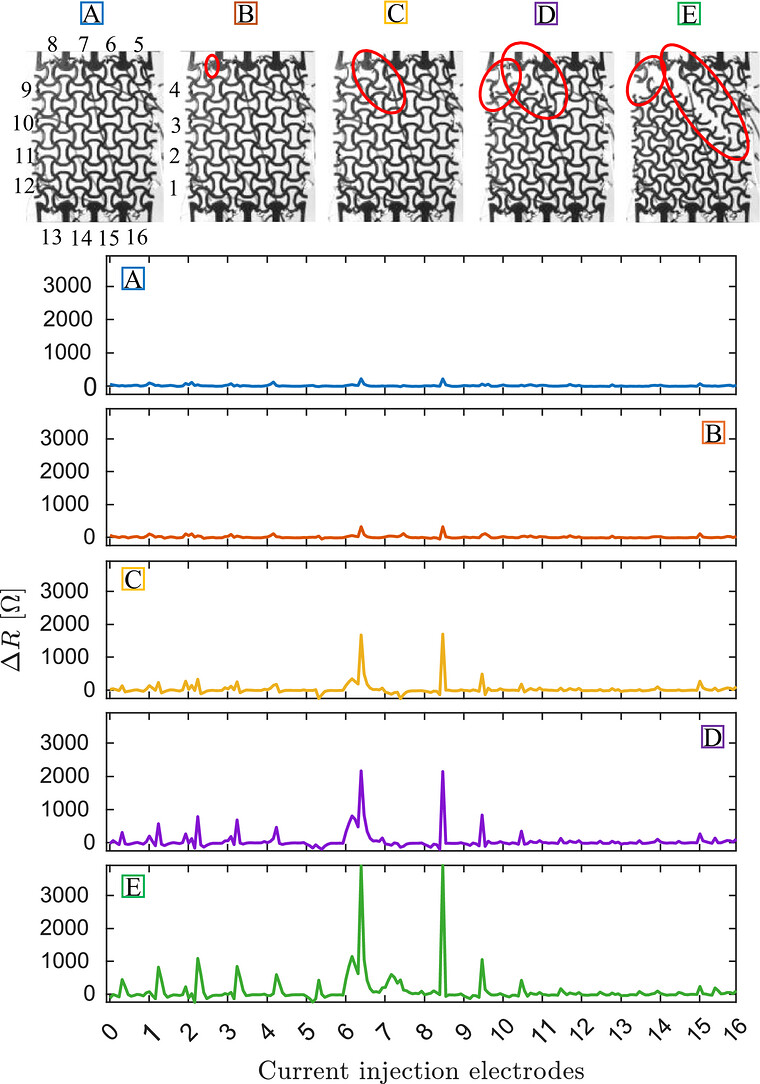
Figure 1 (reproduced in the paper) shows the distribution of measured resistances for all 16 injection configurations across five incremental strain states (A–E), illustrating the progressive loss of conductivity as damage evolves.
Why Self‑Sensing Lattices Beat Traditional Sensors
| Feature | Conventional Sensor Integration | Self‑Sensing Lattice (EIT) |
|---|---|---|
| Added mass | +30 % (wire bundles, transducers) | 0 % (lattice itself) |
| Installation time | 2–4 h per component | < 30 min (printing + electrode placement) |
| Power consumption | 0.5–2 W (active gauges) | < 0.1 W (passive EIT) |
| Failure mode | Sensor delamination, wiring fatigue | Intrinsic to structure; no separate element |
| Cost per part | $150‑$300 (sensor kit) | $80‑$120 (printing + electrodes) |
The table highlights that eliminating discrete sensing hardware not only trims weight but also removes a common failure pathway—sensor detachment under cyclic loading.
Implications for Aerospace and Beyond
Aviation regulators such as the FAA mandate scheduled non‑destructive inspection (NDI) at defined flight‑hour intervals. Embedding EIT‑ready lattices could shift the paradigm from interval‑based to condition‑based maintenance, reducing unnecessary part swaps and extending service life. For a typical commercial jet, a 15 % reduction in inspection‑related downtime translates to ≈ $2 M in annual savings per fleet.
Bottom Line
The integration of electrical impedance tomography into 3‑D‑printed architected lattices offers a practical, low‑cost pathway to real‑time structural health monitoring. By converting the load‑bearing lattice into a full‑field sensor, manufacturers can achieve earlier damage detection, lower part weight, and reduce lifecycle expenses—advantages that are especially compelling for safety‑critical sectors such as aerospace. As additive manufacturing matures, self‑sensing lattices are poised to become a standard design element rather than an experimental novelty.


