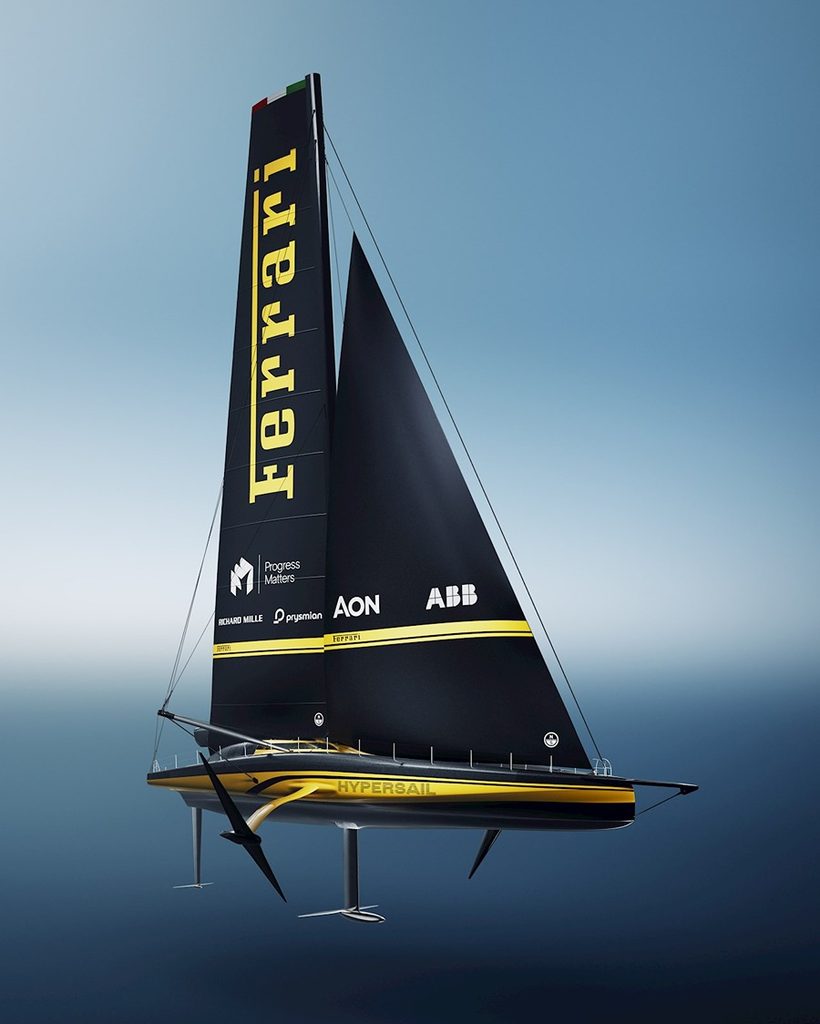
Key Takeaways
- ABB, 100-ft foiling yat için DC-güç uzmanlığı sağlayarak Ferrari Hypersail’in Elektrifikasyon Ortağı olur.
- Gemi, yenilenebilir üretim, gemi içi depolama ve itiş gücünü birleştiren çift-voltajlı (48 V / 800 V DC) bir mikro-ağ çalıştıracak.
- ABB, > 25 yıllık DC-teknoloji deneyimi ve > 700 patente dayanarak zorlu açık deniz koşullarında akıllı güç dağıtımı sunar.
- Ortaklık, denizde dayanıklılık, verimlilik ve güvenliği gösteren bir sonraki nesil endüstriyel mikro-ağların canlı bir test ortamı görevi görür.
ABB and Ferrari Hypersail: A New Chapter in Marine Electrification
Partnership Overview
ABB announced a strategic technology alliance with the innovative yacht builder Ferrari Hypersail. Under the agreement, ABB will act as the Electrification Partner, applying its deep knowledge of marine power, direct-current (DC) systems, and advanced electrical architecture to one of the most demanding offshore projects ever attempted.
About Ferrari Hypersail
Ferrari Hypersail is a 100-foot (≈30 m) full-foiling monohull designed to run exclusively on renewable energy. The yacht combines high-speed performance with a self-contained power ecosystem that must survive extreme cold, salt spray, high pressure, and constant motion.
ABB’s Role and Technical Assets
- DC-technology pedigree: More than 25 years of development and a portfolio of over 700 patents in DC conversion, distribution, and storage.
- Energy-management expertise: Real-time balancing of generation (solar, wind), battery storage, and load demands.
- Marine-grade integration: Proven solutions for corrosion-resistant cabling, sealed switchgear, and vibration-tolerant power electronics.
ABB will deliver system design, integration services, and on-board diagnostics to ensure the yacht’s micro-grid operates continuously under offshore stressors.
The Dual-Voltage DC Architecture
Ferrari Hypersail’s power network will employ two DC levels:
| Parameter | 48 V DC Sub-system | 800 V DC Main Bus |
|---|---|---|
| Primary function | Low-voltage safety, instrumentation, foil-control electronics | High-power propulsion, battery charging, critical navigation |
| Typical current | 150 A max | 250 A max |
| Energy source | Solar panels (≈12 kW) + wind turbine (≈5 kW) | High-density lithium-ion pack (≈500 kWh) |
| Converter type | Isolated DC-DC (48 → 12 V) | High-power DC-DC (800 → 48 V) |
| Redundancy | Dual-path topology | Parallel-bridge architecture with fault-tolerant switching |
The 800 V bus enables efficient propulsion while keeping conductor losses below 2 % over the 30-m cable runs. The 48 V side isolates safety-critical functions from high-energy transients, meeting IEC 60945 marine safety standards.
Why DC Beats Traditional AC in This Context
| Aspect | Conventional Marine AC (400 V, 50 Hz) | ABB-Enabled DC (48 V / 800 V) |
|---|---|---|
| Conversion losses | 8-12 % (AC-DC-AC) | 2-4 % (DC-DC) |
| Cable weight | ~30 % heavier (due to larger conductors) | ~15 % lighter |
| Harmonic distortion | Requires filters, adds complexity | Naturally low-harmonic |
| Fault isolation | Slower breaker response | Instantaneous solid-state protection |
| Scalability | Limited by transformer size | Modular DC-DC converters allow incremental upgrades |
The table underscores how a DC-centric design reduces weight, improves efficiency, and simplifies the power-distribution layout—critical advantages for a foiling yacht where every kilogram influences speed.
Testing Resilience at Sea
ABB will install intelligent power-distribution units (IPDUs) that continuously monitor voltage, temperature, and vibration. The system can autonomously reroute power around a failed module within ≤ 10 ms, preserving propulsion and navigation. Data collected during offshore trials will feed back into ABB’s industrial-microgrid portfolio, accelerating the rollout of similar solutions for offshore wind farms, floating data centers, and naval vessels.
Bottom Line
ABB’s partnership with Ferrari Hypersail transforms a cutting-edge sailing yacht into a floating laboratory for high-performance DC micro-grids. By delivering a dual-voltage (48 V / 800 V) architecture that blends renewable generation, robust storage, and intelligent distribution, ABB demonstrates that DC electrification can meet the toughest marine demands while delivering weight savings and efficiency gains. The insights gained will ripple across the broader offshore industry, paving the way for greener, more resilient power systems on everything from wind turbines to naval ships.