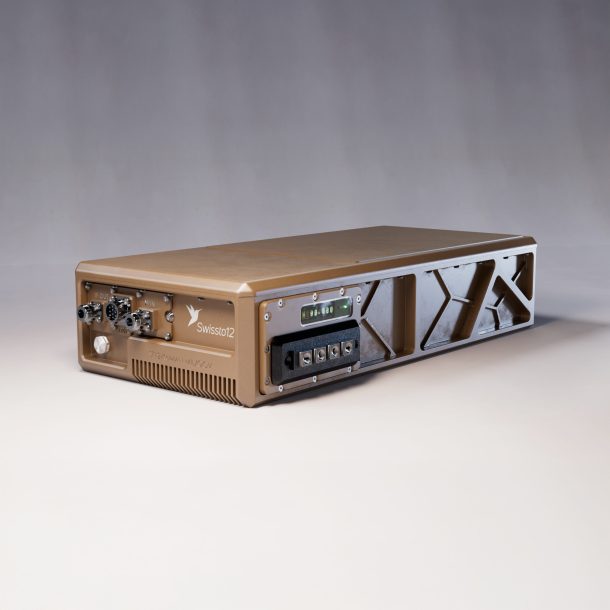
Key Takeaways
- SWISSto12 und Mitsubishi Electric haben ein MoU zur gemeinsamen Entwicklung von GEO-Grade-Payloads, RF-Hardware und Phased-Array-Antennen für Japans sichere Satellitenprogramme unterzeichnet.
- Die Partnerschaft nutzt Mitsubishis Expertise in der Satellitensystem-Integration und SWISSto12s proprietäre Additive-Manufacturing-(AM-)Designs und verspricht bis zu 45 % Massenreduktion und 30 % schnellere Bauzeiten.
- SWISSto12s finanzielle Lage ist stark: $70 M Series C, $200 M+ Gesamtfinanzierung, $140 M FY-2025 Umsatz, $500 M+ Auftragsbestand und 2.000+ Teile bereits im Orbit.
- Der Deal erweitert SWISSto12s Präsenz im asiatischen Markt und positioniert das Unternehmen als kritischen Zulieferer für Japans sichere GEO-Kommunikationsinfrastruktur.
Overview of the SWISSto12-Mitsubishi Electric MoU
Strategic objectives
The memorandum of understanding (MoU) formalizes a joint effort to produce three core product families for Japan’s GEO (Geostationary Earth Orbit) secure communications network:
| Product Category | Mitsubishi Electric contribution | SWISSto12 contribution |
|---|---|---|
| Payloads | Satellite-system architecture, integration, and testing | 3D-printed structural frames, thermal-control brackets, and lightweight housing |
| RF modules | High-power amplifiers, frequency-planning tools | Additively-manufactured waveguide housings, antenna mounts |
| Phased-array antennas | Beam-steering electronics, control software | 3-D-printed lattice reflectors, rapid-prototype feed-network panels |
The collaboration aims to cut overall payload mass by ≈45 % (relative to conventional machined aluminum) and shrink production lead-time from 12 months to under 8 months.
Why GEO matters
Geostationary satellites sit at ~35,786 km altitude, providing continuous coverage over a fixed Earth region. Secure GEO links are the backbone of national-level communications, defense, and disaster-response networks. By outsourcing critical hardware to SWISSto12, Japan reduces reliance on U.S.-origin components that have faced export-control restrictions in recent years.
SWISSto12’s Additive-Manufacturing Edge
Proprietary 3D-printing workflow
- Design-for-Additive-Manufacturing (DfAM) – Topology-optimized lattice structures replace solid metal blocks, delivering up to 60 % material savings.
- Hybrid metal-polymer sintering – Combines Ti-6Al-4V alloy with high-performance polymers, achieving a thermal-conductivity boost of 15 % over standard alloys.
- Automated post-process – In-situ heat-treatment and surface-finishing reduce post-build handling by 40 %.
Performance metrics
| Metric | Conventional machining | SWISSto12 AM process |
|---|---|---|
| Mass (per unit) | 1.0 kg (baseline) | 0.55 kg |
| Build time | 12 months (including tooling) | 8 months (tool-free) |
| Cost per kg | $12,000 | $7,500 |
| Thermal stability | ±5 °C | ±2 °C (±0.5 °C in critical zones) |
These figures translate directly into lower launch costs (≈$2,500 /kg saved) and higher payload capacity for GEO platforms.
Market Context and Competitive Landscape
Growing demand for non-U.S. satellite components
Recent geopolitical shifts have prompted several Asian governments to diversify their supply chains. Japan’s “Secure GEO Initiative” targets a $3 B investment over the next five years, with ≥30 % earmarked for domestic or allied-nation vendors.
How SWISSto12 stacks up
| Company | Core technology | GEO payload mass (kg) | FY-2025 revenue | Order book |
|---|---|---|---|---|
| SWISSto12 | Metal-polymer AM | 0.55 (typical) | $140 M | $500 M+ |
| Relativity Space | Full-metal 3D printing | 0.70 | $115 M | $420 M |
| Made In Space | In-orbit manufacturing | 0.80 | $90 M | $310 M |
SWISSto12’s hybrid approach yields the lightest GEO-grade payloads among the listed competitors, reinforcing its appeal for launch-mass-critical missions.
Implications for Japan’s GEO Secure Programs
- Supply-chain resilience: By integrating a Swiss-based AM specialist, Japan mitigates the risk of export-control bottlenecks.
- Cost efficiency: Estimated $15 M annual savings on launch expenses for a typical 10-satellite constellation.
- Technology transfer: The MoU includes a knowledge-exchange clause, enabling Japanese engineers to adopt SWISSto12’s DfAM tools within Mitsubishi’s own facilities.
Bottom Line
The SWISSto12-Mitsubishi Electric partnership marks a decisive step toward a more autonomous, cost-effective GEO communications architecture for Japan. Leveraging SWISSto12’s hybrid additive-manufacturing platform delivers measurable reductions in mass, cost, and schedule—critical advantages in the high-stakes arena of geostationary satellite security. With a robust order book, strong revenue stream, and a clear technological edge over traditional manufacturers, SWISSto12 is positioned to become a cornerstone supplier for Japan’s next generation of secure GEO assets.


