Key Takeaways
- New model: 3DCeram’s CL 50 is a compact, top-down digital light processing (DLP) printer dedicated to ceramic parts.
- Target audience: Industrial manufacturers, research labs, and schools that need a small-footprint solution for technical ceramics.
- Open-material workflow: Users can upload proprietary slurry recipes and adjust curing parameters via 3DCeram’s native software.
- Launch timeline: The machine will be demonstrated at Formnext 2026 (Nov 17-20, Frankfurt, Hall 11.0, Booth B32) and becomes orderable on Nov 17, 2026.
- Strategic fit: CL 50 expands the Sinto portfolio, complementing existing SLA systems with a DLP architecture that can reduce support requirements and simplify post-processing.
Introduction
At the upcoming Formnext trade show, 3DCeram plans to debut the CL 50, a tabletop DLP printer engineered for ceramic additive manufacturing. The system adds a top-down light-curing approach to the company’s existing line of stereolithography (SLA) machines, giving users a new option for producing dense, high-temperature parts in a compact footprint.
What Sets the CL 50 Apart?
Top-Down DLP Architecture
Unlike bottom-up printers that lift a vat, the CL 50 projects UV light through a transparent window onto a moving build platform. This top-down configuration enables:
- Reduced support structures – parts can be oriented vertically, minimizing the need for sacrificial scaffolds.
- Simplified post-processing – fewer supports translate into less grinding or sandblasting after sintering.
Compact Build Envelope
The printer is marketed as a “compact” solution. While exact dimensions have not been released, comparable DLP ceramic systems typically offer a build volume of ~120 × 120 × 120 mm (≈1.7 L), which is sufficient for most prototyping and low-volume production tasks.
Open Material Development
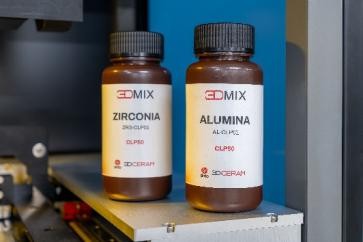
The CL 50 does not lock users into a single resin. Engineers can formulate their own ceramic slurries, adjusting solid loading, binder content, and photoinitiator concentration. 3DCeram’s proprietary software provides real-time monitoring of exposure energy and layer cure depth, supporting iterative material optimization.
Integrated Software & Services
A dedicated software suite handles slice generation, exposure calibration, and build monitoring. Optional training packages and hardware add-ons (e.g., heated build plates, automated cleaning stations) are available on request, allowing a turnkey implementation for new adopters.
Comparison With 3DCeram’s Existing SLA Line
| Feature | CL 50 (DLP) | 3DCeram Sinto SLA (Bottom-Up) |
|---|---|---|
| Curing Mechanism | Projected UV through a transparent window (top-down) | Laser-based point curing (bottom-up) |
| Typical XY Resolution | 50 µm (pixel pitch) | 75 µm (laser spot) |
| Layer Thickness Range | 25–100 µm | 30–150 µm |
| Build Volume (approx.) | 120 × 120 × 120 mm | 150 × 150 × 200 mm |
| Support Requirement | Minimal for vertical parts | Frequent for overhangs |
| Material Flexibility | Open slurry formulation | Open but often limited by vat viscosity |
| Footprint | ~0.8 m² | ~1.2 m² |
| Typical Print Speed | 0.5–1 mm³/s per layer (full-area exposure) | 0.2–0.5 mm³/s (point-by-point) |
Data are based on manufacturer specifications and industry benchmarks for comparable systems.
Practical Implications for Users
- Rapid Prototyping: Full-area exposure in DLP cuts per-layer cure time, enabling part turnaround in hours rather than days for modestly sized components.
- Educational Adoption: The smaller footprint and lower ancillary equipment cost make the CL 50 suitable for university labs where space and budget are limited.
- Industrial Scale-Down: Small-batch production of high-performance ceramics—such as wear-resistant inserts, micro-nozzles, or biomedical scaffolds—can be achieved without the overhead of large vat printers.
Availability & Where to See It
- Formnext 2026: Demonstrations will run from Nov 17-20 in Frankfurt, Hall 11.0, Booth B32.
- Order Date: The CL 50 opens for purchase on Nov 17, 2026 via the 3DCeram sales portal.
- Further Information: Visit the official site at 3dceram.com.
Bottom Line
The CL 50 marks 3DCeram’s entry into the DLP segment of ceramic additive manufacturing, delivering a space-efficient, top-down printer that promises fewer support structures, faster layer curing, and full material openness. For manufacturers, research facilities, and academic programs seeking a versatile yet compact solution, the CL 50 offers a compelling alternative to traditional bottom-up SLA systems, with a launch date that aligns perfectly with the high-visibility Formnext 2026 showcase.


